3D Glasses; hopefully soon a thing of the past.
CES 2011: In the last 18 months, the world seems to have gone mad for 3D, with more and more films, and even TV shows and sport evens, being produced in 3D.
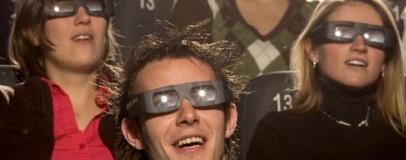
Whether you think 3D is a cynical fad to gouge cinema audiences out of extra cash, or a genuine step forward, the largest drawback of the technology remains its dependence on dorky looking bulky glasses. That and the threat of a 3D Noel Edmonds.
Out at CES in Las Vegas, though, Toshiba has raised a few eyebrows by demonstrating its glasses-free 3D technology, having already sneakily released smaller 720p 16in and 20in displays equipped with the technology in Japan during December 2010.
Knowing that us Europeans would scoff at such tiny panels, however, Toshiba is aiming for a worldwide launch of glasses-free 3D TVs in the fourth quarter of 2011.
The demo panels here at CES are 56in and 65in respectively, with both boasting 4,096 x 2,160 pixel (4k2k) resolutions. Rather than previous attempts to make glasses-free 3D TV, which have used methods such as ridged panels, Toshiba claims its technology offers wide viewing angles, and doesn't even require a 'sweet spot' in which you have to sit.
When pushed on how the technology precisely worked, Toshiba described it as a sheet across the display, which pitch-shifted certain frames to create the 3D effects, with the help of an on-board software algorithm named CEVO.
Toshiba will take off all the wraps later today when the main CES exhibition opens. However, those that have already seen the effect say that it's not yet as convincing as that of shutter glasses, but still impressive.
Pricing details remain sketchy, but Sascha Lange, Toshiba's Head of Marketing for Visual Products, was keen to stress that the technology will launch at a price point some way above current high-end displays. In short, very expensive.
Nevertheless, ditching the specs is a big step forward for 3D adoption, and a few years down the line we can see every TV shipping with similar technology. Our big question, though, is with glasses-free 3D now firmly on the horizon, will anyone buy all the clunky, uncomfortable shutter glasses now hitting the market?
What's your take on glasses-free 3D? Would this convince you to ditch 2D for good? Just bought a 3D TV and unhappy? Let us know in the
forums.

24 Comments
Discuss in the forums ReplyThis will be the defining moment of 3D in the living room due to the barrier of glasses.
4K has been a japanese standart for some time now. We'll get it as "normal" 1080 here, but that's a good start.
Recent 3d cinema is a little better but i doubt you can even get that quality level at home. I'll go back to another 3d cinema in 5 years and see if it's any better. till then - @home 3d will still be..... meh.
To those suggesting the intro of consumer 3D is just another way to get people to rebuy media they already own, but in 3D - that is not entirely accurate unless you are a brain-dead fan who insists on owning hard copies of all their fave media on whatever format gets newly released (ie. VHS to DVD to BD and now to 3D). I already have Sky HD and Sky 3D is included in my package, therefore I already have access to 3D films etc whenever I want them. No need to rebuy anything, I just set my Sky boxes to record the films/content whenever it gets shown. I don't buy any films these days, saving myself hundreds of pounds over the year.
Till they do propper 3D not intrested. Glasses or not.
So you'll only be happy when Bruce Willis jumps out of your TV and punches you in the face?
ALL 3D technology is an illusion at the end of the day...
Chuck Norris already can
yeah, save us Obi-Wan!
wonder how well these will work with people who are blind in one eye. A problem my friend has with the current incarnation of 3D. The first time I tried 3D i was one of the few who suffered from headaches and motion sickness, recently I went back and tried 3D again and was left very unimpressed. The films the guy in the shop showed me left me feeling 3D is a waste of time. Animations work well but Alice and wonderland and resident evil where horrible to watch due to the scenes being so dark and fast panning was just a disorientating blur. Yes it is good in some cases but overall Its just not brilliant. While removing the glasses means its easier to pick up and use for a slightly extended period of time, I can still see it having the "Alice in wonderland problem" of just not working
(a) you use a filter over each eye to selectively present a different image to each eye. I know of 4 distinct implementations of this:
(i) alternate frame with synchronised shutter glasses ("active" 3D as deployed on most consumer 3D TVs);
(ii) alternate lines with left/right circular polarising filters on the TV and the glasses (as used in the sort of setup you're likely to see in a pub);
(iii) alternate frame projection through a single projector with an alternating polarising filter and left/right circular polarising glasses (as used in the "real-d" 3D projectors currently used in most of the new generation of 3D cinemas); or
(iv) twin projectors, one with a horizontal polarising filter and the other a vertical filter, matched to corresponding filters on viewers' glasses (as used in IMAX).
I've seen all of these, and Real-D is by far the most comfortable and convincing to watch. I find cross-talk to be a real problem in IMAX and active shutter setups (though I believe plasma can reduce this compared to LCD 3D TVs, which is all I've seen), and the 'passive' LG LCD I saw just felt wrong. Active shutter also gives me a real headache after less than a minute, though the interaction with the horrible fluorescent lights in the store where I tried it probably contributed to that.
(b) some sort of mechanism to direct a different image to each eye from the display, with no glasses required. This is how the Nintendo 3DS works, using lenticular lenses in front of each column of pixels. I imagine this works well on 3DS, because typically you only have one viewer and he's looking straight on. The problem is you need to be in a sweet spot to make it work, otherwise the left and right eyes may see the same image (so you get a 2D image), or (worse) the images may be received by the wrong eyes, so you get a screwed up 3D image where depth is reversed, which I imagine would bend your brain pretty quickly.
(c) a system which somehow detects viewers' eye positions and adaptively displays each pixel in such a way that the left and right eye of each viewer sees only the appropriate pixels. Apple has just patented such a system, but at present I think it is fanciful that it could be implemented, especially for multiple viewers. Maybe in 20 years.
(d) some sort of holographic projection. This is what naysayers mean when they talk about "true 3D" and say that current stereoscopic solutions aren't "real 3D" they're just "2D with a 3D effect / illusion". Sadly not going to happen any time soon, and even if the display technology existed, the bandwith required to transmit such an image (if you could even figure out how to capture it) would be enormous, as you're representing not simply 2 perspectives on the same scene, but the entire scene in 3D. Maybe in 50 years.
decent & thoughtful explanations of 3D techniques
A: Glasses) Most versatile. I've tried some that I don't mind. And I say that as someone who wears glasses every day.
B: No glasses, 1 image per eye) Forever limited to a single user in the sweet spot. Could be awesome for certain things but of limited use.
C: Detect viewers eye positions) I expect this to be crazy complex for multiple viewers and foresee that leading to displays that are "good for up to _ number of viewers only".
D: Holograms) Easiest with computer simulations and perhaps live actors would all end up being motion captured then rerendered in computers. The big question is what resolution would be good enough? Another issue is that, while being the most 3d of the bunch giving every viewer a slightly different angle on the show could end up ruining the show for those not in the sweet spot (though I guess it would be like having bad seats at a play).
eBtN1i3O4fY
And?
3D conversions look like crap. Even Native 3d movies Resident Evil 4 and Tron: Legacy failed to impress me, they looked NO better in 3d than they did in 2d. So after Tron:L, I gave up completely on 3D, its a waste of money unless someone uses it that knows how to do it right (ie: James Cameron). I certainly won't buy a 3dtv just to watch ONE good 3d movie.
I'm far more interested in 4k resolution. Heck, then again, even getting tv's that properly display 24p is still difficult! (fyi, just because it says it "supports" 24p, doesn't mean it displays it correctly, MOST STILL DONT)
Perhaps not so unbelievable a possibility - there have been articles published on medical research into reversing (certain types of) blindness. These processes rely on a "digital retina" system, with the values being sent directly into the optic nerve. Tests so far have allowed patients to determine light/shadow only due to very low resolution, but improving that's just a matter of investment and time.
See a related BBC news article at http://www.bbc.co.uk/news/health-11670044
If it gets good enough, I would envisage people eventually being able to elect buying this type of enhancement to replace all types of screen / mobile phone / etc... Oh no - that means "Enhanced reality" - next need would be a block on the virtualised adverts. Symantec in your head? Hmmm.