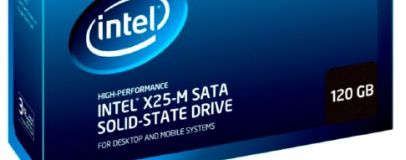
Intel has launched a new 120GB capacity to its X25-M G2 series SSDs with an attractive price drop.
With all the news of
Sandforce 2000 being on the horizon, Intel has quietly launched a new 120GB addition to the X25-M G2 SSD range.
Still using the 34nm NAND of the 80GB and 160GB models that launched a year ago, the new mid-capacity solid state drive features the same performance as the 160GB unit: 250MB/s read, 100MB/s write, 35k IOPS 4k random read, 8.6k IOPS random write, and TRIM support - but at a significantly lower price than its 160GB model.
Currently the best price for the new 120GB X25-M is
£173 inc. VAT in the UK.
Even if it can keep the £175 price tag though, we have to wonder; why has it taken a year to drop a G2 into the popular 120GB capacity range, and would anyone really buy one now knowing the upcoming G3 is due very soon with faster/cheaper 25nm NAND?
Either way, SSD price drops and competition are always welcome, and we hope it spices up a stagnating SSD market in Q4.
Are you in the market for a new SSD - if so, what are you looking for/waiting for? Let us know in
the forums.

26 Comments
Discuss in the forums ReplyI was going to sell it and buy a Crucial C300 but I read (in another great site) that that drive has (or had) lots of problems with firmware, and I don't want a troubled drive :)
Junction points and steam backup are your friends.
+1
Any links?
+1 more
Phil "Boots Win7 in 13 seconds" Rhodes
this.
I'd buy an SSD for an OS partitiion, but they are way over-priced for me at the moment. My F3's are fine
It's all done through command prompt really, although there are some programs around to do it too. XP uses junction points, Vista/7 also have a symbolic link.
hard drives are currently the main bottleneck of computers. they're terribly slow compared to what everything else can do. personally, i don't care enough. even if you have a gaming computer, loading speeds are still faster on the crappiest of hard drives than from reading from the disc on a console. hell, even computer disc drives are faster than the ones on consoles.
but for those who want real disk performance, ram drives are the best. thankfully me being a linux user, i can do that for free and very easily. windows users either have to buy a drive for that or buy a program, both of which aren't nearly as fast.
Erm... he's asking why people want fast write speeds (ie why they need them), given that write speeds aren't as important as reads in terms of snappiness - the main use of an SSD. Also - you essentially make no relevant point in that post. Just pointing that out.
oops you're right, he did say write. in that case, that is a good question, because most of the time you don't need high write speeds except for servers.
and my point from my previous post was (referring to read speeds) that hard drives are currently what slows down computers the most. most of your waiting time while opening a program or booting up your computer is due to the hard drive. i was also pointing out that if we moved into ram drives instead of solid state drives, we could have even faster read and write speeds. an actual drive composed of ram uses a battery to keep it going while the computer is off or unplugged, which i think is a worthy sacrifice for that much speed. the problem is, windows users can't easily or cheaply do this.
Here's hoping the smaller 25nm refresh helps them reach that goal.
SSD manufacturer's take note - your mainstream audience has spoken :)
It is getting there, slowly. I just bought a OCZ Vertex 2E Bigfoot from an online retailer for £170. Really happy with it so far. Cheaper than the 120GB X25-M in the article and much faster write speeds.
Two things - the first is installs. I don't want to wait 30 minutes for a game to install due to the write speed being slow. Yes, I realise that I don't do this on a daily basis, and I could just live with the slower speed of an install, but I choose not to - I want my PC to be fast, all the time.
The second is that the write speed can really impact the general speed of the PC. I had one of the first generation Intel SSDs without TRIM support. After about 8 months or so my system had become less responsive than with the old Raptor hard drive - it would lock and stutter horribly whenever there was intense disk writing. AS-SSD showed the write performance had dropped to 10 Mb/sec.
I got an OCZ Vertex 2 120Gb, and the system is much better since.
The sandforce drives performance drop when they come across data they cannot compress. And in actual use I couldn't tell the difference between the two of them.
And Intel drives are still #1 for reliability.
LMAO @ Taninver 30 mins to install a game because of the 100mb write cap Sure bud!
I call BS on that you are telling me your Raptor with like a 7-8ms access time was faster than your SSD which is at 0.1ms even if it doesn't support trim and performace was degraded there is no way the system should feel slower than a HD. I think you had other issues with your rig bud.
First off - yes, 30 minutes to install a game. Not because of a 100 Mb write cap - I had an Intel X25-M 80 Gb, generation 1, which has a theoretical max write of 70 Mb/sec, and I said its performance had degraded due to the lack of trim support - AS-SSD revealed 10 Mb/sec on sequential writes, and ever lower on random. The game itself came on two DVDs and was about 14 Gb once installed. Crunch those numbers and you will see a minimum time of almost 24 minutes to write that 14 Gb of data, assuming it was all sequential writes of large files, which it wasn't.
Second, your call of "BS on raptor being faster". I didn't say the system was faster with the Raptor, if you care to read my post, I said it was less responsive, and I meant it. You didn't experience the system, so please don't try to tell me how it was. Let me give you an example - I start copying a single large file from my 2 TB storage drive to the Intel SSD - about 5 seconds into the process, the system becomes very poor to respond. I'm not talking about general slowness, I'm talking about even mouse movement locking up for about half a second at a time, every few seconds. Taking 15-20 seconds just to open Task Manager, more than a minute to open Firefox, that kind of thing. There were no other issues with my rig, as you put it, because as soon as I replaced this SSD with the OCZ one, doing a direct image from one to the other with Acronis TrueImage and changing nothing else, this problem was entirely gone and the system is fully responsive even during intense disk writing.
Sorry about the tone was a long day :P
I've done those task you have done on my friends system that has a G1 80GB intel and the system never felt unresponsive ever to the point where a raptor felt faster. now I didn't actually run a benchmark on it at the time so I cannot tell you if his was hitting 10 mb/sec in AS-SSD but I do know it was a 6 month old OS install.
I've never seen a SSD take 15-20 seconds to open Task manager even on those first gen POS SSD's with the jmicron controllers.
Unless Intel plans to release say the 160GB G3 for $300+ but for what you get that is not going to be worth buying. Anyone else see $200 price tag on the 160GB version (after the initial hype)