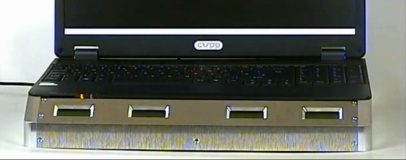
The CUPP 'Computicator' is an x86 PC with integrated ARM subsystem - the best of both worlds?
The ARM architecture has much to recommend it over x86 for many uses, not least of which is the extremely low power draw of ARM-based processors, but there's one thing which has kept it from the desktop: lack of Windows support. That could change, with CUPP Computing announcing a hybrid system it calls, for no immediately discernable reason, a
Computicator.
The all-in-one PC, which the Norwegian company describes as a demo platform for its patented hybrid technology, combines an Intel Core Duo 2.3GHz processor with dedicated 4GB RAM with a Texas Instruments OMAP 3430 ARM Cortex A8-based processor running at 720MHz with its own 512MB RAM. A single 320GB hard disk and 16" LCD display are shared between both platforms, as is a keyboard and trackpad along with HDMI output and three USB ports.
At its heart, then, it's two computers with a few shared components, but it's the closest thing to an ARM-based desktop likely to make it in to the average person's home or office. CUPP claims that by integrating the ARM processor into the southbridge, a technique for which it owns a patent, it's possible to "
deliver functionality previously impractical in a personal computer, and [gives] users the flexibility to use the PC in ways that best suits their needs."
The company isn't above dropping the green card, either, claiming that "
if implemented on a wide scale, this technology would have a significant impact on global power consumption."
Perhaps the most interesting aspect of CUPP's hybrid system is that both the x86 and the ARM subsystems are active at the same time: an innovative ALT-TAB-style system allows a users to flick between Windows 7 Professional on the Core Duo and Ubuntu LXDE Linux on the TI ARM on the fly with no reboot required.
Although the company has stated its plans to "
bring a product to market [by] Q2 [2011]," it's not yet clear
what product will appear: although the testbed design is based around a notebook, it's likely that the company will look to an all-in-one desktop for its first real product.
For those curious to see the demo unit in action, the company has posted a series of
videos on its YouTube page.
Do you think that hybrid devices such as CUPP's Computicator could be the push ARM needs to make it back into the desktop market, or does it offer too little advantage to the consumer to make a purchase worthwhile? Share your thoughts over in
the forums.

22 Comments
Discuss in the forums Replywait for Cortex A15 and then simply build an instruction decoder to decode x86 commands, and promote use of Linux for full speed.
or instead of trying to give full desktop experience, off load things to the ARM chip as a co-processor. of course, a smartphone SoC won't be needed then.
home mod's rule
The chances of Intel or AMD letting ARM at its abstraction layer are, of course, "a snowballs in hell's."
that's why i suggested it, it'd be much more transparent, and if it allows us to access the RISC instructions, we could see more optimised programs.
Stolen from The Reg :/
From what I've heard Microsoft has plans in the works to introduce ARM support in it's mainstream operating systems.
Currently those background tasks just use a small fraction of a modern x86 processors power, but that 1% or so of CPU usage takes up an entire processor. Taking an 'asymmetrical' approach to parallel processing would be much more power -and- cost efficient than the "more cores is better" approach
Another good thing however is to adapt your idea and have cores that can reduce their power usage when they aren't needed as much. Intel already have this, it just needs to be more adaptive to cover cores that are only partially used as well as ones that aren't active at all.
Would also be interesting to have a TINY SSD for a linux boot drive for the ARM and a FAIRLY SMALL Win7/XP SSD for the x86, plus a shared HHD.
Reminds me of that... I believe it was a foxconn Mobo that had an integrated Atom processor along with a 775 socket. I like the idea of shared HD space. Too bad the price was far too high and was outclassed at launch by cheap x58 systems
Does anyone know how Windows CE was put together? MS has some experience with the ARM architecture through that and while I don't know how difficult it would be, it's a starting point. It would also have the advantage of a more restricted hardware base and so a stripped down version of Windows for ARM Seems like it has a lot of potential.
What ever happened to Via's new CPU (Eden?)? The Via low power chips seem like exactly the right answer for this sort of thing, but they haven't caught on.
Also the x86 chip in this hybrid will obviously go into a low-power halt state of some sort when using the ARM chip. I doubt it will even need much power at all. You guys have the ability to think for yourself you know.
Anyways, even if you get Windows for ARM all applications would need to be recompiled for ARM which would take a while. Most open source or free software would be quickly ported across but huge software packages would take longer. Granted this is a non issue in the long term but it had to be said. Seems like some of you think it is just flipping a switch over at Redmond.
And yes Microsoft has lots of experience with multiple architectures. Windows NT was available for MIPS, ALPHA and PowerPC in addition to x86.
PowerPC is in XBox 360, Cell (PS3) and the Wii. It doesn't seem to have a future in desktop or portable areas ATM. IBM seems much more interested in POWER.
MIPS may turn out to be a competitor, since China seems to have picked that to become its national CPU (Longsoon) architecture. We'll see.
If it's so capable of going into such a state, then why have the ARM at all? Intel touts their low power tech, but nowhere will they cite numbers. Historically the difference between full load and idle power on mainstream CPUs has not been very great. If the Intel could drop to a very low power state when operating, then why add the ARM?
How many "huge software packages" are you going to run on a little mobile ARM ultra-portable?
Troll much?
What I'm talking about is off-loading all those processes using just a fraction of the CPU to a low-power processor which will then allow the x86 CPU to be disabled completely.
But if intel developed a CPU with a separate atom processor integrated onto the same die, it would provide the same sort of power saving but with only a bit of extra code required in the OS to decide what work to allocate to the atom