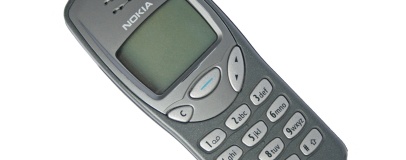
Older handsets could be upgraded to support a touch interface, thanks to some innovative software.
A Cambridge-based firm is looking to give
every phone a touch interface with an innovative sound-based system, which it claims requires no additional hardware.
The basic principle behind Input Dynamics' technology is similar to that demonstrated back in 2009 by
Sensitive Object: rather than having a physical panel, a sensor picks up the vibrations of your finger moving anywhere on the object and uses that to determine what you're trying to do.
Where the system developed by Input Dynamics differs, according to
New Scientist, is that it dispenses with the piezoelectric sensors in favour of a sensor that your handset is already guaranteed to have: the microphone.
As well as turning a standard display into a touch-screen, allowing the same sort of control that a traditional touch-screen would offer, the effect can be extended throughout the body of the handset; running your finger along the back might adjust the volume, for example, or a tap on the side could bring up a particular application.
The software powering the system is still very much at the concept stage, with Input Dynamics admitting that at the moment, it's only able to discern a tap and not a swipe action, but the company claims to be refining the algorithms to detect differing actions - and possibly even to enable multi-touch tracking.
The man behind the technology, Giovanni Bisutti, claims to be in talks with "
tier-one handset manufacturers" about building the software into their devices, with the possibility that it could even be ported to existing handsets via a software download.
Whether the acoustic signature, which is currently accurate to around one square centimetre, can be refined enough to replace expensive touch-screen components altogether remains to be seen.
Do you think that this sort of technology could spell the future of low-end handsets, or will capacitive touch-screens always rule the roost? Share your thoughts over
in the forums.

20 Comments
Discuss in the forums ReplyI'm with you man I purposely choose cheaper phones with a proper keypad or full qwerty to avoid touchscreens they are just overrated and are just frustrating even on high end hardware.
http://www.retrobrick.com/7110.html
Call me old-fashioned, but I just want a phone that does text messages and phone calls and stores numbers. I've spent a lot of time building and configuring computers to do everything else I like to do and I'm perfectly capable of keeping myself sufficiently organised to avoid the need for web/email/maps/stocks/music/movies/gta/fart machine to be built into my phone.
That said, some touchscreens are fantastic (E.g. the uniquitous fruit phone*).
*Let's see how far the comments can go before someone mentions it by name.
don't go for that phone, had one of them, they brick up after a couple months of use =/
at least it was a company phone...
sure it has a nice screen, but said fruit phone is too overpriced...
1200 over here (not many people like buying phones with contracts... specially if those contracts are only nice when you pay 100/month, yeah portugal sucks with contract prices)
Going back to physical keys only would be like someone taking away my mouse and saying "keyboard only for you young man." Sure, I could survive, but it would be a chore.
*And not on a fruit. Because fruit is for monkeys.
-1000000000 and comment ignored for losing the fruit game.
Couple that with the wildly different acoustic properties of different rooms (you'd have to calibrate the touch screen again when you went to the bathroom), and you're already talking about a system that will be fraught with so many problems it's not even feasible on paper. And that's before you start worrying about how to filter out back ground noise, the sound of you simply holding the phone as it moves slightly in your hand, and of course the sound of you talking into the device.
In addition, sound in a solid travels considerably faster, closer to 500 m/s. A sound wave in a device will take only a 1/500,000th of a second to travel 1mm. The response time is therefore going to necessarily be close to the MHz scale. Considering that audio quality is measured in the KHz, I really doubt it is possible for the triangulation to detect a meter difference.
Exactly! Standard wave mechanics states you need a higher frequency wave to measure smaller objects and be able to resolve down to a smaller resolution. If this Cambridge firm did any research at all, they'd know that!
fail. Good concept though, just unworkable and in the end pointless on old handsets.
Yeah, if you wanna go retro get a 6310i - they work and they last. I've been back using one for a couple of years now. Best thing is the 7-day standby time - and that's with a 2nd hand battery. Strangely the thing I miss most about more modern handsets is being able to have my own mp3 ringtone - couldn't give a monkey's for all the other nonsense!
Yep, the ones with the roller button tended to break quickly, as dust gathered in the roller-bearing.
Why Nokia hasn't got anything to replace the 6310i is beyond me.
(Also why "Retrobrick" doesn't offer any 6320i's...there's loads of in-car kits for them (standard on Mercs))
I still use a 5 year old 6021, that has a standby-time of a week with it's 5-year old battery.
And yes, MP3 ringtones is all I miss too :D