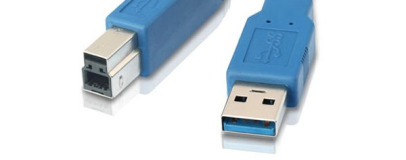
A report claims Intel will announce USB 3 in its Sandy Bridge chipsets at IDF in a few weeks time.
Intel is set to announce a change of heart at its IDF in just a few weeks time, as it will instead adopt USB 3 in its upcoming
Sandy Bridge chipsets.
It appears to be a last minute change due to industry pressure from AMD, which will have USB 3 in its upcoming Fuzion chipsets, thanks to a cooperation with
Renesas - the maker of all NEC-branded USB 3 chips used on motherboards to date.
Many motherboard manufacturers already have board designs including third-party NEC and possibly VIA USB 3 chipsets, claims the report in Chinatimes (via
Yahoo news in Taiwan, so grab a translator), so these companies will have to decide whether they have time to redesign their motherboards to use the integrated USB3 from Intel's chipset instead.
So far, the report states the change affects Intel 'Cougar Point' chipsets, but it is currently not more specific in terms of
which chipsets have changed and how many ports are being provided.
To date Intel has previously been betting on its
Light Peak technology as a faster alternative to USB 3, however that's still a way off and the weight of industry adoption already behind USB 3 is claimed to have caused the turn around in attitude.
Let us know your thoughts, in the forums.

34 Comments
Discuss in the forums ReplySpot on! Light Peak looks to be the way forward. If USB3 was a DVD then Light Peak would be a BluRay. (Simple explanation for those who don't know what light peak is)
I guessing that USB3 will hit Intel/LSI/3Ware/Adpatec and similar companies most. USB3 delivers great performance for external HDDs. Finally USB3-RAID is real possibility with great performance and at much, much lower cost. Looking forward to see some (hardware)RAID cards for USB3. Should be interesting. And with LP out later in the decade, eSATA will be dead and buried altogether.
i have 2 usb3.0 sata hd dock for data transfer, and the speed is much better, than usb2
Most new intel based motherboards have USB3 anyway and have been benchtested here. Most major manufacturers have also updated their best boards with USB3 (along with Sata6Gbps). So Intel users haven't missed out on anything.
Those third-party USB 3 chips don't come for free, so if you've already designed your motherboard to have one and then Intel integrates USB 3 into its chipset, you either leave the third-party chip and ask your customers to pay double for USB 3 support or you put a load of extra work in to redesign your board. The difference might only be £10, but that can be the difference between selling your board or not. It's not a trivial problem.
Why go to optical until we've reached the limits of copper?
hmmm... Actually USB 2.0 would be DVD, USB 3.0 HD-DVD and Light Peak BluRay
:P
*hides*
Except Blu-Ray players can still play regular DVDs.
If anything, Light Peak is positioned more as an eSATA replacement than a USB replacement. There are boatloads of USB devices that don't need crazy high datarates, but need power.
Mice, keyboards, external sound cards, external NICs, external DVD burners, low-capacity flash storage, cameras, cell phones, printers - none of those need even the full USB 2.0 bus.
Fast external hard drives, Blu-Ray players, and SSDs need high speed. Stuff that normally would have a SATA connection might stand to benefit from Light Peak or another very high-speed standard, like USB 3.0.
About time Intel gained some sense!
Most of the implementations of USB 3.0 and SATA 6Gbps chips on current Intel chipseted MBs make single GPU configuations work at PCI Express 8x, the rest of the bandwidth is used for USB 3.0 and SATA 6Gbps.
AMD is puting USB 3.0 directly on the chipset*, bypassing that limitation. And it seems Intel is following the same path after having insisted on LightPeak.
PS:
* - AMD is currently in talks with Renesas Electronics, which was merged with Japan-based NEC, about the licensing of USB 3.0 technology, and is considering integrating USB 3.0 support in its upcoming Hudson D1 southbridge chipsets, according to sources from notebook makers.
But we have seen boards here with USB3/Sata6Gbps and GPU configurations working at PCIe 16X and multiple sockets as well.
I really don't see how we (and not the royal we) have been disadvantaged all this time by Intel when I can't see how.
Otherwise, I agree - external HDDs and SSDs will benefit from USB 3 or Light Peak, but to be honest the backwards compatibility of USB 3 is likely to see it win mass adoption. I see Light Peak going the way of Firewire - lots of love from video pros, otherwise limited adoption.
Fiber home networking or fiber HD-video streaming, or fiber home backups, it makes sense.
The advantages of fiber is that it's more robust and has less attenuation. You can fit a lot more data onto a single fiber strand than you can a single copper conductor, and you can go miles and miles before attenuation hits, or you become dispersion-limited.
If you have very long arms, and want your mouse to be 50m from the PC instead of the usual 5m limit of USB, then optical might be nice. But for the short distances that most peripherals are, you're not running into problems with copper.
For which WE the consumer have to pay. Someone above said it very well... board manufacturers have to decide whether they want lower BOM costs & more redisgn work - or higher BOM costs but no redesign.
My guess is they will mostly redesign... (fingers crossed)
How much of a difference will this make to the overall cost to us? or will the manufacturers just absorb that into their profits and not pass it on to us? Making no difference to us at all.
(I know it's not an exact comparison but it's pretty damn close)
But the manufacturer wouldnt have to buy a USB 3.0 from NEC (or whatever...) and would not have to redesign the MB layout.
So the price would sit between 73 and 85.
Lightpeak has speed
eSATAp (eSATA/USB) has compatibility, speed, economical
Implementing eSATAp simply requires a ZERO driver USD 12 Delock bracket
eSATAp can be Hotswap! (Freeware)
99% of machines/HDD/SSD/DVD/Blueray have SATA port
50% of the notebook/pc now have eSATAp
80% of the NAS have eSATA (port multiplier)
eSATAp can operate in IDE mode, no need BIOS ahci or OS registry tweak
NCIX and Crunchgear have proven eSATAp is as fast if not faster than USB 3.0
Great, but are they going to put eSATA on phones or MP3 players or those stupid little USB fans, or those really cool USB dart launchers?
As you point out, USB3 has it's disadvantages for large data transfers, but it has the big advantage of being, well, universal. Unless a lot of things change, you're not going to unplug your external hard drive from your eSATA port and plug in your new mouse. eSATA is only good for one thing, moving lots of data fast, USB is good for lots and lots of things, even if it is a little slower.