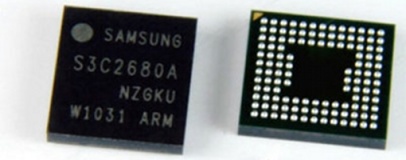
Samsung's low-power wireless USB chipset can transfer data at a rate of up to 480Mb/sec.
Wireless USB is the technology that just never seems to catch a break. Offering all the plug-and-play advantages of USB with no wires to get in the way, it's been a finished specification
since 2005 but is most likely nowhere to be seen in your rig. Samsung, however, is looking to change all that with an ultra-low-power implementation in its upcoming consumer products.
According to an announcement made by the company late last week, the ultra-wide band wireless system uses a pair of chips to send full-speed USB 2 across the aether at an impressive 480Mb/sec, hopefully paving the way for portable devices that can be quickly synchronised with a master PC without the need for annoying cables.
The rather catchily named S3C2680/S5M8311 WUSB system provides static and portable devices with the ability to beam "
high-definition content [...] to a tethered device for viewing," providing the first hint of Samsung's plans for the technology. "
Initial applications are high-resolution cameras, camcorders, TVs and PCs with prospects for adoption in other applications including tablet PCs, printers, beam projectors, portable HDDs, Blu-ray players, and mobile handsets."
The major barrier to adoption, however, is power: whereas wired USB provides devices with both a data connection and a reasonable amount of power, wireless USB needs a separate power source. Although devices such as smartphones and cameras have built-in batteries, it's nice to be able to top up the charge while you're transferring data, which wireless USB can't yet offer.
At least the power won't be
drained too much by Samsung's latest chips: the company claims that even when transferring data at the maximum 480Mb/sec speed of the USB 2 specification, its wireless implementation draws a mere 300mW thanks to a "
65nm low power logic process technology." Even more power is saved thanks to the company's decision to integrate a NAND flash controller into the chipset, avoiding the need to have a separate controller chip in your smartphone or camera.
The company is sampling small quantities of the chips to "
select customers" now, but won't be ready for mass production until the end of the year.
Are you pleased to see that the promise of wireless USB hasn't completely disappeared, or will the technology always stagnate as long as it can't transfer 5V@500mA wirelessly? Share your thoughts over
in the forums.

30 Comments
Discuss in the forums ReplySo, they are talking about televisions; I assume for internet tv(?); and yet it probably won't work with your existing router.
If you are a wireless fan, you therefore need b/g/n dongles for your PC's to connect to the router, samsung wireless dongles for your protable tech and a powerlead to charge it.
At these speeds, IF it can corner the market it might be quite good, but I can't see it overthrowing established tech. (Unless the dongle they makes includes a compatible b/g/n chip as well.)
Maybe the issue isn't so big as suggested here?
Point taken, but this further raises a "whats the point" question.
Add a wireless "n" chip to your device, then have that goddam awful transfer software you always have to install look for wireless devices on your network and transfer via the existing wireless network.
Voila, wireless transfer, at high speed, without all the R&D costs, and without the consumer needing yet more dongles.
Plus, you find me an 802.11n chip which costs as little as this thing will, takes up as little room on a PCB, and draws 300mW under full load. G'wan.
You're comparing apples to Megatron here.
"plug and play" would become "open box and play"
Last question. How does the master PC that the device is going to sync to send and recieve the data? Surely it needs the same tech in the PC, and that means expansion cards or dongles until the motherboard manufacturers stat implementing built in chips?
Like you said, "it's been a finished specification since 2005 but is most likely nowhere to be seen in your rig."
I just immediately assumed that a dongle was going to be needed.
Obviously a dongle or PCI card would be needed until it was integrated into motherboards, and I assume you would only need a single dongle to connect multiple devices.
Bluetooth devices for the PC haven't really caught on, hopefully the simplicity of being able to use existing USB drivers for a wireless device will encourage manufacturers to start using the technology
you wil sill have to have you pc switched on
why dont they save themselfs the trouble and just release a wifi router with nas support built in s you just attach a usb hdd to it
errr... they have
i mean speed wise not power.
Agreed. We already have a standard for low-power wireless data.
While it hasn't really taken off on desktops, it sure is popular on smartphones and laptops.
What would this provide that Bluetooth doesn't?
second'd
and furthermore, dont some motherboards already have bluetooth tech on-board?
This could be cool for all sorts of remotes too by simplifying the connections.
Bandwidth.
how are you going to power a memory stick, if you put a battey in it, it will need charging and thus you'll need a charger, pushing the price of the device up, and the chargers wont be "universal/compatible".
if only there was a type of connection maybe a serial bus that many devices could plug into that was able to output a charge and transfer data at the ssame time, maybe a series of universal cables and connections on lots of devices like phones, memory sticks, external hdds, printers etc, it would simplify my cable collection
some devices will charge over USB as well. phones and mp3 players for example...
*sarcasm* Hey I got an idea! Lets make all computers wireless! I'll just need 400 car batteries and a forklift to move it around... but it will be totally wireless! *sarcasm*
[rant]The day I can plop down a device on a pad to power it and connect it to my PC is the day I will get excited. I just get annoyed with these schemers and their tactics of 'lets make it really cool! then we can sell all the addons and make the whole thing really profitable!'. How about this model; Make a damn decision about your product and what you want it to do, then do it. Shove all the little money grubbers down a hole and make something great that will actually be useful. Damnit I want a device pad thing that does what I just said...[/rant]
It's also been my experience that wireless is always more complicated and difficult than a comparable wired system.
Wireless networking: Turn on devices, look for correct network, enter passwords, mess with profiles and connection priorities.
Wired networking: Plug in the ethernet cable
Bluetooth headset: Turn both devices on, press sync on both devices, put them next to each other and hope they're actually talking to each other. Try to interpret the blinking lights and beeps.
Wired headset: plug it in
My general experience with wireless devices is that they're slow, unreliable, and complicated. Also, they usually still have to be plugged in to power, so you've only achieved going from two cords to one.
I, for one, will welcome this technology.
I've a number or USB devices with proprietary connecting ends, e.g My Blackberry, iPhone, their accompanying Bluetooth headphones etc. While I'm organised, and always know where their respective cables are, It'd be much quicker to just be able to sync/connect these devices by just placing them atop my desktop computer, and let the magic happen.
While I understand the point re: powering currently unpowered devices, i.e. USB storage, this is the only device I can forsee with the power problem. Most larger USB peripherals, are either self or wall powered.
This will also end my nightmare that is... The automatic charge.
This current 'feature' that would seek to charge my device batteries whenever it's hooked up to my PC, with no way to disable it.
I'd like to cycle my batteries myself please.
Zero, I can assure you the range & wall penetration on this technology will be small enough that should it be compromised, a wired equivalent would also find itself equally in harms way.
TSB
+1
The cable issue TheStockBroker mentioned is a good one. I currently have about 5 USB cables sitting next to the computer, each with a different connector for a different device. And I hate having to unplug the USB cable from the AC adapter in my bedroom just to sync the phone with the PC
And as far as the syncing issue goes, why couldn't it just be like XBox 360 or Wii controllers? Set the host to scan for devices in range (either by a software or physical button) and do the same on the device. Finish.
EDIT: wikipedia to the rescue
1/3/24 mbits for class 1/2/3 devices
Turns out my relatively new bluetooth dongle is a class2 3mbit one, i don't think class 3 is widespread.
so class 1+2 are much slower than USB1 and class 3 not much faster than USB1