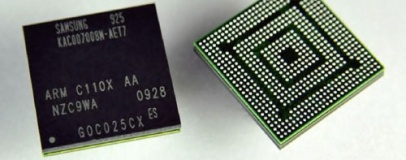
ARM's latest Cortex A9 chip uses a 28nm process to hit 2.5GHz - and can boost to 2.8GHz.
ARM has announced that it has successfully taped out a 28nm version of its Cortex A9 processor, and a process shrink has bumped up the specifications considerably.
While details of the new Cortex A9 chip are still scarce,
PC Perspective is reporting that the 28nm edition, which has been built in partnership with AMD spin-off GlobalFoundries, features dual-core construction and will
start at an impressive 2GHz at Vdd-10 percent before rising to 2.5GHz at Vnom.
Interestingly, a slide announcing the achievement made by ARM suggests that a "
voltage overdrive" system, presumably similar to Intel's Turbo Boost technology, means that the processor can even hit 2.8GHz when extra performance is required. It isn't currently known whether the performance boost will work across both cores or if, like Intel's equivalent, it requires one core to be disabled in order to conserve power.
It's quite an achievement, and paves they way for even more powerful smartphones from the RISC specialist. Sadly for Intel, it also demonstrates just what an uphill battle the company's
smartphone-oriented Atom processors have to compete in a market where ARM rules the roost and RISC is the norm.
So far neither ARM nor GlobalFoundries have offered a suggestion of when the new chips will be ready for mass-production, so it's hard to guess when we'll start seeing them appearing in devices. It wouldn't be unreasonable to expect the GooglePhone-after-next to come packing one of these puppies under its belt, however.
Are you pleased to see that ARM continues to push the boundaries of its processor design, or will Intel succeed in capturing the smartphone market form the long-time leader? Share your thoughts over
in the forums.

25 Comments
Discuss in the forums ReplyIntel has an uphill battle ahead of it in the low-power sector. And, if ARM can get this much performance in low-power devices, I wonder what it could do in the desktop segment.
http://www.globalfoundries.com/technology/28nm.aspx
off topic: Is it me or does Global Foundries sound like an evil corp? Like the company in Oddworld or the like?
Certainly interesting now that they're picking-up in performance, clearly driven by the surge of purchasing by smartphone manufacturers funding further development.
It's taken a while, but I honestly think that in the next few years ARM could find its way out of our pockets and back on to our desks. Hell, when the CEO of Intel mentions you by name and says he's "not scared," you know you're doing something right.
I'd love to see a low power (low watt)/high power (high MIPS) non-x86 laptop or even a desktop, but given the prevalence of Windows, I don't think it's that likely to happen any time soon.
Not since the days of NT4 have Microsoft dabbled in non-x86 architectures (WinMo notwithstanding), and I don't know whether ARM have the influence or money to persuade Microsoft to dabble again.
I doubt TSMC is happy about this :)
At this rate I would expect to see ARM-based PCs appear on the market in a few years time as well :)
Also, while people may think Intel is a huge company, ARM and its licensees not to mention the total number of ARM CPUs shipped each year completely dwarfs anything Intel does. If Intel is an 800 kg gorilla, then ARM is the titan which is about to crush it without even feeling a bump.
And confusis, yes. Global Foundaries sounds like an evil corporation! Reminds me of Horzine from Killing Floor. "Science and Steel"!
'Cause dey turkin our jerbs!!!
In all seriousness, British website, British tech company and an extra choice never hurt anything but margins which is good for us.
Assuming there's no price fixing anyways.
ARM is a far more clean architecture than x86. It'll be great to finally have some real competition between x86 and another architecture again. ARM appears to have the advantage when it comes to performance/Watt, which should extend to PCs as well. Due to the limitations of embedded platforms, ARM has had to try everything to optimize their designs, whereas Intel just could aim for a 100+ Watt TDP and nobody would even blink at this. It's no wonder that Atom for phones is just a silly pipe dream at this point.
I just have to wonder if that performance/watt focus will be maintained if they hit the desktop market. When you've got big, juicy household outlets to draw from it's a bit harder to sell performance/watt. Some enthusiasts may be persuaded to keep their bills down, but hop into your local PC World and the chances of finding stats about a PC's power draw are pretty slim. No one would know how much power they'd save with the hypothetical lower power draw ARM desktop.
Yeah, I'm curious to see how this works out as well. One reason why ARM CPUs generally run at <1 GHz frequencies is to keep power usage down. If you remember the Netburst (P4) architecture, that one started to leak current like a sieve when they tried to push it towards 5 GHz. Running the same circuit slower generally means that it is less leaky, plus one can use a lower voltage, which means lower power usage.
Still, just looking at the difference between AMD's and Intel's current CPU offerings, one can't help but notice significant differences, even though AMD is hardly new to the business. ARM is even larger and more experienced than Intel in making the most out of the fewest transistors (which is why they generally use hardwired ops instead of going for a uops decoding system, like with CISC, this saves a lot of power and transistors).
Power draw is of course most important with portable devices, including laptops, which incidentally is a rapidly growing market. Intel's (C)ULV CPUs are quite popular there, and even the anemic Atom chip is doing okay. I think that's the market where ARM will strike first, obliterating Atom and threatening those CULV chips. At least ARM will give Intel a run for its money :p
28 isn't a SOI process, just HKMG, IE its decent, but its cheap and its never going to be possible to get 4-5Ghz speeds Bulldozer will be operating in on a non SOI process. 32nm isn't available yet either, both 32nm SOI and 28nm bulk are due around the same time, but they are for strictly different markets, theres also two 28nm, uber low power, and better performance. Not actually sure which the ARM would have taped out on, theres potential for them making more expensive ultra ultra low power chips on the slightly more expensive low power 28nm and higher volume slightly cheaper "normal" 28nm chips aswell.
AMD have taped out both Llano(i'm 99% certain its on 32nm, I just can't remember of the top of a my head a statement confirming it), and Bulldozer for 32nm has definately taped out aswell.
Chips for a SOI, expensive and ultra expensive process that needs to be around for a longer time generally take a year before tape out and release, gpu's, low power chips, more simple designs like ARM on a cheaper process can do that in 3-6 months.
AMD will almost certainly push Ontario(bobcat + intergrated gpu, fusion product) to 28nm when its available and has large production numbers, its starting off life at 40nm at TSMC.
Long term, post 2012 when GloFo's $8billion+ New York State fab is up and running they'll have significantly higher capacity than they do now(at their best fabs) and AMD CPU's and GPU's will almost certainly move to only GloFo production. TSMC have some big troubles, Samsung has commited billions into getting into the competitive manufacturing market, planning to open several fabs and I believe they are targetting 20-30% market share, GloFo have bought out Semi's fabs from Singapore for 3-4billion iirc, which gave them an extra 4-5 fabs, though most are 200mm or below and way way smaller than the in construction NYS fab or the two Dresden fabs.
Theres a reason after years of skimping out on R&D, and having late and off spec process's TSMC finally started investing billions in the last couple years. UNfortunately for consumers, theres been very little competition for TSMC, so late process's, high prices and pretty bad quality process's made no difference to TSMC, AMD and Nvidia, and hundreds of others still needed their chips, so spending less meant more profit and no loss of sales, because there was no one to lose them too.
Even if AMD and ARM go exclusively with Glofo, Nvidia and many other people will benefit from an increase in spending and quality at TSMC.