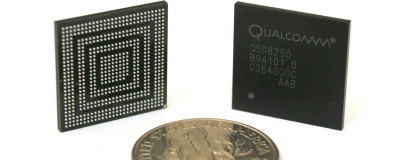
Qualcomm's latest Snapdragon chip - due to launch in Q4 - features two 1.5GHz processing cores.
Intel's planned fight against ARM in the ultra-portable market just got that little bit harder, with ARM licensee Qualcomm announcing a new Snapdragon CPU due to ship towards the end of this year.
With the company's 1GHz Snapdragon already a staple in several top-end handsets, Qualcomm is generally considered to be a market leader for smartphone processors - but its latest model looks set to leave that standing.
According to an article over on
Computerworld, the company will be launching its QSD8672 in the fourth quarter of this year, and the specs should give Intel cause for concern: the latest Snapdragon chip will be a dual-core beast running at 1.5GHz.
As well as top-end smartphones, Qualcomm is looking to capitalise on the success of Apple's iPad, with vice-president Mark Frankel stating that the chips will find their way into slates and - if he has his way - low-cost laptops.
To keep power consumption at a minimum - despite the aging 45nm process on which the chip is based - Qualcomm has added the ability to scale the voltage and clockspeed of each core independently, while Frankel adds that 1080p video playback will be possible without needing a separate decoder chip.
While a high-speed 1080p-compatible ARM processor is enough to give x86 market leader Intel cause for concern, there's more bad news for the chip giant:
VentureBeat reports that fresh young start-up Smooth-Stone has raised the capital it requires to launch a line of ARM-based server processors - taking the fight to Intel's core business.
With Intel making its first
tentative steps into the ultra-low-power market, it looks like the company is going to be fighting ARM on several battlegrounds - and for once, Intel isn't likely to be the obvious victor.
Do you think that ARM can ever challenge x86 outside of specialist areas such as smartphones and set-top boxes, or will Intel always have desktops and servers to fall back on? Share your thoughts over in
the forums.

24 Comments
Discuss in the forums ReplyThey shouldnt even try to play in the sharks playground......ARM is a great British success story and its achieved its success by being highly specialised and doing things better than everyone else in its field.
If it tries to step on Intel's and AMD's toes, they will use every dirty trick in the book to bring it down or take it over.....and Britian will lose yet another technological world beater.
it would be nice to have an arm cpu in a laptop, intel cpu's are still too resource hunfry for current battery technology
most laptops only have a 5 hour battery life, that means i would be stuck next to a power plug when ever i want to use it, like most people i forget to charge things like my phone and i do it all the time
To those worried about ARM stepping on Intel's toes, you probably don't need to. Remember, ARM is different to other CPU companies in that they don't actually make the chips, they just design them. As such, they'd probably only seriously invest in a design that would compete with a strong Intel chip if one of their customers wanted them to, and I'm sure they'd have their customer pay for a good chunk of the R&D first. Thus, even if it failed it would be their customer who takes most of the loss. The other way it might work would be if their customer licensed their design and adapted it themselves, but again ARM wouldn't bear much of the risk there either.
Hope that helps!
I know, but if they dont have an x86 license then its tough for them to step on Intel/AMDs toes. if anything it would be the other way round.
Given the massive degree of cross-licensing on everything IN ADDITION to x86 it would be impossible. The only thing stopping ARM becoming wildly popular is Microsoft not recoding Windows for ARM, which it could do, but won't due to drivers and its commitment to Phone series/CE based OS. Also drivers - have you ever seen ARM drivers available? ;)
Is anyone besides me worried about how crap the battery life on most smartphones is? A dual core 1.5GHz CPU won't help things.
As for smartphones, don't expect it until the 28nm shrink. Last I heard, getting 28nm ARM products out for Qualcomm was GlobalFoundries number one priority, so expect it not long after the release of this product.
I think ARM could do really well in the HTPC arena.
ARM cannot have x86 support because they are essentially mutually exclusive. It's like saying "can a PS3 play XBox 360 games, all it needs is a license"
Qualcomm, for example, is a manufacturer that has an ARM license.
Via, for example, is a manufacturer that has an ARM and an x86 license. They can't *yet* use one chip to run both instruction sets.
I can see this being awesome on a number of fronts, especially for things like laptops and tablets with a small and fixed hardware base (think Apple). a 1.5 GB dual core chip is enough to run any application 98% of people will ever want to run, and coupled with a specialized version of linux or ChromeOS and an app store sort of format, you could have a real winner here.
How hard is it to program for ARM or to port x86 software to ARM?
yes, exactly. ARM Holdings sells licenses for the ARM instrution set to vendors (like Qualcomm and Via) who make the chips.
To stick with my original analogy, ARM Holdings getting an x86 license would be like Sony selling XBox Arcade titles in XBox 360 format on the Playstation Network Store: Desireable for those that want the extra architecture, but useless due to the incompatability in its current form...
ARM is a very clean architecture compared to the legacy cruft x86 has collected over the years. It's RISC so it has plenty of registers, comes with a compact instruction set for embedded systems where data storage space is at a premium and even has things like Jazelle, meaning a hardware Java VM straight in the chip (optional module).
While there are some differences between different ARM designs/chips, it's generally fairly consistent and aside from the need to align data (something x86 scoffs at despite the huge performance penalty), relatively easy to port to and to design new software for.
Well, consindering today's impressive power gating technology, as well as other power saving features, the way you need to look at it is thus; two cores doing nothing is going to draw just as much (or as little power) as one core doing nothing, and while two cores doing something is going to draw more power, it is also very likely to do it faster. The power draw will be higher, but not for as long, relatively speaking.
The performance per watt should increase, which is what we need. Power draw is irrelevant if you have to draw it for much longer.