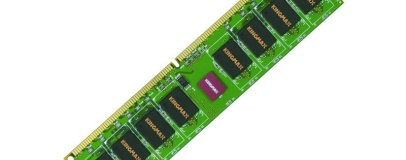
New Kingmax memory modules are set to include an innovative feature: invisible heat sinks.
Kingmax has announced its latest - and rather bizarre - innovation in memory chips: the invisible heat sink.
The company's latest memory products come with something Kingmax is calling a "
Nano Thermal Dissipation Technology" layer - which it claims can "
increase the release of radiant heat."
Although the company's
press release is a little light on technical details, the technology apparently takes the form of a "
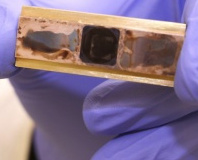
nano-size silicon compound [that] fills up the invisible vacant space of the smooth surface to remove the surface heat more quickly[, acting] like a sponge [to] pull the heat and release into the air at a faster rate" than an untreated chip.
In actual terms, the company claims that the technology - however it turns out to work - makes a real-world difference of around two degrees Celsius, which could mean a more stable overclock in marginal situations. Kingmax also claims that the coating can be combined with traditional active and passive cooling systems - including watercooling - to further increase the performance gains.
The first memory modules to feature the nano thermal dissipation technology coating will be Kingmax's Long-DIMM DDRIII 2400 Dual-Channel 4GB kits, comprising two 2GB DIMMs running at 2400Mhz and designed to operate at voltages between 1.5 to 1.8V. All treated modules will come with Kingmax's lifetime warranty - and as the company is aiming these modules at overclockers, we'd hope that Kingmax won't mind if you tweak the voltages or speeds from stock in order to see exactly how much difference the 'invisible' heatsinks make.
So far Kingmax hasn't announced availability of the modules in the UK markets, nor how much such magical nanotechnology will set you back.
Do you think that the Kingmax technology holds promise, or are you yet to be convinced that it's not a load of snake-oil? Share your thoughts over in the forums.

44 Comments
Discuss in the forums ReplySo it's like a wicking fabric, only nano, invisible, and for heat? Could work I suppose, if you happen to live in "Physics Experiment Land" where every process can operate in neat isolation from every other process.
That's probably what ist does, maximise surface area on a nano-scale
are kingmax nigerian by any chance?
Unfortunately, DRAM chips don't have thermal sensors, there's not much chance of being able to verify the technology. I suppose you could apply the goo (?) to something that does have a thermal diode, but as those chips require large heatsinks to keep them cool, we're into the realms of TIM testing and that's a whole can of worms...
Are you familiar with the physical properties of a sponge, good sir? It's maximized surface to mass ratio! Goodness me.
And anyone who knows a bit of nanophotonics will tell you that nano-scale structures have a tendency towards phonon confinement, thus decreasing thermal conductivity. Since the engineers probably aren't completely incompetent, I would suggest that they have found an application with the reverse effect. It's quite amazing the number of people who seem to have decided that 'if you can't see it, it doesn't work'.
Presumably, you are a fan of explosions inside your pc case? =p
Gripping the coating and attempting to shove the RAM stick down = no more coating.
There are some Crucial Ballistix with sensors, and it is part of the DDR3 spec.
An another note, this won't help in OC situations. I've never known an OC to fail 'because the RAM is too warm' - usually it's because they're being push too hard in terms of Volts and they go POP or lose data coherency.
Sounds like some sort of funky TIM, more than a new cooling solution, but who knows it might just work.
So it's not invisible as it is too small to see with the naked eye.
Kingmax, this idea is 'king dumb.
qft
Reasons why it could be good:
1) the material is good at radiating heat. If the material is a good radiator, the temperature could drop.
2) In contact with heatsinks, this could just be a fancy form of TIM. You don't try to maximise the surface area on your CPU do you?
You sound like you've got the kind of job I'd like in the future :D
This, on the other hand.. Well I have my doubts.
but wouldn't that defeat the whole purpose of the "invisible heat sink"
Seriously though, I have to agree with Deadpunkdave - it really is quite strange how it's almost unanimous that because you can't see it, it must automatically be hocus-pocus. An i7-980X six core chip apparently has 1.17 BILLION transistors on in, damned if I can see a single one of them, doesn't mean they're not there though...
It's that people just aren't reading the content of the article and are just reading the title. This is not an invisible heatsink as per say, it's a kind of funky TIM that increases heat dissipation.
Anywho, I'd like to just buy decent memory that doesn't have memory heatsinks that are twice as large as the actual RAM sticks, those mobo designs are getting better but not the heatsinks on the RAM, so therefore I can't put a big copper/aluminum tower HS/F on top of my CPU in most cases..
Oh sorry, thought you were commenting on my post just above yours.
+1
It's regular RAM with optimized heat dissipation, not an 'invisible' heatsink attached to it.
I bet you could add some coolant paste and a heatsink and the dissipation will be 'transfered' because of optimised contant between paste and RAM.
Let me further enhance that to Liquid Oxygen
Very explosive, especially when mixed with Ozone, but extremely cold and I could in theory levitate my pc...
But in reality I was pointing to Oxygen in the form of O2.
So to summarise, oxygen inside your computer case will do nothing unless your computer is already on fire.
In which case you're f*cked.
but as mentioned ram usually doesn't thermally overload.
I'm not sure what Kingmax is doing, or how effective it really will be, but there certainly is the potential for something like this to work.