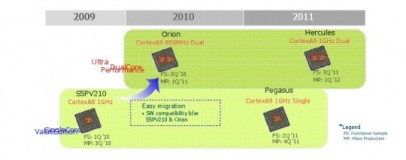
The leaked roadmap document, dated from late last year, shows Samsung's plans for ARM-based netbook processors.
A leaked product roadmap from Samsung has confirmed up-coming quad-core processors designed to bring a significant performance boost to mobile devices.
The roadmap document, which was leaked to
Notebook Italia and picked up to
EETimes.com, was created in November 2009 and demonstrates the company's planned netbook output for the next few years.
While there aren't very many surprises from Samsung's perspective, the document provides a fascinating insight into Samsung's plans to produce its own ARM-based processors - including an up-coming quad-core chip that might finally close the performance gap between netbooks and notebooks.
The first chip listed in the roadmap is the Orion, an 800MHz dual-core processor based on the ARM Cortex-A9 series and due for mass production at start of next year. This will be followed up by a single-core 1GHz version dubbed Pegasus, expected at the end of next year.
If you're still after more speed, Hercules - a dual-core version of Pegasus clocked at 1GHz - is listed as being due at the start of 2012, to be followed up by the dual-core 1.2GHz Draco processor towards the end of 2012 or the start of 2013.
Samsung is also looking to keep things ticking over at the ultra-low power end of the spectrum two, with a pair of new chips for maximum battery life due some time later this year: the Mercury single-core and Venus dual-core, both based around the ARM Cortex-A5 and clocked at 600MHz.
However, the most interesting part listed in the document has been saved for last: the Aquila quad-core. Again based around ARM's Cortex-A9 series, the Aquila will feature four physical processing cores running at 1.2GHz while retaining a low power draw for maximum battery life. Sadly, it's not due to hit mass production until 2012 - or possibly even 2013.
The new chips represent Samsung's desire to move away from a Wintel - Windows OS on Intel chips - platform for its netbooks and towards a future where its ultra-portables run Ubuntu and Chrome on Samsung's own processors.
Are you impressed with Samsung's plans for future ARM-based processors, or will the impressive-seeming 1.2GHz quad-core chip be hopelessly outdated by the time it's released in 2012/2013? Share your thoughts over in
the forums.

17 Comments
Discuss in the forums ReplyI'm pretty sure that before Aquila is even produced, Cortex A10 would have been out, and used by a few manufacturers already.
I would definately be put off if there was not as the thought of not being able to play games would be a turnoff.
ARM processors can do the graphics work (look at all Freescale based Nokia's, all are quite lousy in 3D rendering because the CPU chews all the graphical data. OMAP platforms uses a dedicated GPU, Snapdragon uses a dedicated (and admittedly aging ATI) GPU, and Samsung's chips more or less ARE OMAP (The chip in the Apple iPhone 3GS, for example, came from one of Samsung's foundries and a PowerVR SGX535 GPU, which is the 'big' brother of the PowerVR SGX530 GPU, which the OMAP platform uses.)
x86 is still too inefficient for now - there's a reason why intel has not released a dual core atom (for laptops) yet. The heat one of the latest (laptop bound) Atom processors is 5.5W, and that is ONLY the chip, not inclusive of the chipset. Quad it, and it'd most likely end up roughly 22W. The entire OMAP3430 platform only releases 0.5W of heat? HUUUGE difference, dude.
Also, for low power 15" devices, heard of CULV...?
In terms of sales Wintel will dominate. Effortlessly.
that just got me remembering a CPC review on the dual core atoms in which they said the chipset was still the bigger power drain. Im surprised intel hasn't really addressed this yet. I guess theyre waiting to integrate CPU and GPU to solve that issue.
The entire thing (N450 + chipset) now is supposed to only consume 7W, of which the CPU contributes 5.5W. Mostly because they shifted the GPU to the CPU package, though.
SO yes, it has already been done by Intel - albeit by a not very orthodox method. Cedar View SHOULD see Intel having both the CPU and GPU in the same die, not just on the same package. TDP should fall as a result.
Also will this rush into net-books, and their required high efficiency processors and lean OS, put pressure on x86/x64 OS or maybe even a new OS standard?
Just a thought on market pressures...
Correct,
see the Linux-on-Netbook story. The devices really took off with windows, although they were cheaper AND faster with linux.
Call Centre Guy : Please load the X-Terminal
Customer : What thermal?
CCG : X-Terminal. It's probably near -
C : What in the blazes is that?
CCG : Just load the program.
C : Riiight, and now it pops out a Command Prompt box. What did I do?
CCG : It's supposed to appear that way, sir. Now, please type in 'sudo -' "
C : It plays Cluedo?
CCG : ...