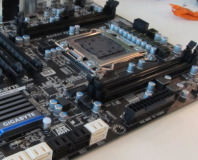
Intel's next generation platform to replace LGA1366 will arrive late next year, so an upgrade to the Core i7-930 is still a good investment.
Here’s a quick bit of overheard info for you – Intel’s replacement for its current high-end Core i7 CPU range will arrive in Q3 2011, so if you’re planning an LGA1366 upgrade now (perhaps with a
Core-i7 930) then it’s still got plenty of life left in it.
The bad news is, there will be no compatibility between current LGA1366 Core i7s and the new socket. Intel is planning on launching a new socket for every new major CPU revision as it’s continuing to incorporate more and more features into future CPUs, which means pin-counts and sockets will inevitably change.
Our sources in Taiwan also told us that the new chipset that will accompany this socket - inevitably being called "X68", although this is far from being an official name - will feature
four DDR3 DIMM channels. It will only support one DIMM per channel as this maximises memory bandwidth, but memory density will be overall lower than current LGA1366, Core i7 systems as there will only be four sockets versus the six you see on current X58 boards. The chipset will include more PCI-E lanes of some description, either 2.0 or 3.0.
No details on the socket pin-count or size are available yet, however we do know the first CPUs will be a native eight-core, 16-thread design (as seen in the just launched
Xeon X7650), based on the upcoming Sandy Bridge architecture.
The good news is for those who upgraded to LGA1366 in late 2008 or even last year have had a fantastic investment of their money as we expect their systems will continue to be the fastest products available until the replacement late next year. Interested in saving up for a new 8-core behemoth? Does this change your upgrade cycle? Let us know your thoughts,
in the forum.

47 Comments
Discuss in the forums ReplyThat said, these boards are going to be horribly expensive. Just the thought of wiring up four discrete channels passing through a northbridge.
And AMD have turned into Intel from the past. :D
AMD had socket A, 75, 939
Intel had 775 for ages (and 478).
AMD ruled performance with the Athlon.
Intel struggled with the P4.
AMD has had AM2 and AM3.
Intel 775, 1366,1156,and now another one
Intel ruling performance with Core i and c2d range
AMD struggling.
:D
How long has 775 been around for?
I'm still using a E6600 on a P45 board, and see no reason to upgrade my CPU at the moment.
My next upgrade will probably be for a DX11 graphics card.
If I feel that I need more CPU power I'll just switch to a Q6600 or Q9300 as lots of people are selling those as they upgrade.
They seem to be pushing the X58 and this successor into enterprise territory more and more. Its clear that 1156 will last at least a while, anything else and your asking to pay a early adopters fee with no guarantee that your next upgrade will be compatible.
Pin count is a hardware limitation, and we all know there is only one way to remove that limitation.
Intel must be envisaging that 4gb dimms will be abundant and cheap(ish) in 2011, because servers always want more memory, and limiting it to 4 slots seems crazy. Go try and tell an enterprise server they can only use 3 memory slots per CPU and they would laugh at you and buy something else.
Don't forget that they are talking about the desktop part, not a Xeon.
This will make its way into workstations, but servers will be for the Xeon part.
and don't forget that the 4 slots will probably be able to take 32GB of memory (assuming 8GB modules start to show up then).
socket LGA1576 next year?
Oooh I never noticed that pattern. Would be funny if you're right.
same boat with u :) Q6600 on 775 is still good for now.
2011 its a new socket.
and maybe next year ill grab a cheap Fermi470 to keep it running for another year.
Guess i'll just skip x58 and wait till 2011 for the new socket, games are pretty much GPU limited anyhow and 4ghz on the q6600 isnt going to slow much down anytime soon.
Waiting till crysis 2 before I spend any dosh though...
Not really as this will be the X58 LGA1366 replacement. X58 will be EOL by this point (as no doubt will the i7 in its current form).
On an i3/15/i7 the memory is directly connected to the CPU
I wouldn't bother waiting for that. If it can run on a 360 it can run on anything.
My question is, what becomes of i5 in all of this?
(and thanks to BlackMage for pointing out the cheapness of quad cores on ebay, I think I'll have a little incremental upgrade sometime this year)
Regardless of upgrading to a 6 or 8 core setup, it would be a huge upgrade over my socket 775 system I am currently running and worth the money to do so at that point.
I was just thinking the same thing :D
To be honest, i7 isn't exactly going to become slow overnight ;)
Memory slots is a big selling point for the new blade Cisco is selling (and the rest of the hardware to go with it). It can support 48 DIMMs (with some limitations).
But the article says it 4 channels, not 4 DIMMs per CPU. If the CPU can support a 3 DIMM per channel configuration like some of the Xeon stuff now does, then you have 12 DIMMs per CPU for a total of 24 DIMMs which is quite good.
As for the socket, I had personally hoped QPI would help here and let at least some of the stuff they are building onto the CPU sit close to it but allow for a common interconnect. But I hoped FB-DIMMs would have matured to allow for a common memory interface as well, and that was pure wishful thinking.
Another socket type doesn't bother me as the current i7 on 1366 will blow away my current AMD rig, as that is about 4-5 years old and went EOL ages ago I think the i7 would probably last me the same amount of time regardless of whether it was EOL or not.
The ex58-ud3r, the old budget x58 board, has only 4 DIMM slots to save space and money. As previously stated, Intel are banking on 4GB sticks being more main stream. But even still, unless you're doing something other than the norm (VMs, or as I do, scientific simulation), 4x2GB on your system will be plenty.
It could well be that Xeons support more than 1 DIMM per channel, but I would expect that Xeons will have LR-DIMM support for greater DIMM counts.
And the upcoming Phenom II X6 CPUs are AM3. I wouldn't say AMD are struggling by any means. Intel certainly beats them with higher-end CPUs, but AMD is doing well with the lower to mid-range market. The upcoming X6 will only help AMD gain more of this market.
Sorry for being off-topic.
I first heard about 4 channel about four years ago and it wasn't brand new then. I reckon all developments are drip-fed to us about five years late so the manufacturers can maximise profits. I bet there is already technology, in the labs, ready for production, at least a hundred times faster than what has already been released.
Yeah I hear ya, nice time to retire my 775 P4, shudder, I know. Between this and the hopeful Light Peak tech, I can't wait.
Early 2009 I moved onto the i7 920 D0 – once again, due to recommendations made by places like Bit-Tech.
Can’t help but feel I've struck gold twice in a row, purchasing at the right time and getting almost 3 years out of the 1366 platform before 2011 comes along. Oddly, whenever I purchased, RAM has always been at its lowest price also.
I'll be watching places like Bit-Tech carefully when the 2011 comes along, purchasing based on their recommendations as always.
I never want bleeding edge computing, I can't help but feel the benefits of buying such fast components never justify the price tag. Not unless you really need it (Video encoding all day long etc), which 99% of people don't...
From what I've seen over my last two upgrades, there is always that “sweet spot” CPU.. One that offers incredibly good performance, with a very competitive price tag. Which will last you to the next generation with ease, with plenty of room to overclock if required.