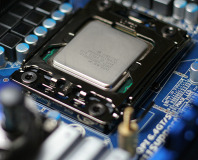
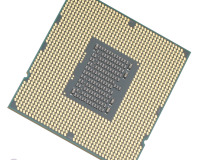
Intel's prototype CPU builds on the work carried out by its Tera-scale research unit and provides 48 physical processing cores.
Intel has announced that "
limited quantities" of an experimental processor featuring 48 physical processing cores will be shipping to researchers by the middle of the year.
As reported over on
ITworld, the Intel Labs evangelist Sean Hoehl announced the company's plans to provide academic researchers with early versions of its massively multi-core processors as part of the company's Tera-scale research programme - almost certainly a variant on its
Single Chip Cloud Computer project.
Whilst hard details as to the precise specifications of the processor weren't made available, engineer Christopher Anderson hinted that each physical core on the chip would clock in at around the same speed as an Atom processor - so we're looking at anything between 1.2GHz and 1.8GHz per core. While that might not sound like much, remember that Intel is building
forty-eight of these on a
single processor - and there'll be nothing to stop dual- and even quad-processor motherboards being manufactured to accept these new chips.
Interestingly, one fact that did come out during the announcement was the power draw of the new chip: depending on workload, the 48-core processor is expected to draw between 25 and 125 Watts - with the massive difference due to the chip's ability to shut down groups of processing cores if they're not actively being used.
The prototype chip is based around the same mesh technology behind the more impressive 80 core version that the Tera-scale research team
developed back in 2007, but unlike previous efforts this latest version is a fully working processor - albeit in prototype form.
Sadly, Intel hasn't offered any hints on precisely when processors with this many cores will become a commercial reality - but at least this will give researchers time to develop the tools and skills required to take advantage of such a massively parallel processing platform.
Are you impressed that Intel has made it to a viable 48-core processor already, or are you only going to take notice when the triple-figure chips hit shop shelves? Is the future truly in many low-powered cores, or should the company be concentrating on fewer, higher-speed cores in its processors? Share your thoughts over in
the forums.

31 Comments
Discuss in the forums Reply48 core won't be much use to the average internet surfer. Maybe the technology will help with the production of very low energy single and dual core models that will pop up in all sorts of embedded applications?
How about a folding rig?
+1
Have you never noticed how in EVERY SciFi setting, everything always smokes?
Star Trek-Star Wars-Stargate...as soon as someone hits a console with a kids toy gun, the things smokes and explodes.
(I'd always thought it was steam, but nobody's ever burnt, just blastwounds...so it must be smoke...Smoke's the future!)
Think about it, that's almost identical to the CPU/GPU setup - quad core + 1600 shaders is 4 powerful cores and 1600 smaller, slower cores.
If the 48 cores are all x86/64-bit compatible though with reasonable logic, that's the middle ground. Expect to see workstations with a quad/hex/octo core and then 4/8 of these chips inside.
read recently they they've managed to multi thread word.
That sounds like AMD's Fusion/Llano.
Watch this 1110011 1110000 1100001 1100011 1100101!
Binary fail!
Read this (ASCII): 01000010 01101001 01101110 01100001 01110010 01111001 00100000 01100011 01101111 01100100 01100101 00100000 01101101 01110101 01110011 01110100 00100000 01100010 01100101 00100000 01100100 01101001 01110110 01101001 01110011 01101001 01100010 01101100 01100101 00100000 01100010 01111001 00100000 00111000
I think x86 compatibility would be important to most users. I don't think the market is particularly large for a processor that requires a custom OS.
As for multi core systems, I've said it before and I'll say it again, I really hope it's a long time before anything more than 4 cores becomes mainstream.
I think we are already starting to have problems with lazy developers not optimizing applications because dual core 2gb ram systems are becoming the norm. I dread to think what would happen if 20 cores and 20 gigs of ram became the norm. We'd probably end up with notepad apps taking up 100% of a 2ghz core and 6 gigs of ram. Imagine iTunes... :P
I'd have to say not very well since crysis only uses 2 cores it should perform miserably compared to a i7/i5 :P
True, but ample processing power should not be an excuse for sloppy programming. It is, always has been, and always should be, imperative that executable code is optimized to run as economically as possible (within reason).
I didn't buy a dual core processor and 2 gig of ram so iTunes could stretch itself to 50%+ cpu cycles and hundreds of megs of ram. Put another way, if my computer is capable of running even something as old as FarCry (original) at 1280x1024 at full quality, cover flow in iTunes should not stutter.
(Sorry to pick on iTunes, I know it's not the only one (zune software anyone?))
I wasn't implying that programmers to be reckless but that they should catch up with where the hardware is going. If 4 cores are common place, and 6, 8, 12, etc... are going to be common place very soon; programmers must catch up with that. They also must use it as efficiently as possible too. I think that efficiency is part of a program's ability to scale and respond to the users load on the system. But with all of the hardware capacity available it's negligent to the consumer, commercial or private, to not take advantage of their purchase of new technology. I have experienced this with some commercial computer controlled equipment.
NO I AM NOT PICKING ON PROGRAMMERS. (This is a generalization) I hold the MANAGEMENT who sets the WORK priorities for the programmers as responsible. It seems to me that the programming paradigm is stuck on dated ideals, i.e. it works in XP why update it? I do recognize the complexities and difficulties involved with programming and am not marginalizing that, however it can't be used as an excuse to live with merely acceptable performance because it still works. Maybe Microsoft needs to drop more of its legacy support in the name of efficiency.
Can it run Ubisoft's servers 24/7?
I lolled so much to that one.
But at what cost?
One of the main reasons we have so many different platforms is the manufacturers' desire to exercise full control over their platform, including deciding what software can be released on the platform, by whom, and what royalties they will be charged. Developer kits for some platforms (nintentdo/playstation for example) can cost thousands of pounds, and I don't see those manufacturers giving up that money cow willingly.
Another consideration is the cost of actually developing and adding such hardware and whether people would actually care enough to pay for it. Most things that I could do on Windows 95, I can do better in Windows 7, and for the few things that I can't I could use an emulator, if I was really desperate. The point is that saying to a customer "This is £50 more expensive because it can run Windows 95 software" is likely to get you laughed at.
Finally, it is important to consider the different hardware platforms and their relationship the the software running on them. Having the ability to run iOS software on my desktop, would be of very limited use, as the software is specifically tailored for the iOS devices. The same goes for running Playstation software on iOS, or Windows NT on android.
In short, while this sort of thing sounds good in theory, and it would be nice to have one piece of software that runs on everything, in practice we find that it rarely works very well.