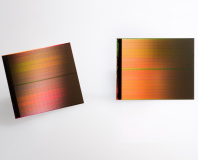
Intel and Micron Technologies have joined forces to create the first NAND flash chips based around a 25nm process.
Intel and Micron Technology have joined forces to create the first 25nm NAND flash chips, allowing for double the capacity over current flash memory.
As reported over on
IEEE Spectrum, the joint venture - called, somewhat unimaginatively, Intel-Micron Flash Technologies - will be the first to start production of flash memory chips based on a 25nm manufacturing process - a significant density increase over current 34nm chips.
Due to start mass production in the second quarter of this year - and to start cropping up in SSDs and USB memory sticks shortly after that - the 25nm process allows for 8GB of data to be crammed into 167mm² - or, to put it another way, ten times the data of a CD in the space taken up by the hole in the centre.
The news of a 25nm NAND breakthrough has come as a surprise to Intel and Micron's competitors, who have been working on a process shrink of their own - but with Samsung looking at 27nm and Hynix 26nm, Intel-Micron Flash Technologies will certainly have a not inconsiderable lead over its rivals for a while yet.
Although Intel-Micron Flash Technologies has yet to talk about pricing for its new NAND flash chips, it is thought that the process shrink and concomitant increase in data density will help SSDs drop to a more acceptable price-per-gigabyte - and surely drive adoption at an even faster pace.
Are you pleased to see solid-state development proceeding apace, or will you believe the advances when you can get your sticky mitts on a product based around the companies' 25nm chips? Share your thoughts over in
the forums.

31 Comments
Discuss in the forums ReplyBut if they can drive down the cost of the older drives, I do see this as good development progress.
I will adopt at 256GB for around £200. That way its the same price as a decent graphics card, and has enough space for OS and Games.
Really? They obviously don't read tech sites then - http://www.anandtech.com/storage/showdoc.aspx?i=3731 - announced 2 months ago :)
(EDIT - ok 1 1/2 months ago. & apologies if I have missed a blindingly obvious difference between the 2 stories...)
Exactly, £200 for 256 seems a fair trade between price per gig/performance.
Crucial started with their M225 series, offering good performance for a reasonable cost, only for the nand manufacturers to raise the pricing of nand chips, meaning Crucial raising their prices. Their 128GB was originally £200, which 6 months ago was good, only to see it hit £300+ in todays market :(
Also, 1TB SSD?? you can get them, but wanting them for £100, not on your nelly, well not until SSD's stop mechancial drives from being manufactured.
This was officially announced some time ago now, 25nm, larger capacity production Q2, available around Q4.
Why so late off the mark BT?
when the prices come down some I'll jump into a 256.. but until then really no benefit.. you'd probably put your games on a harddrive also to save writes to the ssd- I guess maybe to impress someone with boot times and shut down woopee =] least acronis lets you select drives into one backup if you want- so that's covered least..
I'd get one if it wasn't 30 gb for 90 bucks right now on newegg (probably all you need for the os partition) reading about them and firmware updates cause complete data loss? disable system restore, indexing ect.. waiting till all this gets solved and prices aren't so high
No, no conspiracy.....a traditional hard drive costs around the same price to manufacture regardless of the storage size; where as an SSD is dependent on the price of the individual chips that go up to make the drive. So for example a 128gb drive might contain 64 chips that cost the manufacture $5 each to buy in depending on NAND prices at the time.
The "conspiracy" with SSDs is the NAND manufacturers charging far more for their product than it costs to produce.
And thanks to the manufacturers working together we even get legalized price fixing...
When even a crippled 40GB SSD that is called "value" costs almost 100£ something is definitely wrong.
Lucky me for jumping on the ssd bandwagon early enough to avoid the price increases, but upgrading to a bigger one is currently just not possible.
Or a 80GB SSD for that price, once they get that cheap it's much better.
Now that does not mean I would not get 3-4 SSD's and RAID them for some extreme performance! :D
is there any performance increase with the move to 25nm?
SSDs derive their performance from the ability to perform many parallel writes to a number of NAND chips, so increasing the density of an individual chip won't do much for performance compared to increasing the number of chips you're writing to (though any performance increase in read/write rates to a single chip will obviously be multiplied).
Next logical step would be picometre (1x10^-12) but I suspect they will use Angstroms first (1x10^-10). Failing that, they'll do what they did with microns (1x10^-6) and talk about "0.25um" and "0.13um" before switching to picometres. This is, of course, ignoring the limitations imposed by atomic size, and looking purely at the naming conventions.
You can't raid SSDs, Trim doesn't work in Raid, while of course you can still Raid them to show off some impressive benchmark numbers its useless to raid ssds for normal usage as they will just get slower.
As a couple of people above have said, I think around a £1 per 1GB would be the psychological tipping point for my first foray...
I remember buying a 10MB HD in 1986 for 600 ;)