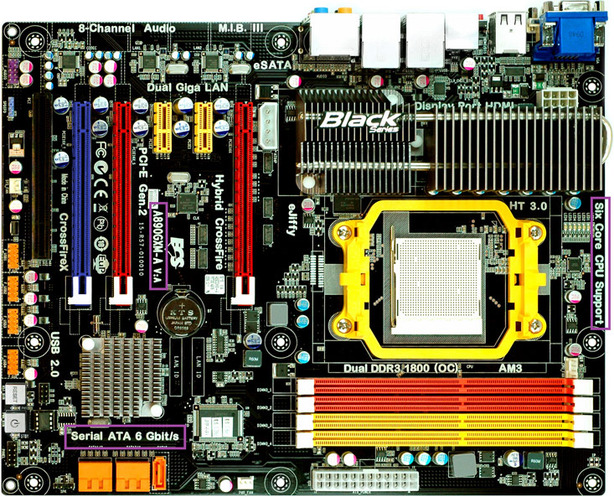
ECS' latest 8-series AMD motherboard features support for AMD's latest 6-core CPUs and SATA 6Gbps
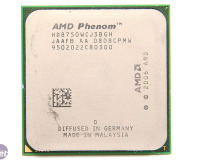
Details are starting to emerge about March updates to AMDs CPU and motherboard chipsets. Arriving in Q2 (May is claimed), four 6-core CPUs are slated for launch at the standard AM3 socket, taking the name "Phenom II X6 10xxT" - where the xx designated the model number.
OC Workbench alludes that they will start at 2.8GHz with a 140W TDP, and that each contains the normal 6MB L3 cache a quad core Phenom II currently uses. Notably the HyperTransport clock has also been increased from 2.0GHz to 2.4GHz, most likely in order to relieve the data stress of adding two extra cores.
The new 'Thuban' die is still made using AMD's 45nm SOI process, although recent advancements in FAB technology at AMD, which was evident in the recent Phenom II X4 965 C3 stepping, have made its leakage more manageable.
Since these CPUs still use the AM3 socket, they should be drop-in compatible with current 790FX, 790GX and 785G AM3 motherboards, providing there's a BIOS update available.
With regards to AMD's new chipsets: the 890GX will be launching in March, with announcements at CeBit we expect. Inside there's an updated graphics, named Radeon HD 4290 - so it's still RV6xx based with DirectX 10.1, although we're still waiting for boards to arrive in Feb to tell us the exact specifications. We hope the UVD video playback is updated to 5xxx series standard to compete with Intel's latest Core i3/i5 Clarkdale CPUs, and maybe, just maybe, AMD will finally support dual digital display outputs.
Most notably though is not the integrated graphics, but the new SB850 series southbridge the 890GX will be paired with. It has SATA 6Gbps natively included, but when it comes to (the arguably more useful) USB 3.0, unfortunately we still have to pay for the additional NEC controller.
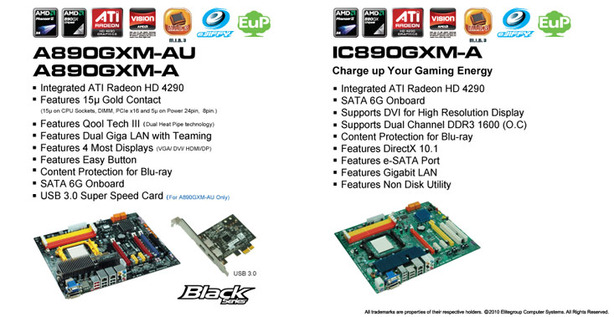
Still wondering if it's just rumour or real? Check out ECS' latest 890GX board then:
Has this news made a future upgrade turn to AMD? Let us know in
the forums.

45 Comments
Discuss in the forums ReplyJust as I think... 2 more threads, but with lower clock speeds and with a big TDP... That's not good
The way I see it, it's largely not viable as an upgrade for most of us with existing AM3 systems; Intel will still retain the performance crown with its quad-cores, inhibiting purchases from anyone in the know. I don't see a market for them, but I'd be glad to be wrong.
I'm assuming the release dates are an error. God help us if AMD are still on socket AM3 in Q2 2013!
Either way The only thing that interests me in these new mobo's is USB3 and 6Gbit/s SATA and Will the increased Hypertransport clock help with overclocking phenom II X4's?
Arab investors maybe =p all they need is a football team xD
Drop in replacement for a power starved data center if I remember correctly xD
AMD needs to come up the another Athlon 64 Intel killer or, sad to say, don't see them in the high-end market much longer.
Actually Clive says £200-220 I recon more.
"ATI Radeon HD 4290" = ati2mtag_RS880, PCI\VEN_1002&DEV_9714"
Looks like a nice board, for people who encode media, it would probably pack a punch for its price.
that is what i was looking for here. something with enough potential that intel will have to lower their launch price, or at least lower it quickly after. but from this initial report, do you think it looks promising enough? i don't.
Guess it'll depend how intel price theirs. £200-£220 seems too close to current phenomII's but AMD could need to be that aggressive. They have to offer price vs performance to compete in my eyes. I can't see it releasing at that price but maybe after launch prices could drop to around that, especially if opteron's are an accurate performance indicator.
tasty! will wait for benchmarks. 6 core rendering dream
And also that a 890FX chip comes out of the "oven", I don't like GX or X, I'm all for FX. That two little things "cooked" really nice could be a huge kick-start to AMD back in the front. Here's hoping Asus makes a Crosshair IV juicy enough to go along with that.
2013 will be the year of the 3.6 Ghz (+), 22nm 8-core K12 Bulldozer CPU (with integrated ATI 7100) after all!! With socket AM5 (a 1024 LGA socket) and HT4.
if you think about it they are trying to make it a standerd conection for there proccesors like usb for example i know they are fundementally diferent but in essence its the same where as intel keep releasing different chipsets amd keep the same and improve on it
Yes the recent past is non-comparable to the present.... Especially when it's only a one generation change (p45....p55... .... ..)and they use the exact* same chipsets for devices like usb and sata...... but totally non-comparable.... :D
I use all ten of my sata ports on my 790fx-ud5.
but anyway, it seems like the wait for 32nm with AMD is going to be a while. i am starting to think i would have been better off spending a bit (well, it would have been a good £200) more on a i7 920.
for SSD drives.
it seems AMD has everything together (in terms of global foundries business) but they need to scrap 45nm stuff and K10.5. Then just start with a blank slate and 32nm (or less) and make a new CPU.
@l3v1ck - very likely unless AMD decides to skip 32nm all together. Which would be good as long as it can really compete with Sandy Bridge.
When you think about it, they only got half decent 45nm parts once intel changed archeticture. They're now a month behind intel on 32nm and counting.
I expect a significant increase in performance from the Hd 4290 not only that but this chipset is a very attractive, capable, and cost effective way to enter PC gaming.
the more the better! 6 cores will make multitasking in a x64 OS even more enjoyable. More complex real time rendering and better AI.
We all know Intel is the poster boy for performance. 2 or 3 frames faster in games. With other "Real World" applications blink your eye twice and you may miss Intel beat AMD.
I'll take the second place trophy and spend my savings on other upgrades.
Of course when it comes to multi-threads...that's going to be different.
On the AMD front, a 6 core CPU has a nice ring to it, though I would have hoped that what would appear to be their top end Phenom II X6 part would have been clocked higher, as I am still using a dual core AMD cpu on the older AM2 socket running at a nice 3GHz.
With the motherboard only supporting DirectX 10.1 rather than DirectX11 and not natively supporting USB 3.0 and uncertain about dual display support, this is most definitely a miss for me.
I am hoping that we have some much better hardware come out during the course of this year with decent specs that makes it worth the effort of upgrading.
You mean, just as the similar wattage 955s and 965s can't overclock?
http://www.bit-tech.net/hardware/cpus/2009/04/23/amd-phenom-ii-x4-955-black-edition-cpu-am3/3
http://www.bit-tech.net/hardware/cpus/2009/11/04/amd-phenom-ii-x4-965-be-c3-review/2
On the first sentence, thank-you Captain Obvious. On the second, in the same way Intel's Core 2 was just a tweaked, die shrunk Pentium M (Banias) from 2003?
So AMD should do this instead of going ahead with their current plan of replacing 45nm and K10.5, and starting with a blank slate on 32nm with a new CPU (Bulldozer)? Dirk Meyer, someone's after your job!
Or did you mean do it now? But what would AMD sell until 32nm and Bulldozer arrives?
And completely re-do their upcoming design just as they are testing early Bulldozer samples on 32nm? And piss away all the money and time AMD has already spent on the current design? And the hundreds on millions GloFo has already spent on 32nm research, redesign and retooling? Which, by the way, is almost finished. Piss it all away for a process (22nm) that they have only just completed early SRAM test wafers and won't be ready until 2012 at the earliest?
Wow, I just re-read that and I sound like a sarcastic tw@t. Thankfully, I feel like a sarcastic tw@t tonight so no need to go back and rewrite.
Most games can't utilize 4 cores, so what good is 6?
Sure, maybe graphics gurus and folding farms...
But I don't think that'll bring them the money they need/want.
faulk wulf the idea of six cores is to make it do you can do more demanding things easier
anyway i thought games now adays more graphics intensive than cpu intensive and i would get one of these becasue i do a lot of video encoding/transcoding and this would let me do many files at once at full speed and speed up the total time
6 core proccesors are probably geared more towards media centre pc's than gaming pc's
6 core CPU's and Ultra powerful Gpgpu's are turning PC's into SILICON MONSTERS
These 6-core CPUs don't provide any more multi-threading assistance than a dual-socket Pentium 2 system did over a decade ago. It's 100% a programming exercise.
This is why I don't see these 6-core AMD CPUs selling to consumers in any real numbers. Reviewers have enough trouble finding benchmarks that support more than 4 threads - let alone real-life applications. It'll be good for people who render stuff, and it'll be good in the server markets. But for consumers the reviews will simply read 'No performance increase, lower core clock means quads are a better investment'.
Until physics are done on a much larger scale, games won't scale very well beyond ~4 cores, even beyond 2 cores is problematic for a lot of them.
Think of multithreaded programming as managing an office. If you're on your own, you can do all the work however you want to do it - but there's only one of you. Now, let's add another person. You can delegate entire tasks to your underling, and only really have to worry about syncing your work up at the end of the day.
Now add a few more people - a total of 6. Now the question is - can you even divide the work up between all 6 people? Assuming you can, what about syncing everybody's work up together? There is a very real chance that you'll end up spending more time in meetings and dividing work up than actually *doing* the work!
What about with 10 people? If you're an artist - it's not like you can have one person paint the top half, and another person paint the bottom half!
Ultimately multithreaded programming is exceedingly complicated because you end up with many issues that compound each other:
* Finding enough work for all the cores to start with
* Ensuring the work is big enough that it's even worth it - don't want to spend more time setting up the task and syncing up than it takes to do the work itself
* Conditions where one core is waiting on another core to finish - but it actually waiting for you to finish - but you can't until the other core is finished - you're waiting for each other!
* Simpler version of the above - but due to bad scheduling cores wait on other cores and the work is done all in the wrong order - so it actually ends up taking longer than if a single core did all the work itself
End result? Some things lend themselves to multithreading, and other things not-so-much. It's great having lots of cores - but it's a rather brute-force way of increasing the FLOPS of your CPU.
The best way of increasing flops is the GPU which lends itself better to parallism. Adding more cores is an easier way of increasing performance since there is a limit to how small you can make transistors and changing architecture can be costly. Yes some things lend themselves better to staying single threaded but other things like gaming need to go multi-threaded. Its an easier way to increase performance than rely of hardware. what I mean is, software needs to advance too. AMD doesn't have Hyperthreading so 6 cores is very welcome in my eyes. Especially those looking for a cheap alternative. Not all applications have to be thread heavy to benifit, a heavy multitasker will enjoy it as much, ie. multiple single threads. Thing someone rendering while being able to continue on another project.
Multi cores is the easier way forward than hot running, high Mgz processors aka Pentium4.
Umm, hello?? Consumers (real, proper, non geeky ones) don't read benchmarks. They go,
"Wow! 6 cores, and at a price I can afford!! Woohoo!!"
Yes more cores is nonsense for most people, but nonsense sells. Just look at Bose, Apple, Pioneer DJ equipment, the list goes on. It's not all about the product.
by April we will have:
a 975 at 3.6GHz at 140W
a 965 at 3.4GHz at 125W
a 955 at 3.2GHz at 95W
surely we can manage at least 3.0GHz with an X6 at 140W!
Overclocking is not as issue for a workstation, neither is the TDP in this range.