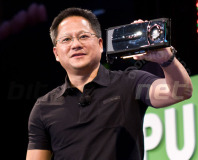
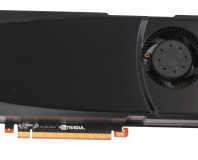
Nvidia has confirmed that the Fermi card held up by Jen-Hsun on stage wasn't real, but was adamant that the demos were.
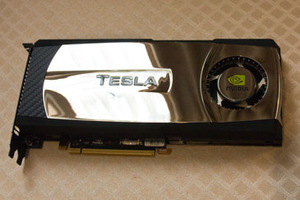
On Wednesday, Nvidia CEO and President Jen-Hsun Huang showed off what was believed to be the world's first Fermi-based graphics card, but upon closer inspection, we found out that the card was indeed a mock up.
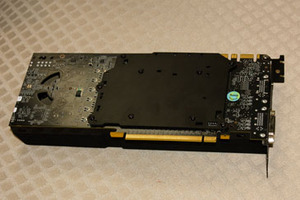
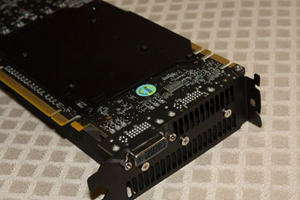
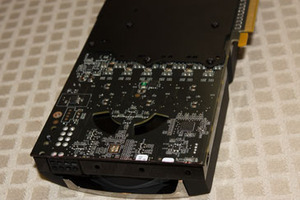
The first alarm bells started ringing while I was waiting for an interview and noticed the card being heavily guarded by one of Nvidia's PR managers. I asked if I could take a closer look and I noted that there was no GPU under the heatsink and then started to take some more detailed pictures of the card.
It wasn't until I got back to my hotel room that I realised the card wasn't real, where I noticed the PCB had been cut down to fit the shiny heatsink's dimensions. The power connectors also don't line up with the contact points on the board and there are contact points for a second DVI connector. We're sure there are quite a few more discrepancies too, but we haven't spent a great deal of time looking any closer.
When I questioned Nvidia about this, it confirmed that the board was a mock up and that we'd see product shots as soon as the board designs have been completed. The company was adamant that the demos on stage were in fact real and said that the bring up board has wires dangling from it, so it isn't a pretty sight at the moment.
Being the sceptic that I am, I asked if I could see the boards used for the demos, but I was told that all of the cards had already gone back to Nvidia's labs to continue the bring up process - they want to get the cards in gamers' hands as soon as possible, after all. However, I did a bit of digging and managed to see a blurry-cam shot on a mobile phone of what my source claimed was one of the bring up boards.
It was difficult to make out any of the components, but it looked like some kind of weird explosive device based on the number of wires coming out of it. Also, while the source was happy to show me the photo, they said they couldn't give me the picture, let alone post it - we're going to have to wait and see what the real Fermi looks like.
This kind of stunt isn't exactly cool, but given the early nature of the silicon, it was almost entirely expected... it was a visual aid that was convincing from a distance, but not so when you got up close and personal to it. Hopefully, Nvidia will learn from this particular lesson, but I guess it shows how excited the company is about Fermi.
Discuss
in the forums.

So NVidia expects people to believe the demo was genuine if the card doesn't really exist yet in its final, complete state?
Even better... them telling you, oh no, we cant show the ones used in the demo because we already sent them away. Regardless, of whether they are being truthful or not, it does raise suspicion.
Yep, it does, which is why I tried really hard to get them to let me see the bring up board. The PR team seemed very willing to show me when I asked - they said they wanted to show me it although they said if I did, I wouldn't have been allowed to take pictures. A couple of hours later, they came back to me to tell me that they couldn't show me the board because they'd already been rushed back to the lab. That's when I started doing a bit more digging around.
I'm not 100 per cent convinced, but then I don't think anyone is - the proof is going to be in the pudding when the product comes out. They were demoing a 6x speed up in double precision performance over the previous generation single GPU on early silicon at clocks much lower than what they expect to ship at (the claim in all the whitepapers is an 8x speed up clock for clock), so if it's not able to manage that kind of speed up, they'll be taken to town when we do have real hardware. It would be a very risky move for Nvidia in that respect if the demos were fake.
Let the pants drop and the hammer fall.
http://www.semiaccurate.com/2009/10/01/nvidia-fakes-fermi-boards-gtc/
published on 1st October...
Going back to 2006-7 when NV came out with the G80, while ATI was 6 months behind reminds me that history repeats.
If ATI had hold similar strategy, G80 couldn't be such success from the moment that came out. The significant majority of the cards sold for 6 months were Nvidia because of compentition lack supporting DX10 no matter if they were any DX10 games out.
When the first MAJOR DX10 game (Crysis) came out almost a year later after the initial release of G80, they had new cards out (8800GT, 8800GTS512) to be able to play that game properly because most of the initial ones (8800GTS640/320) couldn't.
After that I'm getting an ATI in November, (have to pay the £300 fee for the divorce filling this month) not because it's bad/good but because I want it. Plain and simple.
What really will count is if they can get the hardware in to our hands ( even if in small amounts ) before christmas, how fast or not it is and its final price.
Charlie's article was about 300% more anti nVidia and 500% more paranoid.
Charlie is not at the show and has a big chip on his shoulder.
If that is case, then it is kind of stupid since given one days time, any one with reasonable skills could have rebuilt the cover to fit the full card.
The revelation does undoubtably put added pressure on Nvidia over the presentation's use of performance information using a "working version". On Fermi itself, this thing could be huge for Nvidia in the compute field - ECC at all levels might be the the final hurdle cleared.
1, Get a totally crappy mock up card (maybe they contracted Apple to build this one)
2, Get people around shooting photos of the card
3, Create the "Buzz" around the mock up (just check all the tech sites, every one of them has a few articles about it)
4, Isn't it funny that this "NVidia-cock-up-with-the-mock-up" coincides with the ATI Launch?
They are good at this. I just wished they're products were as good as they're marketing...
The Custom PC/Bit-Tech benchmarks will sort the wheat from the chaff when the final cards are available.
Game over Nvidia, try again in 2011