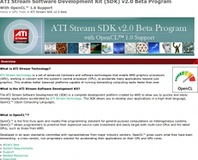
AMD's ATI Stream SDK v2.0 beta 2 doesn't support GPU acceleration for OpenCL and instead only supports CPUs at this time.
Despite releasing an updated version of its ATI Stream SDK last week, AMD still doesn't support GPU acceleration for OpenCL applications. The current release, version 2.0 beta 2, only supports x86 CPUs with support for SSE3 (or later) and GPU support isn't included.
Unfortunately, we wrongly reported that
the SDK included support for GPU acceleration and, upon speaking to AMD, we have managed to get a better understanding of the company's plans.
AMD said that this release was "
purposefully targeted at the CPU and the SDK portion of CAL (Compute Abstraction Layer) was not included on purpose."
A company spokesperson was keen to stress that the current version of Stream SDK 2.0 is a beta and doesn't fully reflect the final product. He went on to say that the CAL portion of the Stream SDK will be added back in, complete with GPU accelerated OpenCL support, "
in the very near future," but stopped short of giving a more specific timeframe.
The spokesperson recommended that developers who wish to continue using CAL in the meantime should use ATI Stream SDK v1.4, which includes support for Brook+ but not OpenCL.
Considering the focus AMD has placed on its support for OpenCL and other 'open standards', the company isn't yet delivering on all of its promises. Naturally, support is forthcoming as AMD has made clear and the OpenCL drum has been banging since before the Radeon HD 4890's launch, but it's not ready for prime time yet.
With that said, it's very early days for OpenCL at the moment and although Nvidia has made
OpenCL drivers available to developers for all GPUs based on its CUDA architecture (G80 and beyond), they're still some time away from making it into the publicly released drivers.
Discuss
in the forums.

It's for anything that isn't graphics processing and physics is one task that OpenCL can be used for. Havok is adopting OpenCL and I'm hoping Nvidia will do the same for PhysX. It makes sense for consumers and hopefully common sense prevails. (GPU accelerated) OpenCL can also be used to accelerate video transcoding, video decoding, encryption/decryption and anything that is heavily threaded - the benefit is that if the application is written correctly, it should spread tasks across all available processors that support OpenCL (i.e. CPU and GPU).
KoenVdd, developers have had good success speeding things up with Nvidia's C for CUDA API, so I've got high hopes for OpenCL.
I'm kind of glad that someone has found a way to run SLI on the X38 chipset.
I'm basing myself on that nVidia is almost twice as fast in f@h because they expose some high speed shared memory to be shared between threads which allows to skip so double computations, in CUDA, among other things. Now unless the f@h developers are lazy for not trying to make use of everything AMD offers or AMD has not yet chosen to expose all of their hardware features (dispite all my love for AMD, I do get the feeling they have a habbit of implementing features without making them usable), AMD is probably not going to magically catch up to nV with OpenCL. Don't expect f@h to bring out a OpenCL client anytime soon. But who knows, maybe OpenCL will make it easier to write efficient code. OpenCL will mainly make it possible to write vendor independant gpgpu, things may start going faster because optimizations can easily be shared and possibly more effort is going to put in gpgpu now you don't have to choose between vendor API's. But it won't expose any magic features that will make things faster for either party.
NVIDIA had more influence because they could toss money at developers/programmers. That's strictly what the TWIMTBP program is.
Pretty much, DX10.1 was halted due to Nvidia's complaint to Microsoft that their cards couldn't support it.
well more so to the gaming industry then to MS, thus the patch for Assassins Creed that downgraded it from 10.1 to 10 ~_~
=> http://developer.amd.com/GPU/ATISTREAMSDKBETAPROGRAM/Pages/default.aspx