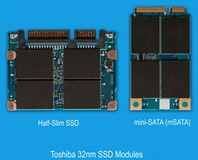
Although the humble solid state drive has a lot to offer over its mechanical counterparts, manufacturers still aren't seeing great demand for SSD-equipped notebooks.
Solid state drives may offer a wide range of improvements over their mechanical counterparts – including far lower seek times, lower power draw, and improved resilience to shock and temperature – but it seems that the notebook industry still isn't convinced by their merits.
According to a report from DRAMeXchange – quoted by
Fudzilla – it is predicted that notebooks equipped with SSDs as their main storage device will make up a paltry 1.5 percent of all notebook shipments in 2009.
The figures are improved somewhat in the netbook market, which the report treats as completely separate to laptops: there, a more impressive 10 percent of all devices shipped will be equipped with solid state storage – a near-must in a small, lightweight device designed to be as portable as possible.
The reason for the poor market penetration is thought to be most related to the higher price: as component prices increase thanks to the struggling global economy and manufacturers seek to increase their margins while offering cheaper units to the masses, it's clear that a 32GB SSD is a harder sell when compared to a 250GB mechanical drive that can often be had for the same price – or a 120GB drive that can be purchased for significantly less.
However, we're already seeing the prices of SSDs suitable for laptop use
dropping even as we see peformance
rise – which means that while 2009 might be a disappointing year for the SSD, 2010 could well see it poised to take over from the clunky mechanical drives to which we've become so attached.
Do you believe that SSDs are the future for the notebook market, or does the industry still have some major issues to address before you'll give up your spinning platters? Share your thoughts over in
the forums.

i think they dont realise that alot of people, maybe not as may here use their laptop as a primary computer
Eh?
I do think that the companies who make these SSD's are charging a premium that the current market is not willing to bear (a bit like NVidia did when they used to sell 7800 GTX 512's for £500 !)
Also, there are potential questions still about how performance 'degrades' over time,poor drivers in the OS's, and stuttering or something which tainted the market a little bit.
I also have an issue buying a 128GB model say for XXX when I think the 256GB model will shortly be the same price... If I wait a little bit longer !
"Can I plug my printer into it?"
I think for laptops and netbooks, power usage would also be a big issue (and definitely an advantage of SSDs, but how big of an advantage!?).
Laptops are mostly cheap, which instantly rules out SSD because they are expensive.
Desktops are mostly cheap, which instantly rules out SSD because they are expensive.
Does anyone see a trend here?
SSD won't be commonplace for another couple more process shrinks. Even then it will be for system drives not media storage, and it will still cost significantly more then a HDD of the same size.
my prediction is 1-2 years and we'll see them take off, price goes down performance goes up and the advantages over physical storage are there.
this is how it's been for all of life, blu ray drives didn't take off fast, neither did dvd or really any other new consumer electronic device
They'll sink in soon enough
I really think the max I would pay for an SSD would be £1.50 per GB for a 128GB for both Windows and Linux then use a 640GB HDD for storage. If I did buy one now I'd only use it for linux but Ubuntu 9.04 being uber fast at boot up and everything with 9.10 supposedly even quicker why bother :P
Don't recall beta-max ever sinking in. Only sinking!