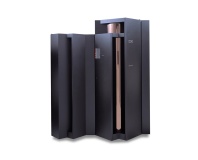
The IBM Aquasar uses a watercooling system running at between 60 and 65°C to keep the server cool and the building warm.
IBM has teamed up with the Swiss Federal Institute of Technology to develop a supercomputer which requires far less cooling than ever before – and uses its excess heat output to warm the building to boot.
As reported by
CNet, the impressively named Aquasar supercomputer – which is based around a pair of IBM's BladeCenter servers filled with a mixture of traditional Intel Nehalem-based processors and the rather more exotic IBM PowerXCell 8i – is predicted to offer a not inconsiderable 10 teraflops of processing power to its users.
With so much power cramped in a pair of racks, heat is a concern – but here's where things get clever. Rather than the traditional high-powered HVAC systems required by standard supercomputers – systems which have a high power draw and significantly increase the cost of running such a system – the Aquasar uses a watercooling system to keep things ticking over.
While watercooling is nothing new, the way the system works is something a bit special: the water used isn't actually chilled, but instead is introduced into the system at a temperature of 60°C. IBM believes this will be sufficient to keep the processors below their maximum operating temperatures of 85°C.
By dispensing with traditional chilling systems, IBM believes that its new system will use upwards of 40 percent less power than traditional supercomputer rigs. Further savings – both monetary and environmental – are made by using the by now quite toasty water, which leaves the system at around 65°C, to heat the building in which the system is installed.
The new system – which further increases efficiency by using a system of jet impingement cooling where the water actually makes direct contact with the surface of the chip – will use a sealed-loop system containing around ten litres of water, which will be pumped through the system three times every minute. A heat exchanger will deliver the excess heat directly to the university's existing heating system without compromising the sealed loop.
Fancy the thought of heating your house in winter via your Folding@Home farm, or does the entire concept of a watercooling system that runs at a whopping 60°C seem madness? Share your thoughts over in
the forums.

26 Comments
Discuss in the forums Reply...someone put the kettle on...
Good idea
The rack itself will heat the water to 60'C without too much trouble from nothing anyway - just lower the flow of the water. Even if they did use a kettle, don't forget you'll only have to heat the water to 60'C once too - it doesn't go off every night like normal computers.
Clever idea really - in summer when the heating's off they can just keep exchanging the heat with the giant heating system anyway, so no worries about overheating!
Google have been pioneering things like this for a while now, basically people realised that you dont need to keep data centers at -20 degrees - I believe Googles' most nerdy datacenter uses an evaporation tower to get rid of excess joules...
They found that more disks went funny if they were kept cold and/or hot, but the longest life was warm.
Or so I remember.
Basically, you didn't need to keep the disks cold was the output.
I find 60C a bit high for a starting point, but they will have tested it to death, and a security will be in place so nothing will fry.
A very good idea.
Exactly my though son :)
So how many normal computers would I need to watercool them all providing enough heat to all the radiators in my house?
:D make one massive loop. 5 i7 OC'd i7 Computers, attached to 1000mm radiators, and a huge waterpump. Sorted :) Well, bye bye heating bills, hello electricty :S
The water is 60C, not the processors. You've got to keep in mind the CPU-water temp delta. Granted, assuming their system doesn't royally suck, their delta shouldn't be anywhere near high enough to matter.
As for the system itself, 10 TFLOPS seems kind of... low...
Seriously, there are plenty of enthusiasts out there that approach half this computing power on video cards alone.
Our data centre is used to heat the building too :)
Of course we'll all be living in arcologies by the time that happens...
P
Nice initiative though.
In the colder day around here I'll leave my computer on (running a 75% with Fold@home) to keep warm
Oh yeah! Awesome :D
I used to heat my room using my computer, but now that I have to pay my electricity bill and heating is included, I switch it off as much as possible!
Remember that gas heating is more efficient than making your computer waste energy (in terms of kW per £) if you are paying for both though!
Sorry to rain on your parade with nitpicking, but the pressure you would need would be much higher than what the blocks you would use would be rated for. Surely?
Tell me about it! My uni room was unbearable most days. 4870X2 and an OC'd Q9550 kept my room very toastie when it ran through my push-pull BI GTX 360. Since it is all in a Cosmos S as well, the heat is literally dumped right into my room with minimal chance to cool down or dissipate first.
I remember my little brother thinking that water cooling would make my room cooler, since the cooling was better. Clearly he didn't think it through before he said it :P
If your computer is in your room, where would the heat go other than heating your room!?
Yes but a 1KW PC should produce 99% of the heat as a 1KW electric fire and your computer can do other things in the meantime. The only problem with this is that you are perhaps losing more money in shortening the lifespan of the components than form electricity however as enthusisasts this might not matter so much. :p
If you have a 1kW computer and leave it on for an hour, you are paying the electricity company for the gas to produce 1kWh of power- which is probably about 2kWh of gas-burning, plus their staffing costs plus infrastructure costs.
If you use your central heating to produce 1kWh of heat, you're just paying for 1kWh's worth of gas, plus a bit on infrastructure.