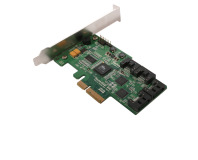
EVGA claims it will continue to test the Silicon Image SATA 6Gbps chipset to check if there is bandwidth issues and whether using it is really worthwhile. Gigabyte and Asus will feature it at launch.
COMPUTEX 09: In discussion with EVGA this afternoon we asked why, considering the company is a leader in the latest fastest technologies, the company wasn’t combining the latest X58 and P55 motherboards with SATA 6Gbps.
EVGA replied it had looked into the first generation Silicon Image chipset but reckons that since it’ll be only connected via a PCI-Express x1 interface, it’ll likely be bottlenecked.
Not only that, but the SATA 6Gbps specification was only recently finalised, so there will be no products to take advantage of it for a while yet and the benefit versus cost to end user is limited for now.
With only Silicon Image launching a SATA 6Gbps chipset for now – and we’ve not heard any other chipset in the works yet – it’s likely to be somewhat expensive.
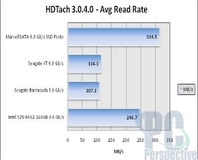
With only SSDs realistically pushing the limits of the SATA 3Gbps specification, but no SSDs yet committed to the 6Gbps spec, we can certainly see EVGA’s reasoning - especially if the claim of a performance bottleneck is true.
We’ll be sure to test it when the boards and hard drives are available. Until then, discuss it in
the forums.

Well, it's not hard to work out: a single PCI-E 2.0 lane can carry only 500MiB/sec in either direction. 6Gbps is 750MiB/sec. Even if it doesn't theoretically reach that, it's still likely to be higher than the single PCI-E 2.0 lane can carry.
Fair play to them, in all honesty. It would only serve to drive the price up, and if you can really afford an SSD that can challenge the rate of 3Gbit SATA, then you shouldn't have an issue purchasing a 6Gbit SATA controller, that sits in a 2x/4x interface. :)
If I could afford a large SSD that would max out my SATA II connections, that'd be great - but I know it won't happen for a few years. :)
That's exactly why. SATA2 and SATA3 are incorrect names that people just made up to coincide with the release version, and such a naming scheme is exactly what SATA-IO didn't want. Officially, they are called SATA 1.5, SATA 3 and SATA 6 so that there is no confusion when it comes to transfer speeds.
SATA II Misnomer
Of course, the motherboard manufacturers are seriously to blame for that, then - my SATA 3Gbps ports are all labelled 'SATAII' or 'SATA2'. ;)
Just a shame that X58 will no longer be a mainstream/enthusiast board by then.. thanks Intel :(
I'd say 6 Gibibit/s is their *maximum* theoritical bandwidth, and so that doesn't imply that they will use all of those bandwidth. How fast are the current fastest SSD throughput? 250 Mebibyte/s? If so, that single-lane would be sufficient (at least for now).
made the above before finding the link below
http://en.wikipedia.org/wiki/PCI-e
even in full duplex its 512MB/s (256MB/s each way), so its not any faster then SATA 300 bit slower in fact (why you norm find that raid cards are norm 2x or 4x PCI-e cards)
Edit
Ops i forgot about PCI-e 2.0 spec it is double the PCI-e 1.0 spec (still need to be PCI-e 2x or 4x thought if its connected via 2.0 spec, as one SSD drive could max it out next year)