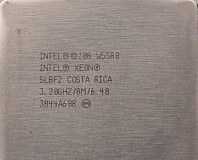
Intel yesterday demonstrated the next step forwards its Xeon CPU line will take with its eight-core, 16 thread Nehalem-EX processor.
The chip giant said that Nehalem-EX will enter production later this year and will feature eight cores, 16 threads and a whopping 24MB of cache packed into a mere 2.3 billion transistors manufactured using Intel’s 45nm high-k metal gate process technology.
In addition, Nehalem-EX will add new reliability, availability and serviceability (RAS) features, such as Machine Check Architecture (MCA) Recovery, which is traditionally only found in Intel’s Itanium family of CPUs.
There are also four high-bandwidth QPI links, enabling up to eight processors to work together in one system for a total of 128 threads.
Intel set up a demo with IBM to show 128 processing threads working in one system – you can watch that demo below, where all 128 threads are pegged at 100 per cent utilisation. The company also said that scalability to 32 sockets was also possible, but this hasn’t been demonstrated yet.
Discuss
in the forums.

16 Comments
Discuss in the forums ReplyIt may be needed for high performance computing and such "pro" stuff. But I hope it never comes in our everyday desktops cause I'm gona go nuts.
BTW I think the link to the thread in the forums doesn't work.
Except for McLaren, who seem to be running their simulations on Wiis, given their performance this season.
As I sit here waiting 20minutes for a single frame render, I am desperately crying out for more threads...
Gimme Intel?
lolololol, awesome!
it may have limited applications for desktop users bit where cgi, simulations and any heavy calculations are required in supercomps, this kind of technology will always help things along.
peace
fatman
Have to say I had said to plenty of people that for the average person quad cores are more than they need and I stand by that.
Still, me want. ;)
Simple answer: No. They're getting very close to the wall on how high they can make a single core run. But with die-shrinking going on all the time, they can still satisfy Moore's law by doubling the cores on a processor instead.
And that's why multithreaded development is the next big thing in computer programming these days.