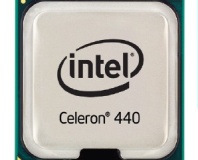
Intel's new logos are joined by a five-star rating system designed to simplify comparisons between chips.
Intel's new logos have officially launched, but the company has also used the rebranding exercise to introduce a much-needed user-friendly rating system for their processors.
As reported over on
CNet, Intel's new logos for each of its chip models – including a newly-designed generic “
Intel Inside” logo – went live on the 1st of April. What is only now becoming apparent, however, is that the company also took the opportunity to add a simplified rating system to make it easier for end users to differentiate between different chip series.
Based around a simple five-star system, the company will include a rating with every chip sold – with five stars being the best possible performance out of Intel's chip ranges, of course. Although the rating system will be used to differentiate between chip models in a particular range, it's main purpose is to help the not-so-tech-savvy end users differentiate between chip ranges such as the Core i7 and the Atom.
In a statement from Intel, Bill Calder said that the plan was to offer a metric to allow consumers to “
go into a Best Buy store [and] distinguish between Centrino, Core, Celeron, Core 2 Duo, Core 2 Quad.” Calder also explained that Intel is embarking on a “
pretty aggressive brand simplification plan” that will see its main commercial brand switched to the Core, with each series under that brand – Core 2 Duo, Core 2 Quad, Core i7 – being given a 'modifier' to differentiate.
Although the move goes some way to offering an easier way for your average retail customer to get a handle on relative performances, it still offers no easy way to compare and contrast chips between manufacturers – and with AMD and Intel unlikely to agree a measurement metric, that's a problem that is unlikely to change any time soon.
Do you think Intel's five-star rating system is the way to go, or should both AMD and Intel agree on a standard benchmark suite and use the scores from that – giving an easy way to compare processor performance between manufacturers? Share your thoughts over in
the forums.

will a game run better on a 3,5Ghz dual core or a 2,0Ghz quad core? it depends on the game. will my internet experience differ between a 2,5dual and a 2,5quad core? No, it will most probably not.
is there a better chip? no there is not. in this time and age, it all depends on what you want to do with your chip. an objective way to measure a chip in any scenario, counting in any other features (bus width, cost, power usage, hardware monitoring, executable bit thingies, ...) , will be so cumbersome and only readable by those who know their way around in the hardware scene anyway.
and no one of those companies want the other to be able to say 'my chip is the best', even by those cumbersome standards.
i hope i made my point clear, despite my less-than-perfect(read: bad) English.
alpaca
What Intel needs to do is to produce a continuous rating system for its chips however thats not going to happen because then consumers would buy less of the very top end when they work out the bang for the buck.
Do all the previous cpus get demoted a star? (could cause confusion if there is still older stock in the store)
Does the new chip get a 6th star (assuming it's the faster processor.)?
what happens when a new proc comes out which sits between 2 of the current ones? (half a star?)
they should rate their CPU within each class, eg: Q9000 gets 5 star from Core2 class, while CoreI class gives 4 stars for 920 and perhaps 3 stars for the i5 CPUs
True, but the same could be argued for the EuroNCAP crash tests awards, a 5 star car of 3 years ago, is not as safe as the latest 5 star car, due to changing test procedures.
I think that, it is a pointless endeavour, as most people who buy pre-built computers, turn off after reading Intel 'Core' etc, and instead concentrate on screen size, hard drives etc.
The people who build or spec their own PCs, will continue to use review sites and the enthusiast community to influence their purchases.
Anyway you can tell that the 5-star chips are all going to be the extreme editions.
I would expect people to think that way... but then again you could equate stars to $$$ (or local currency symbol of choice). You want 5 stars than it's going to be quite expensive. You want a cheap system then it is going to be 1 or 2 stars. Non PC people shopping for their first (or replacement) system usually go in with a budget in mind already then try to find what they can get for that price.
Like CD drives? 16X, 20X, 32X, 48X, 52X ? Makes sense. As faster stuff comes out it just bumps up on the scale.
Although how do you actually determine a ranking? How fast the machine can count to a billion? How well it handles a given application? What if the applicaiton is multi-threaded? or not? A quad core isn't going to help with an app that doesn't understand cores and/or threading and thus may appear slower than an older higher ghz single core CPU. I think Intel's idea has potential but there are a lot of unknowns that are going to make it difficult to implement with the current offerings and even more difficult as new stuff comes out.
It depends on what sort of boundaries and criteria they use to rte the chips really.
If there are just going to have the one system then I agree it could be very ambiguous. I suppose the old Core Extreme Q97(whatever) would probably be higher than the Core i7 920 in this ranking too, when I would much prefer the i7.
Something else that might be useful would be a power (electrical) rating too.
Well AMD 'll follow up and rename as well and nobody will be any wiser for it.
*Bored*
It's already classed out
I know that a Q6700 is better than a Q6600 because of the numbers, even a noob could find that out