VIA has just stepped into the HD netbook debate by announcing its VX855 MSP (Media System Processor), which the company says can bring 1080p video playback to small devices such as netbooks and small form factor PCs. The VX855 features full hardware acceleration for a number of video formats, including H.264, and VIA claims that the chipset only uses 2.3W and doesn’t require a fan either.
VIA’s vice president of marketing, Richard Brown, commented on the new chipset, saying that
"for the first time, system developers have an ultra low power media system processor that delivers high bit-rate HD video to small form factor and mobile devices." He added that
"the VIA VX855 opens up exciting opportunities for several PC segments, particularly the mini-notebook category that will now be able to offer true 1080p HD video playback."
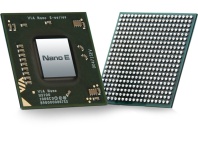
Unlike Intel’s standard Atom chipsets, which features both a 945-based Northbridge and a separate Southbridge, the VX855 integrates the features of a usual Northbridge and Southbridge into a single package that measures just 27mm x 27mm. VIA points out that this “saves over 46 percent of silicon real estate compared with competing twin-chip core logic implementations.”
The VX855 can control VIA’s Nano, C7 and Eden processors, and also features a PC2-6400 DDR2 memory controller that can handle up to 4GB of memory. The chip also features an integrated VIA Chrome9 DirectX 9 graphics processor and a VIA Vinyl Audio HD sound controller. The latter supports up to eight channels for full 7.1 surround sound, as well as a sample rate of up to 192KHz. Meanwhile an EIDE controller enables connection of up to two storage devices, and the chip supports up to six USB 2.0 ports too.
Last month, Intel dismissed Nvidia’s claims about the HD video trancoding capabilities of its Ion platform in a document called
Nvidia Ion Competitive Positioning Guide. The document claimed that
“neither gaming nor video transcoding are relevant to Netbook and Nettop users,” and also pointed out that Intel intended to address the lack of hardware acceleration for HD video decoding in its Atom chipsets with the forthcoming Mobile Intel GN40 Express chipset. In the meantime, however, only VIA’s VX855 and Nvidia’s Ion platform currently offer HD video playback on comparably small platforms.
Is 1080p video decoding a worthwhile feature on small devices such as netbooks? Let us know your thoughts in
the forums.










Want to comment? Please log in.