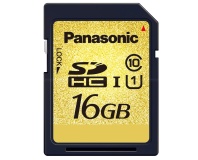
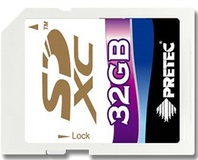
The 32GB SDXC card is a world first for Pretec - and will soon be followed by sizes up to 2TB.
The format war is back again – but this time it's solid state, rather than optical, storage that's in the firing line as SDHC sees stiff competition from newcomer SDXC.
According to an article over on
I4U, flash memory specialist Pretec has taken the wraps off what it claims is the world's first memory card based around the new Secure Digital eXtended Capacity format. Designed as a drop-in replacement for current SDHC-based systems, the new technology takes over where the current leaves off: where SDHC maxes out at a not-inconsiderable 32GB, that's where SDXC
starts.
The SDXC technology – of which the 32GB offering from Pretec is but the first implementation – promises to scale to 2TB without breaking out of the SD form factor, and has data transfer speeds of 50MB/s jumping to 104MB/s “
in the future,” according to Pretec. The SDXC standard itself promises to hit 300MB/s before theoretical limitations stop being quite so theoretical.
While the form factor is the same as the SDHC – and SD – cards before it, the good news stops there: SDXC is completely incompatible with both SD and SDHC-based systems, and will require specially designed hardware to take advantage of the increased speed and capacity it offers. Software implementations will need to be updated too: while SD and SDHC both used the FAT32 file system, SDXC uses Microsoft's proprietary exFAT as standard.
While the increased storage capacity is welcome, the new format could well see a challenge from SDHC in the near future: while the current specification is limited to 32GB, this is an arbitrary figure in the SD 2.0 standards documentation. Should this limitation be removed in future revisions of the standard, there's nothing to stop SDHC also scaling to 2TB – albeit without the speed boosts offered by SDXC.
Does the thought of a 2TB SD card with a 300MB/s read/write speed in your camera fill you with joy, or will it take more than that to tempt you away from good old Compact Flash? Share your thoughts over in
the forums.

19 Comments
Discuss in the forums ReplyI digress, a free file system would be preferable.
I somehow don't think TomTom will be using >32GiB of space any time soon, however.
so then why use the same form factor? is it to fool idiots into buying it, thinking it will work in their stuff, when it wont?
If you buy a new camera, imagine how ticked off you'd be if you couldn't use any of your old memory cards.
Examples were camera writing to it near future can write at 300mbs but that when the camera or even card reader in the pc would still transfer at standard usb speeds.
When I asked all their sales reps, they sent me to the tech's and engineer on hand, who had no answer. Their only answer was they were really marketing at the new HD cameras that take crazy sized hd video; and the new 3d cameras that use more than one capture feed. While enabling the cameras to save enough data fast enough, and have enough room, they were not so forward thinking on how to get that data from the camera to the pc. While the cameras capable of doing said things are corporation level expensive, they will leave the camera transfering tech to the camera people.
NOW ON THE OTHER HAND;
I seem to remember a small drive the size of a notebook hard drive that had 4 slots for sd cards. imagine using 4 of these new xd cards, on one side, and as the current nice feature use a second controller to provide effective raid to 4 more cards on the reverse side, 16Tb flash drive FTW!
Its not like we'll be getting them in 2TB capacities any time soon, its just the format that supports that as a max capacity.
Proprietary? Why, oh why?
Did I miss somthing?
NTFS/FAT32/FAT have been supported for some time. FAT64 (exFAT) is new.
Then you can have Installable File Systems (IFS) that range from ext2 to HFS+, etc.
And they were meant to be on WinFS by Vista, but that never happened. :)
uh, no ****? thats a limitation of USB2, hardly their fault
you'd need an eSATA card reader or some other interface
If anything the new standard on cameras is that every brand/model/type has two slots. I would love to have a redundant backup on camera (I know some pro cameras have this, but who wants to spend $6k on a camera, other then Vers ;) )
Long live CF! :D
Could easily back up system to multiple cards and throw it in a fire proof safe or carry off site.
Even better as an array to back up the entire system. Just a fear factor of "misplacing" a $600+ card with all your data. Must Encrypt!