SanDisk shrinks to 32nm

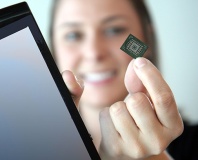
The new 32nm X3 technology will allow for chips carrying 4GB of data each to be squished into a microSD form factor.

While Intel has been grabbing the headlines recently for being one of the first chip makers to introduce a 32nm process, it's not the only game in town: flash manufacturer SanDisk is looking to move its products to a 32nm die size by the second half of 2009.

As revealed over on ExtremeTech, the solid state storage specialist is hoping that a die shrink to 32nm will allow it to make “higher capacities of microSD cards” than was previously possible, according to executive vice president of SanDisk's OEM business unit Yoram Cedar. The 32nm chips will each be capable of storing 4GB – or 32Gb – of data, and are ideally suited to the cramped form factor of a microSD card.

While the 32nm die size products – codenamed X3 – are attention-grabbing in and of themselves, the company also has another trick up its sleeve for release some time in the first hal of this year. Dubbed X4 – unsurprisingly – the companion technology to the die shrink allows for four bits to be stored in a single cell. Based around the company's current 43nm die size, the X4 technology would allow storage of up to 8GB – 64Gb – on a single die.

While the capacity – and die size – is impressive, the need for additional error correcting code and specialist memory controllers common to both the X3 and X4 chips means the speed – while perfectly nippy – isn't anything mindbending: the X4 chips will write at 7.8MB/s while the X3 units can expect a slightly more sedate 5.6MB/s.

The company has not yet announced any firm products based around either technologies, but has presented technical papers on both at the International Solid-State Circuits Convention in San Francisco earlier this week.

Hoping to see some 4GB microSD cards – and larger – or has the day of the removable flash memory card been and gone, replaced with permanently attached SSDs and miniature mechanical hard disks? Share your thoughts over in the forums.

Quote Spaceraver 12th February 2009, 14:12
If they use the tech in SSD's it would be good.. And we might have cheaper SSD's.
Quote DougEdey 12th February 2009, 14:16
I'm confused, SanDisk already have 16GB MicroSD cards...
Quote Gareth Halfacree 12th February 2009, 14:20
Quote:
Originally Posted by DougEdey
I'm confused, SanDisk already have 16GB MicroSD cards...
Multiple dies per card. This allows fewer dies, which means lower costs and power usage - or, alternatively, the same number of dies but more storage.
Quote DougEdey 12th February 2009, 14:56
The article is a bit misleading then because the last paragraph states:
Quote:
Hoping to see some 4GB microSD cards – and larger – or has the day of the removable flash memory card been and gone, replaced with permanently attached SSDs and miniature mechanical hard disks? Share your thoughts over in the forums.

Which states that 4GB and larger microSD cards are not currently available...
Quote Gareth Halfacree 12th February 2009, 15:09
Quote:
Originally Posted by DougEdey
Which states that 4GB and larger microSD cards are not currently available...
Ooopsie - you're right, I made a mistake when writing that bit.
Quote n3mo 12th February 2009, 15:49
Hell, yeah, filling 64GB with 7.8MB/s. ~140 minutes if my mind is right. Twice that with small files.
Quote B3CK 12th February 2009, 19:21
So I take it, this is where the SanDisk "XD" series will be coming from? Or are those going to increase to beyond 2Tb with this new die change?
Quote Furymouse 12th February 2009, 20:32
Anybody else think that this is the future of media and game distribution? At least until high speed internet becomes widespread.
Quote spectre456 12th February 2009, 21:37
Quote:
Originally Posted by Furymouse
Anybody else think that this is the future of media and game distribution? At least until high speed internet becomes widespread.

i doubt, a disc is still cheaper to manufacture than those SD cards. besides, they are so easy to lose.
Quote HourBeforeDawn 12th February 2009, 23:16
well this certainly looks promising, I hope it also gets applied to the SSD market as well.
Quote DXR_13KE 13th February 2009, 01:02
these + the pandora.... WEEEEEEE!!!!!!
Quote iwod 13th February 2009, 02:21
I am sure the Speed is incorrect for the SD Card Part, Since you would combine mutiple chip into one SD card meaning we should get 10 - 14MB/s.....

And why are manufacture concentrating on capacity? I have always think capacity is nearly a non issues with die shrink. ( Next Gen would offer what most people needs today )

But speed is still slow. We need Fusion-IO speed at less capacity, 30 - 80Gb and a reasonable price....
Quote The_Beast 13th February 2009, 04:16
very cool but the speeds are a tad slow (I'd rather have more speed and the same capacity)
Quote Kode 13th February 2009, 09:40
Quote:
Originally Posted by Gareth
storing 4GB - or 32Gb - of data
and
Quote:
Originally Posted by Gareth
would allow storage of up to 8GB - 64Gb - on a single die
why are you stating the Gigabits that these cards can hold? It seems completely irrelevant to me, as people who know the difference between bits and bytes will already know how many Gigabits this will store based on the amount of Gigabytes, those that dont will just be confused, and as i said its irrelevant anyway, noone expresses storage in bits, admittably it would sound more impressive to say i have 32 Terabits of storage on my HTPC. Just wondering if there was a specific purpose?
Quote Gareth Halfacree 13th February 2009, 09:44
Quote:
Originally Posted by Kode
why are you stating the Gigabits that these cards can hold? It seems completely irrelevant to me, as people who know the difference between bits and bytes will already know how many Gigabits this will store based on the amount of Gigabytes, those that dont will just be confused, and as i said its irrelevant anyway, noone expresses storage in bits, admittably it would sound more impressive to say i have 32 Terabits of storage on my HTPC. Just wondering if there was a specific purpose?
I wrote the article, not Harry - and I quoted gigabits because that's what SanDisk quoted. I converted the figures they provided to gigabytes for clarity.
Quote Kode 13th February 2009, 09:52
Fixed the quotes Gareth, dont know where i got Harry from, i think from your surname, im still only half awake, lol.
SanDisk quoted in Gbits? Thats very odd, im still not really sure what the point is as you can get 8GB SDHC cards for like £10, have you got a link to the actual SanDisk statement rather than the extremetech article?
Quote Kode 13th February 2009, 09:55
its ok i found it: http://www.sandisk.com/Corporate/PressRoom/PressReleases/PressRelease.aspx?ID=4505 is it just me that thinks its really bizarre to use Gb when dealing with storage sizes?
Quote DougEdey 13th February 2009, 10:06
They always quote in Gbits, same as all solid state/flash memory always quote in Mbits, it's a number which sounds bigger and will probably sell more.
Quote Kode 13th February 2009, 10:14
Really? only time ive ever seen bits used is in transfer speeds, never for capacity, cant have been looking very hard obviously :) Btw, hope it didnt sound like i was having a go Gareth. Re-reading my post i might have come across like that, it wasnt intentional. I really was interested in why it had been quoted. One small criticism though, why quote extremetech(dated 11th) rather than the sandisk press release (dated 10th)? However i do enjoy reading about this kind of thing so keep up the good work, i generally flick between here and dailytech for my daily intake of tech news :)
Quote Kode 13th February 2009, 10:22
Doug do you mean in press releases or on products? because looking on line they all seem to express capacity in bytes, even the picture for this article, the front of the card states 2GB, granted it was only a quick look though.

*edit* I have to say though that Scan are very poor at doing their titles, they mix and match Gb and GB though when you click through they actually mean GB each time
Quote DougEdey 13th February 2009, 10:23
it's always in press releases and if you look at the physical chips themselves it says it in bits not bytes, that's because during storage the data is actually encrypted in 8b10b encryption (every 8b code gets translated to a 10b code) which allows for better data recovery and provides coverage incase a bit or two gets corrupted/flipped at any stage of its life.
Quote Kode 13th February 2009, 10:26
the physical chip in the picture above says bytes, as does every SD card i own (6), every SDHC card (2) and 1 CF card, unless im missing your point?

*edit* http://images.google.co.uk/images?hl=en&q=sd+card&gbv=2 i cant see a single card in that lot that states the capacity in bits rather than bytes, granted ive only had a quick look through the first couple of pages
Quote DougEdey 13th February 2009, 10:37
That's not the physical chip, that's a casing around a circuit board which has the physical storage chip on it.

top right of the chip 716 is the model 7 = family, 16 = Gb size http://regmedia.co.uk/2007/04/30/sams_16gb_1.jpg
Quote Kode 13th February 2009, 10:45
right, i understand what you are talking about now, but you dont buy a chip without the casing. Anyway, thanks for clearing up some of the confusion, although i still think the press release is misleading stating a capacity in Gb when it will be sold to the consumer in cases stated in GB
Quote DougEdey 13th February 2009, 11:18
The press release is aimed at resellers, the reason that it's put here is because this is a technical website, I suspect it would normally be placed into the Press Release section of the forum but it was decided not to due to the change in manufacturing process to 32nm which reduces the cost significantly as you can produce more off one die.
Quote nicae 17th April 2009, 18:05
I spent over 20 minutes filling up a Kingston 2GB microSD. Quite a while.
But I wouldn't mind. The true problem is my phone, taking 2 minutes to build up the music library and another 60 seconds to filter the songs by genre, artist, etc. Can't wait until our phones are PCs!
Quote Ending Credits 17th April 2009, 22:52
Quote:
Anybody else think that this is the future of media and game distribution? At least until high speed internet becomes widespread.

There's an article on here somewhere talking about Micro SD cards to replace music CDs.
Quote kirsten 21st September 2009, 21:06
this is true - <a href="http://www.gomemory.co.uk/memory/micro-sdhc.html">micro SD memory</a> cards are to be introduced as a new means of musi distribution. It has been tested a on a few music albums in Japan but yet to arrive in Europe or the US at any scale.
Quote kirsten 21st September 2009, 21:07
Quote:
Originally Posted by kirsten
this is true - micro SD memory cards are to be introduced as a new means of musi distribution. It has been tested a on a few music albums in Japan but yet to arrive in Europe or the US at any scale.
Log in

You are not logged in, please login with your forum account below. If you don't already have an account please register to start contributing.