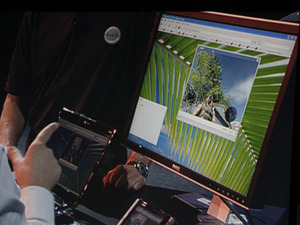
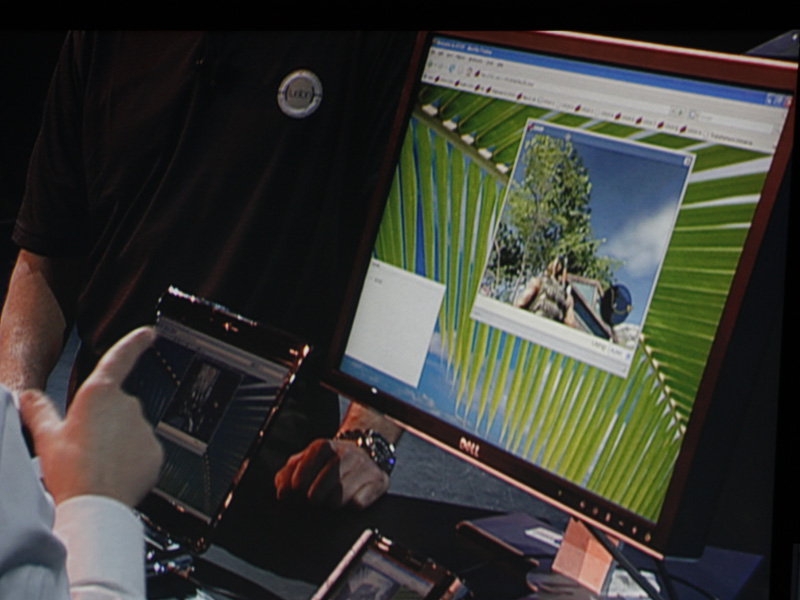
AMD President and CEO Dirk Meyer demonstrated the next era of cloud computing, the HD Cloud, during his keynote address at CES.
CES 2009: AMD President and CEO Dirk Meyer demonstrated the next era of cloud computing, the HD Cloud, during his keynote address at CES.
Meyer introduced the Fusion Render Cloud reference design, a GPU super computer designed to break the one petaFLOPS barrier with more than 1,000 graphics processors.
"
We anticipate it to be the fastest super computer ever and it will be powered by OTOY's software for a singular purpose: to make HD cloud computing a reality," said Meyer. "
We plan to have this system ready by the second half of 2009."
The Fusion Render Cloud will break one petaFLOPS with a tenth of the power consuption of the world's fastest super computer today and it requires a significantly smaller footprint than a conventional super computer - it will fit in a single room rather than requiring a whole building. What's more, the Fusion Render Cloud will be upgradeable unlike virtually any other super computer so AMD anticipates further increased performance in the future.
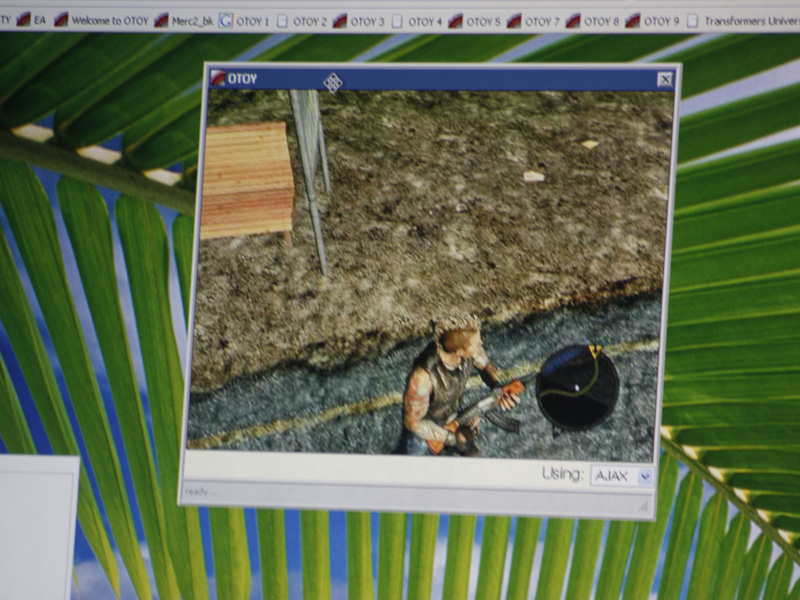
That's all well and good, but what would you use a 1,000+ GPU super computer for? Well, it's designed to run HD content over the Internet (or cloud) through your web browser. Meyer demonstrated full-resolution Blu-ray movie playback through a web browser before moving on to show
Mercenaries 2 running without any lag whatsoever in the same web browser.
The demonstration was polished and impressive - it's possible to move the browser window around while playing the game without any adverse effects on the gaming experience. That has little to no real world use, but it was designed to prove that it wasn't just a canned demo being shown.
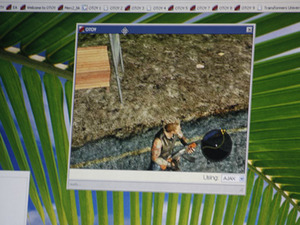
Click to enlarge
Meyer invited Richard Hilleman, Chief Creative Officer at Electronic Arts, on stage after the
Mercenaries 2 demo. "
At Electronic Arts, we have been lucky enough to be a part of the creation of a number of changes in the world of personal computer gaming. From the first PCs to CD gaming to the advent of Internet gaming, we have embraced each new evolution of technology as an opportunity to bring new experiences to our customers," he said. "
OTOY and AMD are at the cutting edge of thin client gaming, and we look forward to the new customers we can reach and the new interactive expressions that emerge from revolutionary technology like the AMD Fusion Render Cloud."
There's no denying this is a massive step forwards for cloud computing, but we have a few concerns - the biggest is that there was no details on how much bandwidth the HD cloud will require to achieve experiences like this through the cloud. The demo was run across a wired network and not through the Internet which makes us wonder just how steep the requirements are. Nevertheless, that doesn't take away from how impressive this demo was.
Discuss
in the forums.

That thing plays crysis FOR me?
Sounds good to me. will be like a guarantee that everyone can play the latest game from a tiny thin client terminal hidden in a desk or even monitor.
Did they mention what resolutions were possible over ADSL?
What impact that'd have on my electricity bill!!! Holy s***!
I think I want it. Even if it means back to gaming at 'low resolutions'. ;)
Firstly, no more cheating in games since you're just sending key+mouse to them and getting video back.
Secondly, a standard platform so game devs can spend less time bug-hunting and play-testing and just concentrate on getting the game to actually be any good.
Thirdly, solves the piracy problem pretty much, meaning the game devs have nothing else to blame when their crap game doesn't sell.
This could also lead to a reasonable pay-per-play model and make game demo's worthless.
They could just give you 4 hours free play to let you work out if you liked it.
Lots of potential but a worrying amount of scope for devs to abuse it to milk their customers. :(
I think Japan has a 100Mbit service available, however, the same applies it's simply not enough. And if they had 1000 users wouldn't that still be like having one graphics card per computer? Not to mention lag issues and video compression which is my main concern. To deliver me uncompressed video at the same quality I can produce on my desktop would require sending me 5-15 TB of data in only several hours. I run 1900X1200 and I'm not giving up a single pixle to mpeg, snipeing would be impossible!
All that said I would greatly appreciate being able to render my 3DS max stuff on it.
Now you and I know you could mostly secure it using encryption but execs tend to have the tech smarts of a mammoth and tbh i'd like to keep sony as far away from the IP spec as possible.
Which, kinda defeats the point of the whole thin-client concept... :D
ie, the render-cloud would be doing the work of a standalone bluray player and the thin client would be acting like a TV?
I can see mclean's point. If you have to decode the stream, you'd rather not waste all that bandwidth... at least I wouldn't.
You could in theory offload the first task to a cloud computer, but there are a couple of heavy drawbacks. First, home broadband in most places (certain inner-city regions of Sweden, Japan, South Korea etc. are the exceptions) are nowhere near ready to take on streaming 1080p video at Blu-Ray bitrates. Secondly, I really can't imagine movie studios lining up to let their precious intellectual property be streamed over the web with no encryption. Thirdly, although the processing power required to decrypt AACS / BD+ in software is not insignificant, as far as I understand, it is much less demanding than the decoding of high bitrate VC-1 / h264 video. Most new graphics cards will happily offload the decoding process, and the decryption and decoding can be handled very efficiently with dedicated hardware as found in consumer Blu-Ray drives. The point is that the capability to decrypt and decode high bitrate protected content can economically and easily be incorporated into any form factor that needs it, so the idea of offloading the processing to a cloud seems rather pointless!
Seems retarded to do that.
I thought the whole point of bluray, HDDVD etc was to allow HD content without the need for compression?
Anyway, I see your other points.
I never said it was a good idea, just that it was a nice concept.
I do still think we'll move more towards online distribution models as internet speeds get faster. :)
What we were talking about was the fact, that you'd have to compress it after it has been decrypted by the cloud to be able to send it to the client without the need for a 3 Gbps connection. And that the client then would have to de-compress that which might require a pretty beefy CPU thus killing the whole thin-client idea.
Uncompressed, the movie needs 1920 x 1080 x say 32 bits per pixel = 66,355,200 bits per frame = ~8MB per frame. At 24 frames per second, a 2 hour movie contains 86,400 frames, so that's 691,200 MB at 8 MB per frame. So you're looking at about 675 GB (1,024 MB in 1 GB) for an uncompressed movie. You need to compress it by a factor of 13.5:1 to fit on your dual layer Blu-Ray. Lossless compression generally gets nowhere near this, and in fact you need to compress it more than that because you have to leave room for audio and extras etc.
Lossy compression using a modern codec such as VC-1 or H.264 generally provides excellent results at a significantly better compression ratio than lossless can achieve.
Maybe for the next-next-gen, when we have multi-TB holographic discs, we'll have the capacity for lossless ultra-high definition video, but who knows?
I don't really think we'll get UHDV anytime soon. 16 times the pixel of 1080p? Would definitely be nice but as HD hasn't taken over the market as a whole by now... And as many people bought silly 'HD Ready' TVs with a resolution of 1024x768 they won't buy a new TV for the next couple of years as they think they're ready for HD. :|
The funniest thing about that is that technically XGA is 'HD Ready'. 768 is enough to fulfill the requirements as it can display 720p.
Seems I got sidetracked...
Here's the video of the demo for those interested. Apologies for the delay. :)
One thing though:
When they show off the live-rendered city it lags horribly. Impressive stuff, sure, but no word about bandwidth. So, again, the question: Do we all have to move to Japan to be able to stream our HD movies?
Streaming video (even HD) over a high speed internet connection to a browser is nothing new. The remote gaming thing is more novel, but I think latency may be a real problem for many games. It's one thing having the common FPS latency thing where if your ping is too high then you shoot people and miss because they aren't where your client software expects them to be (as they have moved but it hasn't updated to your screen yet) - in fact playing a game on Fusion could potentially eliminate that issue - if everyone was playing remotely using hosts located in the Fusion render node, latency between them would be minimal, just like playing on a LAN; but the much more serious issue is that I can't see any way to avoid an unacceptable sluggishness being introduced by the connection latency and the compression (at the server) and decompression (at the client) of the game's graphics for transmission along a broadband line (necessary because even the fastest domestic broadband (say 100 meg) is insufficient to transmit uncompressed video at say 800 x 600, let alone 1920 x 1200).
Don't get me wrong - I'm sure the concept of a GPU supercomputer hosting cloud computing applications has many powerful and useful applications (many of which won't even have been dreamt up by the machine's creators yet), but the idea of running FPS style games remotely through a thin client is total pie in the sky until we have sufficient market penetration of ninja fast broadband (as in gigabit) with near-zero latency.
As a general rule, there is a trade-off between image quality, file size / bitrate, and decoder processing power - VC-1 and H.264 can produce excellent quality at quite low bitrates, but require a lot more processing power to decode, especially when image optimising features are used at the encoding stage, than say MPEG-2, which generally produces lower image quality at comparable bitrates. But for what I would consider Blu-Ray quality HD, you're going to need a reasonably high bitrate as well as some chunky decoding power, either in software running on a powerful CPU (or GPU) or as a dedicated hardware decoder.
I guess the beauty of an "on-the-fly" online streaming service (as opposed to simply pushing the raw HD stream from a Blu-Ray disc down a pipe) is that it would be able to adjust the stream dynamically, so if it detected that there was insufficient bandwidth (say the client reported it was stalling or its buffer was running low) then the server could reduce the bitrate until the buffer was refilled; similarly, if the client hardware was insufficiently powerful to decode certain codecs or certain advanced features or video above a given bitrate, it could adjust the stream accordingly, even reducing resolution if required. So, if you have your super-fast PC on a 100 meg connection, you get ultra-high bitrate 1080p with lots of codec optimisations for ultimate image quality, and you also get 7.1 lossless sound which you can pipe into your surround system; on the other hand, someone streaming to his EeePC over 3G gets a lower bitrate stream (so his 3G connection doesn't crap out) at a resolution scaled to fit his EeePC (no point streaming 1080p if it's only going to be displayed on a 800x480 screen, right?) using a codec that the EeePC can handle with ease; he gets bog standard stereo sound for his headphones. So every device gets a service tailored to its requirements.
Thanks for putting all my thoughts in one post, mclean. It was nice reading exactly what I would've said if I'd had the time. ;)