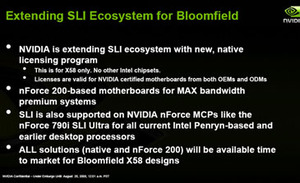
Earlier this morning, Nvidia announced that it was opening its SLI ecosystem up to support Intel’s X58 ‘Tylesberg’ chipset. This is pretty big news and
Rich did a good job of disseminating the information earlier in my absence – I crashed out in a heap before I managed to write anything down after what’s been a long and tiring week.
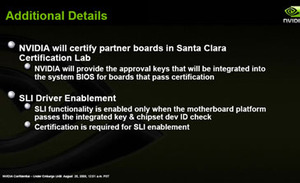
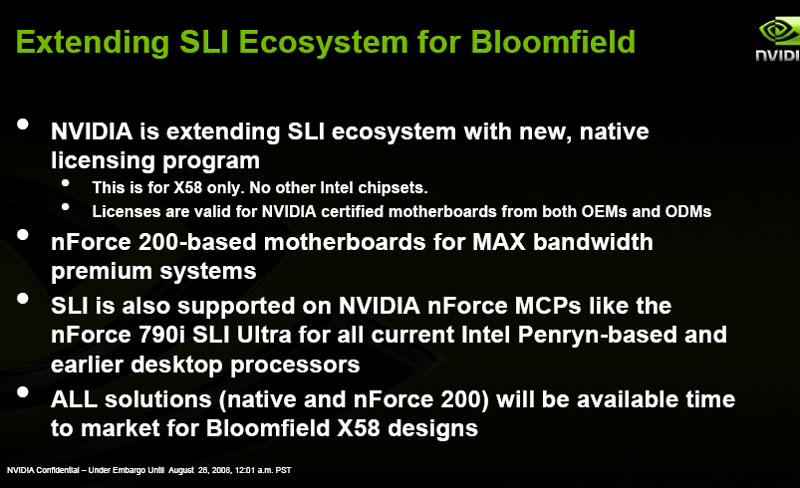
The first thing to note is that Nvidia expects the certification process to be complete on at least a few boards by the time X58 launches. The company’s representatives said the driver work is already done, it’s just a matter of running submitted boards through the certification process at Nvidia’s Santa Clara Certification Lab.
There will be one ‘cookie’ given to each vendor and there will be certain limitations placed on its use – Nvidia wouldn’t answer questions about vendors adding the cookie onto boards that haven’t been through the certification process, but it said logos and branding are a couple of the conditions of use.
So what about if a budding enthusiast manages to extract the key from one or more boards? Nvidia said it wouldn’t do anything to stop enthusiasts enabling SLI support on non-certified motherboards themselves. Tom Petersen, Technical Marketing Director in Nvidia’s chipset business unit, said that he’d be quite happy if enthusiasts did that because it’d mean they’d be using two (or more) Nvidia graphics cards in their system.
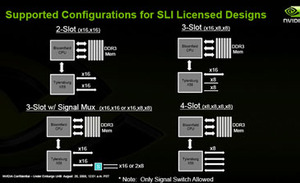 Click to enlarge
He added that the certification process is in place to ensure a great out-of-the-box experience – boards that aren’t certified by Nvidia may encounter problems and it’ll require some BIOS modification on the user’s part. I’m not quite sure how Nvidia will react to custom BIOS files enabling SLI support on non-certified boards being hosted on the ‘net, as the company’s legal team has had a fairly rocky relationship with modified driver developers in the past – things could play out either way here.
I then asked whether Nvidia was planning to support other multi-GPU enabled chipsets from AMD and Intel – sadly, that’s not going to happen any time soon but based on what we’ve been told and that’s a bit of a shame. We’re going one step at a time here though.
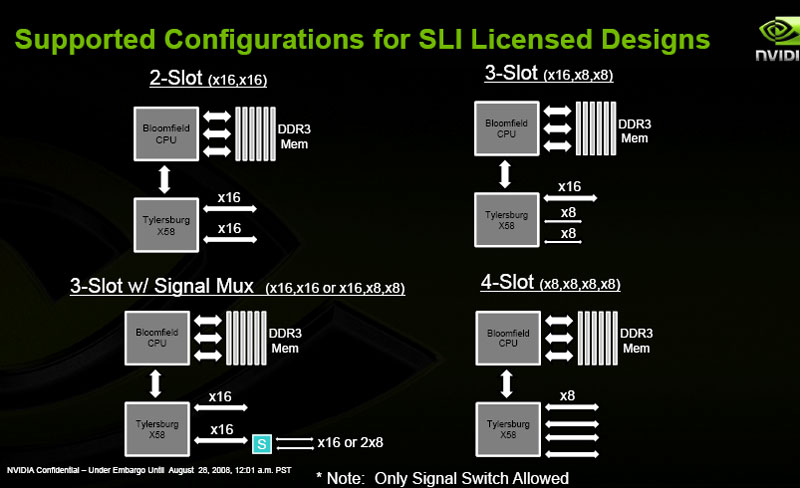
One reason cited by Petersen was that X58 supports peer-to-peer writing which, he says, is almost exactly the same as the PW Short technology it introduced with the NF200 SLI switch chip. As a result, Nvidia is taking advantage of this technology to provide optimal SLI performance on Intel’s next-generation chipset.
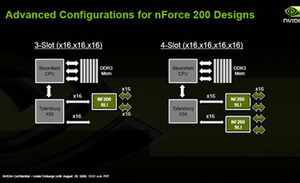
 Click to enlarge
PW Short hasn’t been in every Nvidia chipset though, and SLI still works on chipsets that don’t support the technology – this makes me question what’s actually happening here. On the face of it, what Nvidia is doing is a
good thing and I applaud the step forward it is taking here – but why is it stopping at just X58? It’s undoubtedly down to a combination of chipset sales in other market segments, driver development and the burden of certifying
many different platforms – it’s not just down to the lack of peer-to-peer writes, that’s for sure.
We’ve asked Intel for a comment on Nvidia’s announcement, but we’ve not received anything official at the time of publication. What do you think about Nvidia’s move? Join the continuing discussion
in the forums.













Want to comment? Please log in.