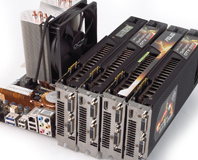
With forty six GPUs running folding@home calculations this is a seriously impressive setup.
Yesterday we
reported that Nvidia had publicly released support for PhysX and other CUDA applications for its 8,9 and GTX 2xx series of graphics cards. It seems that this has certainly caught the attention of Folding@home teams, with the parallel processing power of a high end GPU seemingly far ahead of quad core processor or even PS3 based Folding.
It really shouldn't have come as a surprise to see someone take this new technology and run with it, which is exactly what forum member nitteo has done over at overclock.net.
With
forty six seperate 8 series Nvidia GPUs, mostly 8800GTs and 8800GS' running in a variety of quad, tri and standard SLI set-ups nitteo has created an epic folding farm and he's not done yet, with an eventual target of 51 GPUs!
Even at its current state, the folding farm is able to produce an incredible 265,200 points per day - impressive when you consider that the whole
bit-tech folding@home team have only crunched through 5,999,851 points since the team was created in 2003! In less than a month he's going to overtake us!
Folding@home is certainly a worthier cause to lend all that hardware too than trying to run
Crysis (although we still doubt that farm could run it at 2560x1600 at very high, but that's beside the point) and it's certainly a noble contribution to pay for all the electricity required to power all that hardware - we don't want to think how much all the juice required to power this setup would cost.
If you fancy lending your 8,9 or GTX 2xx series Nvidia graphics card to the Folding@home cause, why not join the
bit-tech team?
Do you think Folding@home is a good use of computer hardware? Or is it just a big waste of electricity and hardware? Will you bother running Folding@home with fuel and electricity costs continuing to rise? Let us know in
the forums.

props to him though
the thing is, i highly doubt the power-to-calculation ratio that farm produces. surely it'd be more effecient to put an IBM's new super computer at work than to use a home-made processing farm. apart from the GPU's stream processors, there's also got to be CPU and hard disk/flash to power.
you mean shouldn't HAVE come as a surprise
*sigh*
The good thing about this is we will probably start to see larger institutions (interested in parallel processed research) building large numbers of these kinds of clusters - given the cheap power of the GPU, and how easy it is to get them fitted into a small space, it'd make a very effective thing indeed, rather than having big clusters of normal PC's.
Correct it, or I'm reporting you to the Grammar Police and they're not a nice bunch of people. I've heard they're now involving some sort of revolving bull as an instrument of torture.
2nd para 'It really shouldn't of come as a surprise' - it's HAVE. HAVE. ffs.
I'm joining that.. I want to be in a team!
i read "folding will cure disease and lead to a brighter future for next generations"
thats not going to happen if the planet dies first though is it
carbon footprint of that rig must be massive
i understand research must be done - the intention of folding is good - but the logistics of it make it a hypocracy
EW!
Too true, too true lol. That must have cost a shed full of cash.
He could have some sort of solar/wind generators in which case they would probably pay HIM some months :)
btw. assuming 13 rigs (52GPUs) with a power draw of 430W each and a price per kWh of 0.1USD his monthly bill for the farm would be about 400USD.
oh and he said that price/performance ratio is way better than using quads. aparently he sold a c2q farm to help with the initial purchase price.
edit: oh and he is running vista
The above can bear repeating. It even irks me, as a foreign English speaker. ;)
On the hand, NVIDIA's client for F@H is a great contribution: take a look at its TFLOP count!
I do seti and folding on the one machine and it would rake me many, many years to get the kind of points that he would acheive in one day..