Industry to start move to 450mm wafers in 2012

Intel, Samsung Electonics and TSMC have collectively agreed to push forwards with plans to move to 450mm wafer production, starting in 2012.

Intel, Samsung Electronics and TSMC have reached an agreement to push forwards with plans to move semiconductor manufacturing to 450mm wafers starting in 2012.

The trio say that they’ll cooperate with the rest of the semiconductor industry to ensure that all of the required components, infrastructure and capability are developed in readiness for a 450mm pilot line in 2012.

The first 300mm wafer production began in 2001, ten years after the first 200mm wafers started to come off the production line. The transition to 450mm wafers will take a little longer than past-history dictates, but the trio say that because of the complexity involved in such a move, the target date will be constantly evaluated, as it will be “critical to ensure industry-wide readiness.

"Increasing cost due to the complexity of advanced technology is a concern for the future," said Mark Liu, TSMC's senior vice president of Advanced Technology Business. "Intel, Samsung, and TSMC believe the transition to 450mm wafers is a potential solution to maintain a reasonable cost structure for the industry."

A 450mm wafer has over twice the surface area of a 300mm wafer and Intel says that the increased efficiency associated with a move to a larger wafer size will also help to reduce the overall resource usage (energy, water, etc) in every chip. Moving to larger wafers will no doubt to lower the cost of production per chip, and this should help to keep costs reasonable and also potentially open the market to a broader audience.

It’s quite possible that we won’t see products manufactured on 450mm wafers for a few years after the transition starts, but we’re excited to see how what doors this move opens for the semiconductor industry. Discuss in the forums.

Quote delsinboy 6th May 2008, 12:18
what does this mean in practice? that was a bit technical for me.
Quote g3n3tiX 6th May 2008, 12:21
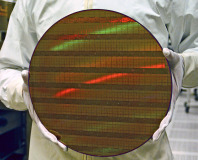
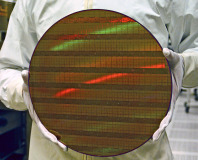
The thing held in the picture will be bigger (i think) so that you can manufacture more chips at once. Combined with the fact that chips are getting finer detail (the famous 90 or 45 nm) and as such smaller size, you fit more into one.

correct me if i'm wrong...
Quote Renze 6th May 2008, 12:30
I've always wondered why the wafers are round. Would it not be more efficient and produce less waste if they made them rectangular?
Still, cheaper chips :D They'll hopefully be out buy the time I'm set for my next big upgrade
Quote iwog 6th May 2008, 12:36
Quote:
Originally Posted by Renze
I've always wondered why the wafers are round. Would it not be more efficient and produce less waste if they made them rectangular?

Its because they're grown not printed. Wiki link Basically its like making a candle where you start with some form of wick to which the silicon sticks to and then you pull it out as the crystals form the layers. And finally after you have you giant silicon candle you slice it and make the chip on it.
Quote theevilelephant 6th May 2008, 12:40
the wafers are round because the silicon crystal the wafers a cut from is cylindrical (sp?). Back ontopic, woooo! cheaper chips here we come

EDIT: doh beaten to it
Quote Renze 6th May 2008, 15:55
Thx guys, you learn something new everyday :D
Quote metarinka 6th May 2008, 18:43
actually silicone crystals aren't round, which makes me wonder why they don't form them in the shape of the crystal ( believe the cross section is hexagonal but my books only list the crystal lattices of metals
Quote Dvs98SK 6th May 2008, 19:03
Quote:
Originally Posted by iwog
Quote:
Originally Posted by Renze
I've always wondered why the wafers are round. Would it not be more efficient and produce less waste if they made them rectangular?

Its because they're grown not printed. Wiki link Basically its like making a candle where you start with some form of wick to which the silicon sticks to and then you pull it out as the crystals form the layers. And finally after you have you giant silicon candle you slice it and make the chip on it.

This is exactly right. I have seen them grown before and that is pretty much what is going on. The neck touches the melted silicon and starts to spin very slowly and rise at the same time. This could take a whole day to grow one rod depending on the materials and size used. I used to grow low temp oxide on Intel wafers before. My wife works on the 300mm SOI wafers right now. Not all the wafers are round either i have seen many different shapes and sizes. One was very square with all kinds of notches sticking out. That one was for NASA. I think they were for the stardust project.
Quote Xir 7th May 2008, 08:48
Standart 200 and 300mm (8" 12") wafers are round, smaller ones sometimes have one flat edge.
While it is possible to cast square blocks of silicon, you end up with polysilicon, while semicon manufacturers need monosilicon.
Poly beeing many crystals, mono beeing one big crystal.

Poly square blocks are used for solar panels for instance.

Monosilicon is usually made round, by the pulling process described above (only still slower)

Having a round wafer has many disadvantages, for instance losses at the corners...layout a grid on a cirkle and count the "incomplete" squares on the sides.
Then notice that when you increase the circle, the amount of incomplete squares compared to the amount of complete squares goes down. So bigger wafers means less incomplete squares (one square usually being a chip)

The good thing about round wafers however is that it is easier to deposit and remove even layers on them. (nitride, oxide, copper...you wouldn't believe how many layers a chip is actually made of...most beeing removed again during production)

Xir
Log in

You are not logged in, please login with your forum account below. If you don't already have an account please register to start contributing.


Mobile Phones

LG Arena ReviewHTC Magic Review

Compare over 250 mobile phones &
52,000 deals!


Broadband

Mobile Broadband

Compare over 100 broadband & mobile broadband deals online!