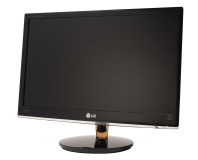
ViewSonic's VLED221wm monitor features a 12,000:1 dynamic contrast ratio and a 118 percent NTSC colour gamut.
ViewSonic has announced its latest LCD monitor, which features all new RGB LED backlighting technology and the result is a claimed dynamic contrast ratio of 12,000:1.
During our chat with the company’s representatives, we were told that ViewSonic is focusing a lot of its efforts this year on colour quality – that’s music to our ears. Thanks to ViewSonic’s new OptiColor technology, the VLED221wm features a 118 percent NTSC colour gamut.
Like most 22 inch displays, ViewSonic’s soon-to-be-released LED-backlit display has a 1680x1050 resolution and this particular display boasts a 5ms response time. What was interesting though was the fact that ViewSonic is using a TN panel in the VLED221wm, which makes the display’s colour reproduction all the more impressive. Even though the display uses LED backlighting, this generation doesn’t use local dimming technology but ViewSonic said that it’s something it is currently researching.
In terms of connectivity, the display features dual analogue and digital connectors, along with integrated stereo speakers – though, going on every monitor we’ve seen with integrated speakers, don’t expect them to be any good. Sadly, one thing that lets the display down is the fact that there is no height adjustment – that’s something we would have liked to see on this display, but unfortunately it appears to only be limited to ViewSonic’s professional monitors.
ViewSonic says the VLED221wm will be available sometime in February at an estimated street price of £499 (inc. VAT). Yes, that’s expensive for a 22 inch widescreen monitor, but don’t forget that this is using LED backlighting technology and compared to other LED-backlit displays we’ve seen, that’s a pretty good price. And looking at the display first hand, the colour quality certainly seemed to live up to ViewSonic’s claims as the colours were vibrant and clear on the source material used for the demonstration.
Would you pay a higher price for a display with super-high colour gamut? Tell us
in the forums.

16 Comments
Discuss in the forums Replydynamic contrast ratio though, so it means pretty much naff all.
I was getting excited thinking it had individual control of the LEDs, but it doesn't, so how is it really any better than a CCFL display?
This guy's even more pessimistic;
Another good read here.
Yes. At the time this is true; I don't have any numbers at the moment, but if memory serves me I think the average life expectancy of OLEDs is around the 3 year mark. Not quite sure though, however they do burn out a lot quicker than LCDs for the time being. I'm sure that when OLED technology matures further they will of course also be made more durable.
Just found this by the way;
"Novaled achieved significant improvements for white OLEDs for lighting applications. An efficiency of 35 lm/W and a lifetime of 100,000h were reached at a brightness of 1000 cd/m2."
http://www.oled-info.com/tags/lifetime_0
So, whilst these are primarily designed for illumination, I'm sure the technology can be adapted. Just a matter of time and patience I believe.
Also, whilst this technology certainly is very interesting, and very elegant, I do believe that PHOLEDs show more potential - at least efficiency wise.
:)
And that is incredibly expensive, I can't see them selling many.
Probably makes the advertising stand out more.
Over time, the monitor dims and what ViewSonic is saying is that the screen will have a full colour gamut for its lifetime.
The NTSC colour gamut does not cover the full range of colours of the visible spectrum it just covers a fair chunk of them, therefore it is quite possible to have a gamut of colours larger than NTSC.
Have a look here; http://www.aim-dtp.net/aim/photoshop/v6/color-settings.htm
there are some pretty pictures showing a variety of gamuts and their relationship to the visible spectrum.
The panel is using RGB LEDs not white ones this means that the LCD panel doesn't have to split the white light into RGB, this give better colour reproduction as pretty much all white light sources are biased towards one colour of the spectrum, i.e. white LEDs are biased towards blue.
We've got a worked open Samsung LCD backlit tv on my work (which I found out the hard way, by checking the leds from 4 cm and then the thing went on x_x ) and it uses groups of three leds (red blue and green).