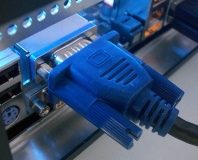
DisplayPort 1.1 - coming to ATI Radeon graphics cards next year.
Earlier this week, AMD demonstrated the first graphics processor with a native DisplayPort 1.1 interface at the Video and Electronic Standards Association’s (VESA) PlugTest event in Milpitas, California.
The next generation chip, whose details were not disclosed, successfully completed interoperability testing conducted by VESA. The test had AMD’s next-generation graphics chip output a signal to a Genesis Microchip DisplayPort receiver, for which many monitor manufacturers, including
Samsung, will be using in future displays.
AMD also stated that it plans to implement native DisplayPort in its ATI Radeon graphics processors in the early 2008 timeframe, which means that it’ll be here in time for
R700’s launch sometime in mid-2008, as we reported last week.
“AMD has been driving the high-definition transition on the PC with innovative firsts such as integrated HDMI, high-bandwidth digital content protection (HDCP) and our Unified Video Decoder (UVD),” said Rick Bergman, Senior Vice President and General Manager, Graphics Products Group, AMD. “With the successful interoperability testing of the first graphics chip to feature a native DisplayPort transmitter, we are once again breaking new ground in customer-centric innovation by offering increased choice in video and display technologies to our users.”
For those not familiar with DisplayPort, it’s a new technology that aims to unify and standardise display connectivity across desktop and notebook computers with a common high-bandwidth connection.
“As one of the founding members of the DisplayPort promoter group, and a very active VESA member, AMD has played a valuable role for more than four years now in the specification development of the DisplayPort interface,” said Bill Lempesis, executive director, VESA. “We congratulate AMD on achieving this tremendous milestone so soon after DisplayPort version 1.1 was ratified in April.”
In related news,
the Inquirer has word that AMD’s next-generation R700 graphics processor will support DVI, HDMI and DisplayPort natively.
DisplayPort is obviously not a good thing for those that won’t be jumping to upgrade to next-generation graphics cards either late this year or early next year, but we’re fairly sure that both DVI and DisplayPort, its eventual successor, will coexist for quite some time. I guess it’ll be just like DVI and VGA in that respect, but with the promise of becoming a universal standard across all PCs.
Discuss in the forums.

seconded
I don't think VGA is going to start to disappear until DisplayPort arrives, as I am pretty sure that all of the big guns will be pushing DisplayPort next-generation notebooks. Monitor manufacturers will be the same too - removing VGA will help to cut costs of monitor production in the long run too.
The reason why DVI hasn't been particularly prominent on notebooks is because of the sheer size of the connector and associated cabling - it's not the easiest thing to fit on an Ultra Portable, for example. With DisplayPort, it'll be possible to implement a high-bandwidth connection so that you can drive larger displays with your notebook. Not only that, but it also delivers higher bandwidth than dual-link DVI, which means we can look forward to higher resolutions, or higher bit depths on the desktop front.
The latter, of course, is dependant on if and when Microsoft adds support for bit depths higher than 24-bit RGB (32-bit colour adds an 8-bit alpha channel), as HD TV technology is further on than PC display technology at the moment - there are TVs supporting Deep Colour (10-bit per channel) already on the market (or arriving soon), and PC displays are stuck at 6-bit at the low end and only the high end displays use 8-bit panels. It's actually quite sad to think that PC display technology is now lagging behind HD TV technology - the reason for that is the millisecond myth.
I'm pretty sure I saw DisplayPort to DVI and VGA adapters too, so if you get a new video card with these on it you won't need a new monitor.
Higher bandwidth and smaller size, but are either necessary?
The majority of people aren't even on super-dee-duper HD yet (maybe they have some sense) and the majority of those who have it probably can't tell the difference between HD and less recent technologies, so I don't really see more bandwidth as being a decent justification for the extra hassle of a new connector/form-factor/standard.
Smaller size? Current connectors aren't exactly massive or cumbersome. :?
Just because something is 'better' in terms of specifications doesn't mean it's better in a realistic sense, nor does it mean it's necessary.
I'm not against progress when there are good reasons for it, but this stinks of "making something new for the sake of having something new", or perhaps "making something new for the sake of raking in money from the people who become convinced that they MUST have it...just like HD Video & Blu-ray/HD Discs"
"Your 8800 Ultra sucks because it doesn't have displayport. DVI is SO last week."
(The above post isn't targeted at you, Snaek, I just used your post as a reference for my views.)
At a loss of colour quality...
VGA with max resolution 2048 x 1536.
DVI came out with "single link" only, which had a maximum resolution of 1600x1200.
Granted, the connection was digital...but single-link DVI was, in a sense, a downgrade of VGA's resolution capabilities.
I think today, single-link DVI can put out 1920x1200 with some video cards...still a downgrade from VGA's resolution.
Later, dual-link DVI came along...but it's really only available on mid-to-high end video cards for the most part. Anybody looking for a bare-minimum type $40-$50 video card is stuck with single-link DVI or VGA if they want higher resolutions.
Dual Link DVI can put out 2560 x 1600.
There are monitors today (30" LCD's) that use this resolution.
What am I getting at? The Wikipedia article on DisplayPort does not specifically mention resolution capabilities beyond 2560 x 1600. It would be very very lame if the first DisplayPort video cards were not capable of resolutions beyond what dual-link DVI does now. It would be even more lame if they came out with "low-res" DisplayPort today, then updated it in a year or two for higher resolutions like they did with DVI, forcing anybody who wanted to benefit to go out and upgrade *again.* If I don't see specs beyond what Dual-Link DVI can do on the first DisplayPort hardware to market, then I'll know the whole point of DisplayPort is just more profit grabbing, by coming out with small upgrades every couple years rather than big upgrades on a more limited basis.
1) AMD seems to be a big supporter of DisplayPort
2) "Another competitor [of DisplayPort] is Unified Display Interface, a low cost compatible alternative to HDMI and DVI. However, the main supporter of UDI, Intel, has stopped the development of the technology and now supports DisplayPort."
In other words, Intel, in a way, stopped production on their own technology and joined forced with their arch-enemy AMD on a single format. Perhaps the HD-DVD and BluRay groups should have learned from this. After all, if Intel and AMD can cooperate and avoid a format war in the consumer marketplace, shouldn't Toshiba and Sony (among others) be able to do the same? ;)
i think it is more because of the license fees...
I always bring this up, but in addition to being a huge resolution, it's (well, technically 3840x2160 in 16x9) the perfect resolution for watching HD video -- it provides perfect integer scaling with 720 (factor of 3) and 1080 (factor of 2). Even a non-existent or mediocre scaling chip will allow any HD video to look good on such a screen. Imagine how cool things could look with a good scaler :).
Well that's the point... It's called "Quad HD" and that is the new standard for ultra high end HDTV's. In Japan they already have such displays.
HDMI costs a licence fee on every single product you use it on, and on the specifications and intention to use it. You have to pay twice. (iirc)
Display Port is an open standard