The Ouya console will be followed by a successor next year, and each year thereafter, as the company adopts smartphone market methodologies.
Ouya, the cut-price Android-based games console that smashed records when it launched on the
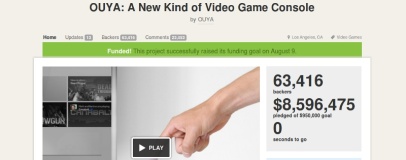
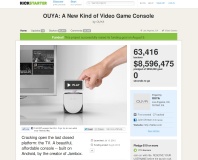
Kickstarter crowd-funding platform - raising a whopping $8.6 million from its original goal of $950,000 - will be the first in a regular series of devices, the company has revealed.
At its heart, the Ouya is an Android tablet minus the display: the compact box packs an Nvidia Tegra 3 quad-core ARM Cortex-A9 processor running at 1.6GHz with 1GB of RAM, 8GB of internal storage and an HDMI port supporting 1080p HD video and 5.1 digital surround-sound outputs. 802.11/g/b/n Wi-Fi is included along with a wired Ethernet port, while a Bluetooth radio connects the wireless controller and a micro-USB port allows for development, debugging and side-loading of apps and games.
If that sounds a little weedy for a console, that doesn't appear to have stopped developers announcing their plans to support the device. Numerous companies have come forward with announcements that they will be launching games on the gadget, with Double Fine's latest title Reds using the Ouya as its exclusive console launch platform. Troubled cloud gaming company OnLive has also announced its support for the console via its game streaming technology - little surprise, given that OnLive already has an Android app that will need little tweaking before release.
When you're launching as a $99 console using the same kind of hardware you'd find in a high-end - or, given it's a last-generation Tegra 3 chip and just 1GB of RAM, mid-range - smartphone, you can't expect the five-year-plus lifecycles of the big boys, though. Even so, the company's proclamation that it's planning an annual release cycle is likely to come as something of a shock to those who have already parted with their cash for pre-orders of the first generation units.
In an interview with
Engadget, company chief executive Julie Uhrman explained that Ouya would be following the same development cycle as the smartphone and tablet market, rather than that of rival consoles. '
There will be a new Ouya every year' Uhrman admitted. '
There will be an Ouya 2 and an Ouya 3.'
That the tablet-inspired device should be following a tablet-inspired development schedule shouldn't really come as a surprise, of course: when you're packing the very latest hardware into a £400 games console, you can afford to over-spec the device and have it last for years to come; when you're dealing with last-generation parts and a strict $99 retail price level, however, it's time to take a different tack.
Uhrman was also keen to point out that existing games will not be lost: a game purchased on an Ouya 1 will work fine on an Ouya 2, an Ouya 3 and so forth. Each game is linked to a user's account, much like titles purchased through Google Play - not supported by the Ouya, incidentally, in favour of its own bespoke marketplace - follow a user through multiple phone and tablet upgrades.
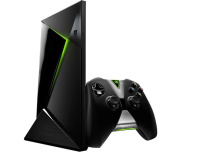
Initial indications are that the Ouya is proving popular with an impressive number of pre-orders, but how it will fare post-launch - and in the face of Nvidia's own Tegra 4-based Project Shield gaming system - remains to be seen.

19 Comments
Discuss in the forums ReplyThis is my reason right there. That, and the fact that Ouya is android based (which means emulators support, for example) and supposedly easy to root.
What makes you think the games are $50 a pop. Evidence please.
I think he meant traditional console games; i.e. Devil May Cry, released around 3 weeks ago, is currently sitting at $58 on Amazon. And people wonder why I don't use my xbox any more...
The gpu on tegra 3 is 2 years + now will be more by the time its released. There is cheap tablets with better specs.( that are on andriod)
Theres games already out for andriod that struggle to run on anything but the latest and greatest tablet from the andriod platform. This will have lower hardware so will struggle even more.
Still think they will struggle to gain much support from developers, Without support will that controller even work?
A company made an Ipad controller a few years back and its supported so few games it quickly disapeared from the market place. It was a major pain to code for was the official reason behind it. Most of the cheapo games work best under touch, Angry birds with a controller would be difficult.
Most of the driving games would benifit from a controller.
Games will likely range from minimum price to whatever they want.
On ios the price range is 69pence( angry birds ect) to i think £11.99 is what final fantasy 4 costs. ( basically the psp version of the game also includes the redone FMWs.)Major difference in quality between the titles though.
FF4 will last you 100 hrs. Angry birds will last you a few hrs at best.
I assume if major developers release games for it they will be charged at a higher price than the next tower defence or angry bird clones.
Going to have to go ahead and disagree with you there. Sure if you're looking at the latest and greatest stuff to be released, then yeah you can call it out of date (although there's no word yet on when Tegra 4 will make it into a commercial product, IIRC). But the Tegra 3 is no slouch; my One X phone runs a Tegra 3 clocked at a slightly lower speed than the Ouya (1.5Ghz compared to 1.6Ghz) and I've yet to see anything that it won't run. I downloaded Epic Citadel recently and was utterly stunned with the quality of the graphics; it was honestly better than some PC games I've seen in the last 5/6 years. I don't know how well that would scale up to a full-size TV (say, >32"), but the One X is already rendering at 720p. And that's just the 3D performance.
Games currently released (PC/PS3/Xbox360) is what I ment. If these were sold for $24.99 a pop at release then there would be much more interest in traditional consoles or PC-games.
Look at all the higher quality games released for the tablets. They're usually dirt-cheap < $10 and basically just as fun to play like all the titles currently released for PC/consoles.
1) tethered power - they don't need to clock it down because it has a dedicated power source; this is done by phones/tablets to extend runtime but it isn't needed for Ouya.
2) Not a phone/tablet - Of course, a lot of tablets are not 3G-enabled and just use wifi, but compared to phones it doesn't need services like the dial, address book, etc taking resources. It will give incremental improvements that could be the difference between playable frame-rate and stuttering.
GPU is the single biggest drawback of the tegra 3 platform as its just not good enough its bearly comparable to the ipad 2 for performance.
Asus transformer prime was one of the last major releases using the tegra 3 gpu. They tested it versus the ipad 2 and ipad3 when it was released.
In grand theft auto 3 the only major developed game on both platforms at the time it was unplayable on the transformer prime unless you reduced the settings. ( you could change settings on andriod) 40% draw distance and 40% resolution was how low they had to go to get it to work at playable fps.
HTC one X USA version uses a 1.5 GHz Dual Core Qualcomm Snapdragon last i checked, using an adreno 225 gpu, this is not tegra3.
I am, but I won't settle for Tegra 3 in 2013. I want Tegra 4 (or something similar from Snapdragon/Exynos lineup).
I'm not as much interested in [Android] games as I am in the prospect of having SILENT computer that is OPEN (so no blocking of "other OSes" by the manufacturer), runs normal desktop OS (I expect few Linux distributions running on Ouya soon after its launch) in a SMALL package, plugs into monitor or TV plus it costs less than $100.
Transformer Prime = Dec 2011
Nexus 7 = June 2012
Granted the Nexus 7 isn't any more powerful than the Transformer Prime, but I'd argue that the Nexus 7 was a more significant/major piece of hardware than the Transformer Prime.
Looks like a Tegra to me...
http://forums.bit-tech.net/picture.php?albumid=1825&pictureid=31928
The one you're thinking of is the LTE variant; all other models - including non-LTE US models, AFAIK - use the quad-core Tegra 3.
This is exactly what I want out of it... The trouble is, I tend to agree on Tegra 3 vs. Tegra 4, and the reason for that isn't necessarily the faster speed, architecture revisions, etc; it's the fact that Tegra 4 supports full-fat OpenGL, rather than just OpenGL ES.
Correct, it's what keeps me from buying a console.
PC games may start this high (but they rarely do) but they go down after a year or so, not console games, heck even the oldest LEGO games cost a fortune on consoles :|
So, it's taken less than a year for Mass Effect 3 to drop from its purported £49.99 RRP on consoles - a price you'll likely never see unless you frequently buy release-day games from Asda or the like - to under £17. Sure, the PC version can be had for under £10 - but I still wouldn't call £17 a 'fortune.'
As for the Lego games? Lego Batman PS3, £11.99. Sure, that's about double the cost of the PC version, but it's still only twelve quid - and the Lego games tend to hold their value more than most on consoles, as young kids don't really care about the latest and greatest but just want to see their heroes on-screen and they tend to play on console rather than PC.
Grand Theft Auto IV, released in 2008 just like Lego Batman, tells a different story: the PC version costs £13.16, while the PS3 version costs £14.77 - only £1.61 more expensive.
Are console games more expensive than PC games? Indubitably, thanks largely to publishers having to pay a licensing fee to the console manufacturers that is absent on PC releases. Do they "cost a fortune?" Hardly.
We do our weekly shop at either so if i ever want a major title on release can get them for £25 ( you have to spend so much in the shop to get that price usaully)
I get 2-3 PC games for one (equal) WII game here in Germany.
Shopto.net is (sometimes) a bit cheaper, but not always.
Got great deals via shopto.net on the raving rabbits partygames, but the lego ones and Zelda aren't coming down, most are ~25-30 while their PC versions are 10