According to Valve, the recent sale of Garry's Mod 10 saw sales jump by more than 1074 percent in a week.
Valve are a company known for a lot of things, but letting the public see just how successful the Steam platform is for them isn't usually one of them - which is why it's interesting to see the sales data for
Garry's Mod released.
Originally a modification of the Source engine that turns the game into a virtual Lego set,
Garry's Mod was released as a commercial product in November 2006. It was recently put on it's first discount sale run, with Valve slashing the price £5.99 GBP price in half for eight days.
According to statistics released by
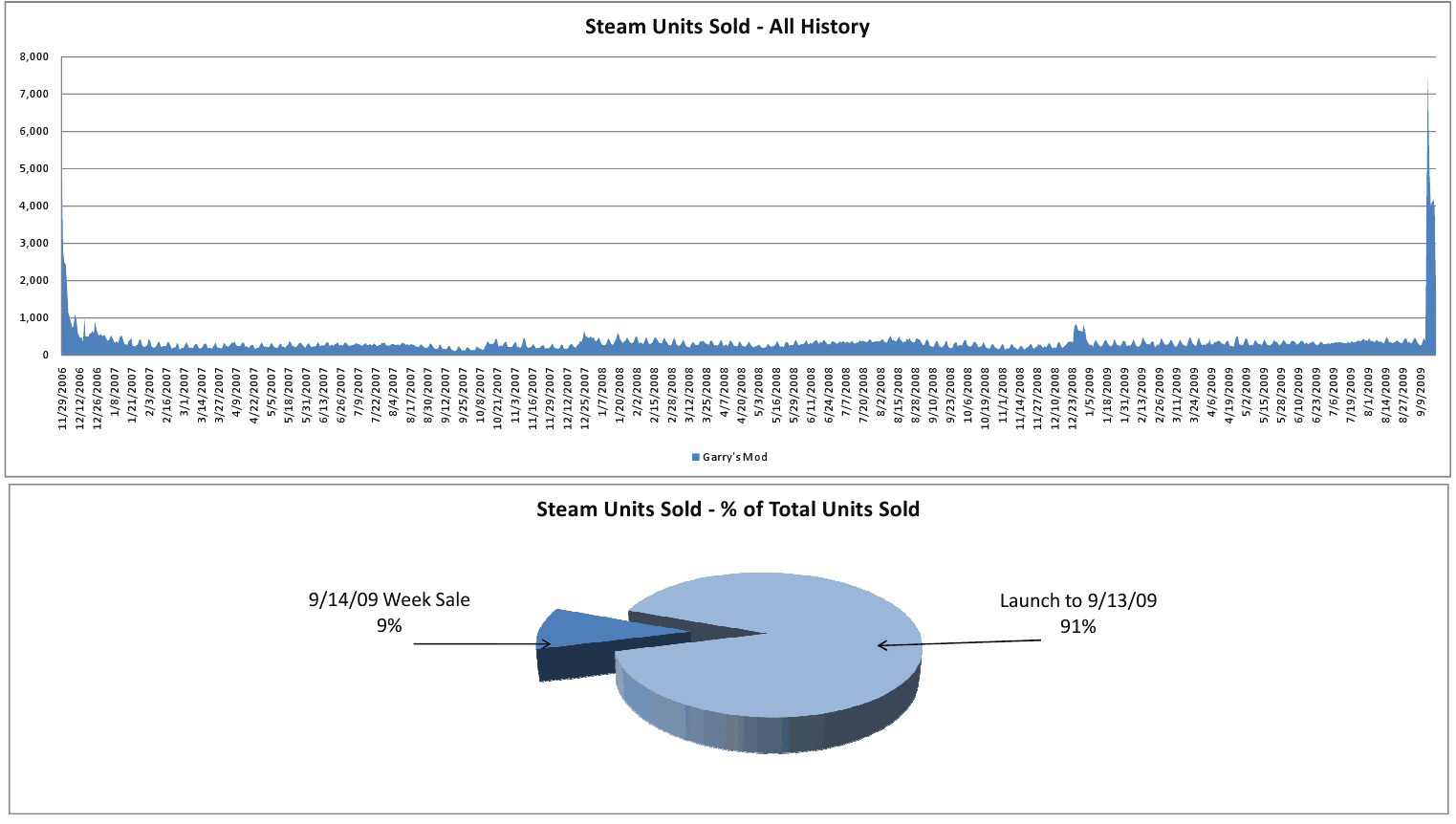
the eponymous Garry, sales then spiked massively. In the eight days before the sale
Garry's Mod sold 2,975 copies.
"
Because it was 50 percent off, we kind of needed at least a 200 percent rise in sales for it to justifty itself.. The actual rise was 1074 percent," Garry said on his blog.
Garry also revealed that the game sold more than 34,927 copies in that eight day sale period alone. Sales statistics show that that accounts for just shy of 10 percent of the mod's total sales.
This isn't the first time that Steam sales have been shown to be so impressively successful. Valve's first
Left 4 Dead half-price sale pushed sales up by 3000 percent and increased Steam registrations by 1600 percent, for example. One unnamed third party game increased sales by
36,000 percent in a single sale weekend.
Have you played
Garry's Mod yet? We very much recommend it, but you can let us know
your thoughts in the forums and check out the sales chart for the game below.
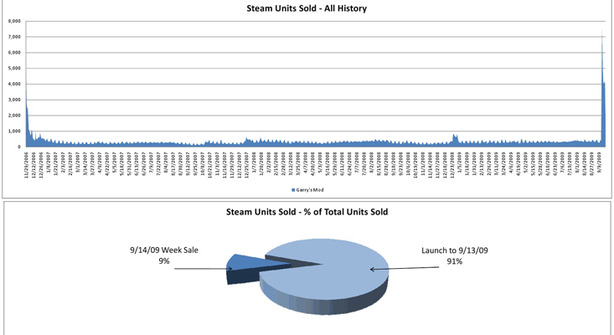
Click to enlarge
I'll always maintain that the sweet spot for a full game (on PC) is £25, the sweet spot for premium DLC is £3 to £5 and add-ons such as skins or extra tracks should be £1 max
just my views though obviously!
The clever bit is betting on whether you can sell the same amount of units at a higher cost over a longer period, and if your bank manager will fund it until you cover your development cost. The figures may look great selling 100,000 in one week at half price, but if that kills sales for the rest of the quarter you may as well sell at twice the price. As long as you sell 50,001 units in that quarter your better off.
Maybe that's why a lot of developers are focusing on games that attract wider audiences now. Increased willingness / ability to pay.
I have to agree with you on the first part, for me there's a certain price point I'm willing to pay for a game which is around 30-40 euros (that's why I'm importing all games from the UK), but those little extra add-ons consisting of only a skin or two should cost nothing imho, they should keep the customer happy and attached to the game and the company so they will buy new games again, not for making money (which in the long run is making money again, yeah I know).
ah, but free is included in £1 max! certain extras you should pay for. extra songs on Rock Band and Guitar Hero should be paid for and should cost the same as an equivalent MP3 download because the artist should be paid for their work as that's what you're buying; an mp3 with quick time events on top.
just a new costume should be free, but if it's a licensed costume, it's unfair to make the developer effectively cover the licensing cost themselves.
He split the profits 50/50 with Valve in exchange for access to all their source code, IIRC.
That's quite a boost in sales.
Actually the average age is much higher, and with elite level games like EVE it is in the 30s.
PC Gaming requires 500 euros a year at a bare minimum, and the ability to keep upgrading. The ages you are talking about are buying the "cheap" consoles and then buying the console games.
Yours in PC Gaming forever Plasma,
Star*Dagger
Lepermessiah is right, 2 year upgrade cycle is more accurate. Only spend 500 euros a year if you like sitting in front of benchmark software with your pants around your ankles knocking out some PC Gaming forever Plasma.