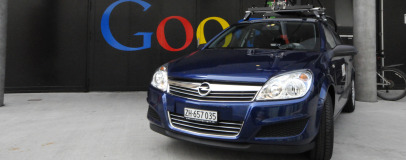
The FCC's report into Google's Wi-Fi sniffing via Street View cars suggests upper management knew exactly what was going on.
The publication of the US Federal Communication Commission's full report into Google's Street View Wi-Fi sniffing, which the advertising giant had previously attempted to block, has revealed some additional details about the case - including the claim that Google wasn't as ignorant of the activity as it had previously claimed.
Google's Street View cars, which feature 360-degree cameras and GPS equipment - were already the subject of
privacy complaints for taking photographs of peoples' houses and gardens, but the news that they were
accidentally capturing Wi-Fi traffic proved too much to bear.
Numerous government bodies have investigated the case, but the US Federal Communications Commission (FCC) has managed to find some additional details missed by others - including the fact that top Google management were aware of the sniffing activity well before the matter became public knowledge.
According to the
LA Times, which has seen an unredacted version of the
FCC's report into the matter, the Google engineer responsible for coding the Wi-Fi data-grabbing portion of the Street View software told his colleagues and a senior manager exactly what he was doing.
That flies in the face of the company's claims of innocence, blaming the 'rogue' engineer for coding the capabilities and hiding it within the Street View software without telling anyone what he was doing - suggesting the company isn't as innocent as it has previously claimed.
'
While we disagree with some of the statements made in the document,' a Google spokesperson told the LA Times of the report, '
we agree with the FCC's conclusion that we did not break the law. We hope that we can now put this matter behind us.'
As Google's statement suggests, the FCC ruled that no law had been broken by the company's activities - but that didn't stop it levying a $25,000 fine against the company for attempting to obstruct the investigation - a charge the company strongly denies.

24 Comments
Discuss in the forums ReplyMe: Thats right Terry!, after helping Grigori with his Poincare' Conjecture malarky and setting him straight on a few matters( obviously if John sold Chris 5 apples at 10p each and then stole them back while he wasn't looking then sold them to Val for 11p each plus 15% interest minus 6.2% investment tax at the base rate of 2.5% he was laughing all the way to Barclays Bank), I went on Chernobyl's got Talent and won!
Terry the Sheep: Meeeeeeeeer!
Me: I know Terry I couldn't believe it either, thay all gave me Three thumbs up
Terry the Sheep: Meeeeeeeeer
To me its all about intent, just as though you might over hear a very personal conversion in the street your intent isn't to be eaves dropping, following people with a tape recorder changes the nature of the situation.
Read up on UK (and US) privacy, computer misuse and wiretap laws for more. That, or just read the FCC's report linked to from the article.
Google didn't proverbially walk in to an unlocked house they walked past and heard part of a song.
No. They were capturing and analyzing few packets of data going through your wireless network, which probably to surprise of some people contains the network identification. And they need this network identification, so they can give you a rough geolocation instead of using GPS.
If they captured few packets of your unsecured data, it is your own stupidity, and everyone else could do that. If they captured few packets of your WEP secured data, same applies to you. If they captured few packets of your WPA2 secured data, then except the network identification no other data can be used.
Also, playing your music where others can hear it is a civil wrong - it's a Public Performance as defined by the Performing Rights Society (PRS) and requires a specific licence. It's never enforced against individuals, but is frequently enforced against businesses - including garages that play the radio when they're fixing cars.
Not that that has anything to do with the matter at hand, but just pointing out that logic and the law do not always go hand-in-hand.
My point exactly Google has violated the letter of the law but it did not violate the spirit of the law. There was no intent to eavesdrop, wiretap or what ever else they recorded a fragment of a private conversation made in a public arena (the street) for at most a couple of seconds.
This is a storm in a tea cup, if privacy campaigners really want to get het up about something there are much bigger issues with much greater intent to fry.
I'm guessing that the issue wasn't big enough, and the data sniffed wasn't used for any purpose (as far as we know), to require a fine - but Google's lying about the matter is what gave them the $25k fine. I'm guessing that this could have further ramifications for Google, as it could encourage investigation into Google's storage and use of other private information?
And the one about the engineer saying his superiors how he intends to do it - we all know was that probably handled :
Employee : "Hey boss, you asked me to add WiFi network enumeration to the Google Street View cars. Well, using standardized methods it is too slow, cars would have to crawl at 20km/h speed all the time. But i came up with an idea - grab the WiFi packets, put them together with GPS location and later extract the network identification from headers. This would allow us to go through the cities at speed limits, without slowing down the traffic. What do you say boss ?"
Boss: "Sure, whatever if it gets the job done".
... some time later, after FCC starts the investigation...
Google CEO: "WTF".
It's an absolute disgrace that management lied when asked if they knew this was happening.
Earth? I'm on earth?
The tools and know how might not be quite as common as turning on an FM radio, but just about any full fledged computer with a Wifi network card can do it very, very easily and with relatively limited or no knowledge of how to (a simple google search turns up easy step by step directions).
As for Google having wide information about it, that doesn't sound like the case. Brueaucraies are this funny things, just because someone, even a few someones know what is going on doesn't mean most people do, or even higher levels. What is a senior manager in this case? The engineers immediate boss 4 levels down from the CEO? Was it was of the C-grade guys running the show? Even a junior VP? Or are we talking some guy so removed from the leadership of Google that they have their email or phone call passed through at least 2 other people before the CEO is going to catch wind of it?
I think you just invented a new word.
I'm going to use that "word" in a meeting at work tomorrow...and see what happens :p
Your information has been shared with anyone who's interested since the dawn of time, it's only the confirmation of that happening that gets people irked.
when you go to starbucks, you should understand the bucktooth bandit is more than likely monitoring and filtering everything you do.. he's not being taken to court (not sure if google is but, really this isn't news)
Taking your stuff would be theft, Google didn't take anything, it was there freely to be picked up and would be the same as someone walking in to your house and writing down what they saw.
Don't forget that even here in the U.K. if you leave your door open that it is considered an invitation and a complete stranger can walk in to your house and although you can ask them to leave they do not have to and using any force against them to do so is also illegal.