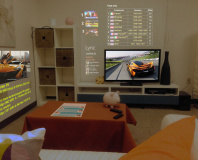
Microsoft's HomeOS might be a prototype now, but the company has no lesser goal than the total conquest of your home network.
Following the stellar success of Microsoft Bob (previous statement may contain traces of lie), the software giant is heading into the living room once more with HomeOS.
For those who are blessed with ignorance of the matter, Bob was a Microsoft project from the nineties in which the company attempted to provide an alternative user interface for non-technical computer users. Designed as an add-on for Windows 95 and Windows NT, Bob was not a commercial success: by the time Windows 98 was released, Bob had been consigned to the dustbin of history.
HomeOS, thankfully, is a very different project, although one with the same overall goal: to make computing easier for the less technical types.
'
It is no secret that homes are ever-increasing hotbeds of new technology such as set-top boxes, game consoles, wireless routers, home automation devices, tablets, smart phones, and security cameras,' the Microsoft research team responsible for the concept explains in an
introduction piece. '
This innovation is breeding heterogeneity and complexity that frustrates even technically-savvy users’ attempts to improve day-to-day life by implementing functionality that uses these devices in combination.
'
To simplify the management of technology and to simplify the development of applications in the home, we are developing an "operating system" for the home. HomeOS provides a centralised, holistic control of devices in the home. It provides to users intuitive controls to manage their devices. It provided to developers high-level abstractions to orchestrate the devices in the home.'
HomeOS, then, is a potential solution to the growing heterogeneity of the modern home network; a single operating system for which manufacturers can write applications for command and control of devices from security cameras to home theatre systems. Such applications will, Microsoft explains, be made available on the HomeStore digital distribution channel - proceeds from which the company takes a cut, naturally.
For now, Microsoft is making the system available under a free licence for non-commercial use. It's already seen adoption by academics from universities across the US, and makes a claim of over a dozen prototype installations in homes.
What the company doesn't have yet, of course, is any customers. It's here that HomeOS is likely to struggle: an operating system to provide a single unified user experience for all network-connected objects in the home only works if all the network-connected objects have drivers and applications created for the operating system.
As a result, Microsoft risks finding its latest project in the limbo of Catch 22: manufacturers don't bother writing support for HomeOS into their products because nobody uses it, and nobody uses it because manufacturers have't written support for HomeOS into their products.
If you think Microsoft might be on to something with HomeOS, you can head over to the
official website for video demos and a list of applications.

27 Comments
Discuss in the forums ReplyLets hope no silly fonts come of this.
It is not (or claimed to be) an operating system that's easy to use for home users
It's an "OS" (Read application and hacked driver package) for managing a network attached home, from turning on the lights to more advanced stuff.
Microsoft have 697 other research projects on the Microsoft Research website. Don't go thinking this is anything special or the next big thing.
This could be interesting, depending on what people much more intelligent than I can do with it.
other than that, I do support the spirit of the project, making advanced windows settings easier to understand and access is definitely a good idea, "non-technical types" is a shrinking demographic, but windows settings are so hard to work with some times it baffles the best of us. I know how to program in assembly, but it took me a whole day to get a home network set up right. If M$ can actually make this a helpful feature instead of just another unwanted abstraction barrier, it could be quite nice for everyone.
:)
However, as Microsoft constantly make a balls up of tying together their existing platforms I'm not convinced they could pull this off.
Really? Unless you have non-windows machines or are mixing windows 7 with XP then I suppose I understand your difficulty with that. But setting up home networks is one of the only things I prefer to do in windows rather than linux due to how much easier and straight-forward it is. I'd say there are some things that Windows does to make changing settings a little tedious or confusing (in Vista an 7 since they have a bajillion separated control panel options), but none of it is really difficult.
They really could do with a few good solid OS's before someone kicks them where it hurts. Have MsOs1, a bottom of the ladder, extremely basic OS which does little more than run a browser. People could use it to surf the web and use google apps, and that would make it ideal for netbooks and HTPC's and home office PC's, and that could be their iPad/iOs competition. It could also compete with Google's OS. You could put it on a 64gig SSD and it would hardly use up any room etc.
Then they should have a bigger version of it with more support for codex and dvd drives and stuff, for use in laptops and more full on HTPC's.
And the MsOs3 which is the full OS like windows7/8. And all of them should be easily controlled by a mouse or touch. And if they can't design a UI that is great for touch and mouse then they are in the wrong business.
You've got a nice idea but I don't think you understand how MS and apple work - Apple targets "elitists" and people who don't care to learn about computers. MS targets the general public and they're notorious for being anticompetitive, meaning, they don't want you using anybody's products except their own. There's a reason they make crappy software like IE and Movie Maker, there's a reason they make services like Hotmail and Bing, there's a reason they make things like Zune or Xbox, and there's a reason they buy out companies like Bungee and Skype Ltd. When you own every major market, you can put your products on every sub-product you have and vice versa, to the point where anything anyone buys is always going to have everything they need all from the same company. MS is like their own ecosystem. Apple today WANTS to be like that but they're assholes toward hardware companies and they're expensive, so they'll never get to that point. MS doesn't need to be mean to companies, because companies know that they'll profit from them, they'll get bought out if they disagree, or if neither happens they're likely to go out of business.
Erm, no. Not quite to this degree, but we've already got that - Home, Pro, Ultimate. If their licensing wasn't so utterly retarded, maybe. About the only thing I'll concede a bit of admiration to Apple for is their OS upgrade model - it's what, $30 to go from Snow Leopard to Lion (or whatever the last gen and current gen are) Yet I get stuck for $200 because they won't let me upgrade from XP Home to Win7 Pro? (Not that that happened to me, but the point remains.)
Flatten it out - one version of the OS, and make "modes" - default to brain-dead retarded mode for my granny, but make it easy for me to switch to Ultimate mode (and hard for my granny so she doesn't do it accidentally.) While they're at it, don't stick me for more than, say, $50, on an upgrade...while I'm fondly wishing, let that upgrade extend back to XP (which still has a ridiculous amount of market share.) $100 flat on a brand new retail license, so I don't have to cheat by building and selling (to myself) a box using a system-builder license. Given how much of their revenue is still Windows, it'll never happen, but I can dream.
Yes.
Yes, actually there are. They have something that is called "money". They use this "money" to pay people like me to set up their extensively networked homes. A lot of people don't care to learn how it works, they just want it to work. just sayin'
Nope. Seeing it written like "homeos" only made it worse :-D
Bob couldn't make use of useful 95 features like long file names. And while Bob was capable of launching Win32 apps(since it was for the most part just a shell), Windows 95 could NOT launch Bob apps(of which there are blessedly few) without Bob.
Having used it before, albeit briefly(found a copy for a dollar, and it was a hilarious purchase at the time for several contextual reasons), there's actually some interesting ideas that were never explored since it was a Windows 3.1 shell launched in 1995.
On the other hand, Clippy the Paperclip DOES trace his origins to Bob, so... there is that.
This is exactly what will happen if they try to take this forward; especially if this is a niche research exercise. It's an admirable goal, no doubt, but I highly doubt it's success/practical use.
Most embedded network-enabled devices (that is, something which actually does it's own processing and isn't just a dumb piece of hardware) already have some version of a universal operating system: Linux.
Instead most tablets have wifi and bluetooth and a rare ammount have GPS. Why don't they release any tablets with ALL possible options to make use of a tablet.
@schmidtbag; actually every system on the network is win7 (excepting a roku media player), the problem was that my desktop (the primary media repository on the network) had the same system name as my netbook, because M$ has never heard of a MAC address this somehow resulted in both systems being listed as one on the homegroup, while no data on either of them could be accessed, but other systems could be accessed from them. All without triggering a warning message.
@mdshann; there are some, but I know plenty of people with more money then they know what to do with, who have a single aging desktop for a 5 person family. In my experience people who need constant tech support don't even realize what computers are capable of these days.
@Bede: I generally agree with you, but I always wonder why people insist on storing banking pins and such in a digital form, despite not having enough tech skills to install anti-virus software.
Much more difficult to lose a computer than a piece of paper :D Tbf, I've never really had difficulty remembering my account and card details, but a lot of people have multiple cards and have to write them down somewhere.