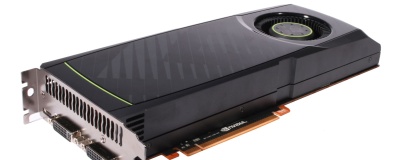
The power limitation function of the GTX 580 GPU, which prevents power draw exceeding 200W, can now be bypassed by GPU-Z.
Nvidia's GTX 580 GPUs include a clever power limiter that keeps the power draw low when executing intensive operations such as the Furmark benchmark. Now, however, GPU-Z developer W1zzard has released a way to disable the restriction - but warns that it's not for the faint-hearted.
The test build, available for download on the
TechPowerUp forums, has the option to disable the clockspeed restriction logic. Although it makes no difference during daily use, when the limiter kicks in during Furmark or similar intensive benchmarking applications, the maximum power draw of GTX 580-based cards jumps from 200W to 350W.
W1zzard warns users that '
exceeding the power limitation of the card may result in damage to card and/or motherboard,' but for those who want to push their GTX 580-based cards to the very limit it's a way to squeeze the very last drop of performance out of the GPU - providing adequate cooling is in place.
Nvidia's GTX 580's power limiting system is something that would have potentially averted the overheating issues that plagued early versions of StarCraft 2. When we investigated the issue back in August, we found that
the lack of a framerate limiter in the software meant that simple scenes, such as the menu, could over-stress the GPU - a problem that the GTX 580's power limiter neatly circumvents.
The news that Nvidia's GTX 580 can draw up to 350W when the power limitation logic is switched off will come as no surprise to rival GPU manufacturer AMD, which famously
mocked its competitor on YouTube for the high heat output of the Fermi architecture. However, the much more reasonable 200W limit of a card with the power limiter still in place will be good news for those looking to upgrade from a power-hungry early Fermi board.
Are you impressed to see Nvidia's power-saving logic circumvented already, or just wondering why anyone would risk burning out their GPU for the sake of a synthetic benchmark score? Share your thoughts over in
the forums.

40 Comments
Discuss in the forums Reply+1 :D
Crysis, for instance, doesn't seem to limit frames while in the menu or loading screens. I can see the framerate jumping up to just under 1000fps on my GTX275 at the menus in Crysis and all the way until it gets in-game. Not that I need to see it, as my GTX275 tends to capacitor-squeal when working like crazy.
Many other games exhibit this behaviour, so players be warned - StarCraft 2 isn't the only game that could drive a GTX580 crazy with this hack. :)
Notice how your GPU fan spins like no tomorrow in the menu or when you pause the game, while in the game, where you would think you stress the GPU, the fan is fairly quiet in comparison.
As the article says, there's no benefit to this modification with real-life usage, only with benchmarks. It could be useful with OCing, but you would risk burning out the card/mainboard any time you hit something like that non-framerate limited menu of SC2 :)
hasn't that been patched yet?
150w + 75w + 75w
8pin + 6 pin + pcie slot
you'd think something gotta give- water cooling at 350w would probably be a good idea to keep temps down on the gpu
allowing it is just dangerous, it should only be done by reviewers and extreme overclockers, normal users should not be allowed to have such simple tool.
You mean a 24pin motherboard connector :)
Yes. See that wonderful little checkbox labelled "VSync"? Click that and the problems are gone forever.
I've got a buddy studying game programming at the moment. He puts caps on all of his games, even ones that take just a couple hours to make. No reason for Blizzard, or any company, to leave one out.
The 580 is not poorly designed because nVidia put a control system on it. Only someone who took it off and then played a game with no limit to framerate would be in trouble - but that would be their own fault.
im sure ive left games paused for hours to go watch a grand prix
Even with
8pin + 8pin + PCI-E slot
150W 150w 75w
we'd be pretty close, wouldn't we? Looks like this beast might run at -10 degrees Celsius using a Prometeia Mach II GT. :|
starcraft 2 thing was related to cheaper video cards that only had just enough cooling to just keep them cool + dust SC2 would make them toast and fail (i could see a lot of Nvidia compaq or HP laptops failing due to this)
Customer call
laptop will not boot up
power light comes on
is it an compaq
yes
does it have an green sticker that says Nivida on it
emm
bottom right hand coroner or left below the keyboard
yes
the laptop has most likely died due to an fault inside the laptop its an permanent fault, laptop most likely would need replacing
(i would still call out just to Flip the ram see if it was that but normally its dead)
No - there's no hard limits on the amounts that can be drawn, just the limits to remain within specification. So if you remove the limiter and draws more power, it's not a big deal - under normal conditions, it shouldn't.
1. You're arguing that there's nothing wrong with programs using unnecessary amounts of system resources. If your processor can run at 100% indefinitely then surely you won't mind your operating system putting it at max load 24/7. Nothing wrong with that scenario, right?
2. As shocking as this may be, even processors can overheat when run at 100%. The tricky thing is, most people with a system designed/built poorly enough to cause this won't be running anything which pushes their system so hard. Along comes Starcraft 2 with its massive popularity and relatively low system requirements. Suddenly, people who never once thought about heat are finding out that their dusty, archaic case without proper ventilation will roast their card when put under such a load.
Is it safe though?
Actually 6 and 8 pin PCIe are both 150 Watt. There are no additional wires for 8-pin. The spec called for an additional sense wire with 8-pin so that the wattage could be increased, but PSU manufacturers instead do the sensing inside the PSU and on the ATX connector, so that a 6-pin connector does 150 Watt with ease.
If you take a look at PCIe connectors, you'll see that the 8-pin version has its two extra pins simply looped back into two existing ground wires, this to satisfy some GPUs which actually check for their presence.
I remember when they had the 6 to 8 pin adapters that came with the video cards too.. then someone pointed out it could cause a fire or something and they stopped supplying them with the card
No other graphics card has ever needed a limiter like this. If the card's capable of drawing such a massive amount of power that it needs to be heavily limited to fall within specification, it's doing something wrong. Very wrong. Doubly so if, as people say, it's not doing anything extra with that power.
Right, so we're seeing a max potential power draw of 350W...
Wait, wut? Does this mean that if we used 2 8-pin plugs on a 580, we'd see even more? I shudder to think!
why are fast saloon cars limited to 150mph?
i don't understand why people see the limiter to be an issue, as long as it produces fast enough performance, why bother fiddle with it?
when you game, it's very similar to driving the fast saloon car on speed limited motorway, as long as it's fast enough, with horsepower to spare, why does anything else matter?
the limiter only becomes an issue when you try to go on the tracks, (aka benchmark) but as tests have shown, 580 doesn't get limited in benchmarks. besides, you can't play benchmarks.
So isn't it a good thing that nVidia have managed to limit power to consumption-heavy yet results-low parts of the card then? The fact that nVidia have managed to lower the temperatures yet increase the performance without fundamentally changing the core should be commended... right?
Creating a card that had lower temperatures, faster performance, and lower power consumption would be a hat-trick. My issue comes with this:
nVidia start throttling the card heavily, should it start going past its stated power draw. The card shouldn't be able to go past its stated power draw - it should draw what it needs, and no more. Rather than saying "This card draws a maximum of 260W, because we're throttling it", they should be saying "This card draws 350W, but that shouldn't happen in gameplay." - better yet, design the card to only be able to draw 260W, not 350W and put on a cap.
To go back to the beaten (and quite frankly, broken) car analogy, it's the equivalent of Ferrari saying "Oh yes, sir, you'll get 12 miles per gallon at 150mph, all possible to this special little gadget we've installed that cuts your engine out half the time, since otherwise it'd be 6mpg". - remember, we're talking about a wasteful, excessive, and more importantly, outside ATX-spec, design. A power-draw limiter isn't the same as a speed limiter.
Am I right in thinking that for those of us who like to overclock our GPUs, this 'limiter' will result in a lower overclock? Because surely an overclock need moar powa!?