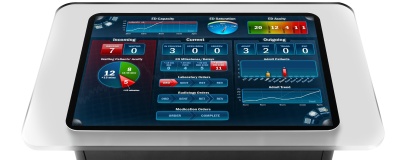
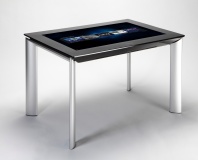
Microsoft's Surface never really took off - but researcher Bill Buxton predicts its entry into homes within the next three years.
Microsoft's Surface, the interactive coffee table, is one of those inventions that appears
awesome but then fails to really go anywhere: aside from a few
in-store demos and an
open-source versionthe technology has singularly failed to take the world by storm. Microsoft principle researcher Bill Buxton isn't willing to give up on Surface just yet, however - and claims that it could appear in homes within the next three years.
In an interview with
The Globe and Mail, Buxton claimed that the reason Surface never caught on beyond niche market segments was "
the complexity of the technology and the cost of manufacturing," with the sheer number of cameras required - five, if you're wondering - bumping the cost up to a point where average consumers just can't afford it.
In order to make Surface a feasible consumer product, Buxton envisions a future where the bulky camera-and-projector-infested table is replaced with "
a big LCD where there's a fourth pixel in every triad [...] which is a sensor that will capture stuff."
While that might
sound like a pipe-dream, Buxton claims that "
sooner than you'd expect - but longer than I want - these things will come in at really cost effective prices and will start appearing in people's living rooms, dining rooms, game rooms, and so on and so forth. And I believe you will see that in three years."
The big question for any new product is, of course: what does it do for me? The killer app for Surface, Buxton believes, is gaming - "
a board game, checkers [...] even Dungeons and Dragons."
Join us in three years' time on your coffee table when we look back to see how accurate Buxton's predictions really were.
Do you think that Surface could make a splash if only it weren't so bulky and costly, or have slates already become the new Surface? Share your thoughts over in
the forums.

12 Comments
Discuss in the forums ReplyThe idea was that by combining sensors, cameras, near-field communication and RFID you could interact with both the table and the items on it. Stick your coffee cup on it, for example, and it *knows* it's a coffee cup - which might mean that it disables incoming e-mail alerts until you've finished relaxing.
The idea went further than that: stick you 'phone on the table, and it syncs with Surface. Touch the table and see all your photos; browse through them and 'swipe' the ones you want to keep over to your PC or external hard drive.
Surface was to be a lot more than a flat touchscreen, but I fear that the message has got lost along the way.
BTW is there any pricing available at this time?
Imagine playing Ruse ...
Then imagine your partner comes over with a saucepan, puts it down on the touch surface and literally squashes most of your armies ...
Anyway, collecting and sending my emails via granite surface ... Yes please.
That is the first thing I've heard that seems entertaining on this sort of tech.
It's not quite the same thing, but this does look like a practical application.
http://www.youtube.com/watch?v=OVD_Lvv4UOI&feature=player_embedded#!
Notice how big the buttons have to be in order to hit them with our fat human fingers instead of the precision afforded by a mouse.
Now if you had a business client, you would both place your phones on the table and it would swap electronic business cards. maybe you could pop up some photos or a document on product or whatever.
That's what I envisioned,
also good for playing games and such. I honestly think it will be a reality in a few years as the technology comes down in place and developers create a standardized platform for the technology.
Honestly everything I just said could be done on a scaled up version of an Ipad quite easily. The computer hardware doesn't need to be extremely powerful, I'm guessing the display hardware is the costly part.
Also I don't see how this fits too much into a home besides being a static version of an ipad. Although i could see it encorporated into a kitchen counter when the prices come down.