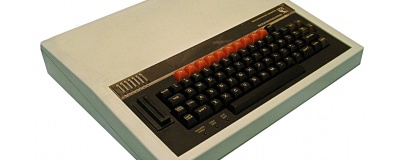
Students invited to TNMOC get to experience programming on the BBC Micro, in BASIC.
A select group of A-level students have been given the chance to step back in time and take part in programming lessons at The National Museum of Computing - learning to code on PDP-8s and BBC Micros.
According to a
BBC article, the move comes in an attempt to teach students the underlying concepts behind computing - and to move them back from modern computers which all too often abstract the core concepts away from the user, making it harder to understand precisely what is going on.
Doug Abrams, an ICT teacher at Ousedale School in Newport Pagnell, sent a selection of his students to the Museum in order to take part in the retro lessons, and is quoted as saying that "
the computing A-level is about how computers work and if you ask any [students] how it works they will not be able to tell you" - but that's something the course aims to fix.
By learning to code on older machines, a better sense of interaction with the underlying hardware can be gained - Abrams claims that "
you can see the instructions happening for real with these [vintage] machines," giving students a greater understanding of how computers really work.
It's an interesting idea, and one that makes a lot of sense. Whereas modern computers dump you straight into a friendly, graphical environment where everything is a click away, the BBC Micro would present you with a BBC BASIC prompt - loaded instantly from ROM - when you switched it on. In order to make computers of that era do
anything - even if it's just to start loading a game from a tape - you have to write a simple program.
Programming on the PDP-8 is an even more raw experience, without the relatively high-level BASIC language to fall back on; instead, students have to toggle switches on the front panel to set binary values directly into memory.
Although the experiment appears to have received the thumbs-up from its participants, it isn't known whether such programming classes are to become a regular occurrence at the Museum.
Would you like to experience
real programming, as it was in the bad old days, or is the retro lesson nothing more than a gimmick? Share your thoughts over
in the forums.

14 Comments
Discuss in the forums ReplyNice idea, if unlikely to be well received by any but us "enthusiasts"
For writing practical programs, modern systems are all very well - you can put together an app with a GUI that does something useful in about 10 lines of code, but it shows you nothing about all the stuff going on to actually make it work - memory allocation, resource management, threading / time-slicing and all the complexities of a modern multitasking graphical OS on modern hardware (multiple cores, processing on multiple platforms - GPU, CPU etc.) mean that writing in pure assembly would be totally impractical and that layers of APIs are needed to make things work, but all that abstraction obscures the important issue (for a computing student) of HOW things work.
ZOMG!! PDP-8!!!
Okay, I've got the over-enthusiasm out of my system, normal operation shall resume shortly after I find some sedatives.
But ehhh:
They could learn this on a modern system (something unix based without the desktop loaded) :D
Scripting != Programming, at least in my opinion. Your mileage may differ. Void where prohibited. Probably contains traces of nuts. Keep out of children.
I think that programming in binary is a step too far and a pointless exercise at best. Programming in the assembly language of a simple RISC architecture is a better idea and teaches you the concepts of the stored program model we use on computers today. You can also do this in an emulator of some sort on any modern computer.
Also, since when did ICT actually become about computers?
It seems like a good idea though. More people need to learn how computers actually work.
I think since far too many people think learning office means they are a computer wizz, as that's all ICT seems to basically concentrate on.
Learnt BASIC on my Speccy, then again on the BBC, then again on the C64!! - still have my programmers reference guide for the C64. although most of the POKE and PEEK commands I used were for unlimited lives in games etc.
I went Spectrum -> QBasic -> Some Casio calculator basic variant -> VBA ->SQL + C#
with the odd other little bit here and there
But I'm not sure you need to go back that far .. so long as you learn how to use C properly (Malloc, Pointers, Garbage Collection) you will be miles ahead of the competition.
We did assembly / binary when I was at college, and no where near enough of it imho. Still having knowledge of how things work, and the mental structure for dealing with things from the base up has really helped me immensely in the commerical world.