An issue with ACPI power management - reported to Microsoft back in June - is being blamed for permanently damaging users' laptop batteries.
While Windows 7 has brought many advantages to users of Microsoft's operating systems, extended battery life may not be amongst them - at least according to some users claiming to be affected by a battery-biting bug.
As reported over on
PhysOrg.com - via
Engadget - enough users have now complained of serious battery life issues with the latest consumer iteration of Windows that Microsoft has opened an investigation into the reports.
According to threads on Microsoft's
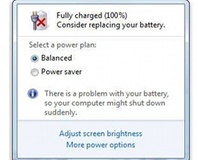
TechNet forums, the issue appears to be related to Windows 7's inability to recognise certain battery types and capacities - with the result that users are receiving error messages telling them to "
consider replacing your battery" despite there being nothing physically wrong with the device.
Rather more worrying is reports that other users are experiencing a real drop in battery life, rather than just an annoying but ultimately ignorable error message: TechNet poster Guy Gordon reports that the battery in his HP 6810b laptop used to get over two hours of life from a single charge under Windows XP, which dropped to 45 minutes immediately after installing Windows 7 - and has now tailed off to a mere five minutes before the system forcibly shuts down.
Microsoft is continuing to treat the issue as a purely software problem - with Windows failing to correctly determine the remaining charge, the system may well shut down prematurely even when there is power left in the battery. More seriously, Windows will struggle to determine when the laptop battery has had enough mains power to be fully charged - something which should be resolved by charging the laptop while it's powered off, rather than with Windows running. However, Technet users are reporting that the drop in capacity is
permanent - with other operating systems, including Ubuntu Linux, reporting massively reduced battery capacity once Windows 7 had been running for a while.
The issue, however, has been ongoing since at least June of last year, and despite workarounds being offered - ranging from disabling the ACPI battery support and using a third-party battery monitoring utility to ensuring that your BIOS is fully up to date - many users are still affected by it. So far, Microsoft appears unable to offer a solution - and is silent regarding numerous requests for replacement batteries from users bitten by the bug.
Any Windows 7 users who've noticed their battery life taking a massive nosedive, or is it a vocal minority who are experiencing an extremely rare bug? Should Microsoft be treating the issue more seriously? Share your thoughts over in
the forums.

28 Comments
Discuss in the forums ReplyI'll be interested to see how MS handles the complaints of permanently damaged batteries - I'm sure someone will sue someone for it.
It does when Windows isn't running otherwise it feeds information to the ACPI management system for software to monitor the battery condition and charge/discharge rate.
I luckily haven't had this problem either, or at least not to my knowledge. i did notice a slight drop in longevity on my Studio 17 from about 3:45 hours in maximum battery saving mode to about 2:45 under win 7 but with how much 7 has been in general on the system and the life still being pretty good i've not bothered about it too much.
My laptop runs Windows 7 since the Beta version, and, as it was written in the article, Ubuntu shows a significant capacity loss now, which is indeed permanent. IIRC the battery life under Windows XP was far better. Interesting stuff.
Shall I charge Microsoft for this?
Seems to be working fine so far though.
Get the feeling that Microsoft won't do a damned thing for all the unfortunate people who've had their hardware damaged by this. There's probably something in the EULA that protects them from this kind of thing, but if there isn't someone needs to get a class action lawsuit together.
Sam
It lasted a good few hours when I was on it. Just something to look out for I guess.
I would assume that under some sort of EU law, MS to would be liable for replacements if it can be proved they have caused it.
life , the retail version has been good, still getting around the 8 hour mark with brightness low and without Wifi.
As batteries are so expensive i'd certainly be complaining if it happened to me
It can be installed along with windows as 'dual boot'.
Questionable, because MS doesn't sell the Laptops with Windows 7 preinstalled, so I think the risk is bigger for Dell, HP, Acer and so on to get sued.
And I'm sure MS has something in the Eula that removes any and all responsibility if you install windows and not a MS approved Company.
Is this a SpamBot?
I've installed Win7 on 3 laptops/netbooks from different manufacturers with 2 XP and 1 Vista originally. I've had no problems at all with battery life. learn how to charge your batteries the most effeciently does actually help the lifespan of any rechargable battery. Go to the manufacturers website will general guide you in the right path.
However, due to Samsung being crappy when I first did it (and I haven't checked recently) there is no way to change the screen brightness. So it is always at 100% :D
Can you not do control panel > mobility centre. Then adjust the brightness from there?
Ah that may be alright for Eee PC's as well, since they use ASUS ACPI drivers (pretty much the first thing you have to install). Still, I think I'll put off Win 7 on the laptop for now. Don't really need any extra overheads and as they say, if it ain't broke, don't fix it. In the mean time I can 'fix' my desktop :D