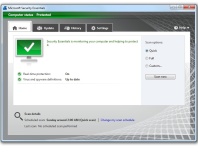
The new Security Essentials from Microsoft offers anti-virus, anti-spyware, and anti-malware free of charge.
If you're running Windows, you need security software - it's as simple as that. Thankfully, Microsoft has stepped up to the plate and released its own package - Security Essentials.
As reported over on
TechRadar, the package - which is provided to all Windows users free of charge - offers protection against viruses, spyware, and various other malicious programs under the catch-all banner of 'malware.'
The package - which is available for
immediate download - is provided completely free of charge, and offers automated updates from Microsoft to ensure that the protection stays up to date. While some may question the wisdom of trusting the company that made the security holes in the software to protect those holes against attack, early reviews and previews from the beta suggest that it's a pretty comprehensive protection suite - and at approximately 6MB of memory while running in the background, it's fairly lightweight too.
Although Microsoft offers the suite without cost to users of "
genuine Windows," business users are still expected to fork out for the paid-for
Forefront Client Security, which offers unified reporting and central management facilities missing from Security Essentials.
Amy Barzdukas, general manager for consumer security at the company, said that its customers have told Microsoft "
that they want the protection of real-time security software, but that they are confused by trials and renewals and concerned about performance and as a result, too many are unprotected. With Microsoft Security Essentials, consumers can get high quality protection that is easy-to-get, easy-to-use, and won't get in the way."
The move is likely to anger security software vendors who have made a living for years protecting Microsoft's operating system: with a completely free solution from as big a name as Microsoft, it becomes so much harder to sell a £39.99-a-year anti-virus package to end users.
Will you be trusting Microsoft to protect your Windows installation, or do you think that a third-party option would be a better choice - even if Security Essentials
is free? Share your thoughts over in
the forums.

30 Comments
Discuss in the forums ReplyI wonder what the EU will have to say about this though.
It's interesting to note the reason for making your malware suit free:
Home users are a good thermometer for what's going on around the Internet in terms of new new threats and trends. Making it free will gives you a much larger user base from that you can gather data from. This information is then used to make your business proposition more effective which happens to be where the real money is!
I don't think MS are going to get finned on this one because there are already lots of free solutions out there using the free for home users model.
Sunbelt Software's Vipre http://www.vipreantivirus.com/
Eset's Nod 32 http://www.eset.co.uk/
I haven't personally tried Security essentials but I have heard from the master of security Steve Gibson that it is pretty good. Saying that I would advise going with a company that is specialised in the security industry, Microsoft as we all know isn't the best company when it comes to security.
Except they know their system in and out, and their program won't delete windows-essential files/settings, they'll also be able to more accurately target infected files and integrate more seamlessly with the OS.
What in particular makes you believe it's a joke?
I approve!
If i pick up Win7 for £30 and the MS security package for nothing I'd actually save money by porting over to a new win7 setup.
Anyoen care to comment on how good this suit is...obv i expect nod to be better, but if this is anywhere near it I'll think about ti seriously.
And this has been a much less of a problem since UAC entered the stage. UAC saved my ass one time (and not some anti-virus software). Also most of the time I don't really need anti-virus because I don't download crap. But I do run certain hmm.hmm software from time to time which requires me to have anti-virus installed. Previously I've run a system with no security software installed whatsoever for months without issues. Call it good luck, or good wisdom.
Microsoft finally broke free of their 'backwards-compatibility' mantra with Vista. But Vista is widely recognised as a dog of an OS and many users got fed up with the frequency of UAC pop-ups so they switched it off and, in doing so, threw out the single most important security feature.
Microsoft is soon to release Windows7 which they say (as they always say with every release) "is the most secure Windows yet". It's all relative. The exciting thing about W7 for the Black Hat community is 'XP Mode'. Microsoft has recognised the embarrasment that was UAC and fine-tuned it so that it's not so annoying and users won't switch it off. That's great, but what it's not telling users is that XP-Mode has left the back door unlocked.
Now Microsoft is coming out with its own anti-viral software. Oh great. It takes them over 12 months to patch ActiveX security holes in IE "but this is different, this time we really are focusing on security". Give me a break. Security is a process, not a product. And Microsoft has consistently proved to itself that it can continue to sell its products without having to worry about devoting any serious developer effort to security issues.
Security Essentials is, again, just Microsoft paying lip service to security concerns.
ive had it since the beta
it is programed to use up less than 50% cpu capacity
and its as slow as hell
to scan my 50gb hdd partition on a sata 2 drive took 3 bloodyt hours
to scan that and my data partition that only has 250gb on it would take 12hours
come on microsoft you can do better than this
it is painstacinly slow its a good antivirus program except this only use this if you dont have a lot of data or you are willing to leave it to scan just before you go to work or school then select what to do when you get back
It is just what the home user wants. As for anti-virus companies. What did they expect? Their lucky enough that Microsoft hasn't integrated this into their OS by default. Something that in my opinion makes sense. It is about providing a more secured OS and protecting their reputation. Other companies do that. Why can't Microsoft do that? Microsoft has been flamed in the past for not providing enough security in their OS and they have focused on that for quite some time. Anti-virus companies may criticize this move, but fact is, they have been taking advantage of a market that shouldn't exist in the first place. Their focus should always be in the enterprise level. The home user should have enough basic protection with what the OS company can provide.
I'm rather liking the MS suite, got it on 2 of the comps at home and it's a lot less load on the system than AVG. +rep to MS