The latest Asus Eee PC features an aging AMD Geode 1.4GHz Socket A processor - but why?
If you're desperate for a non-Atom netbook, but don't want to have to wait for
ARM to make its move outside of the mobile and embedded market, the latest Eee PC from Asus might catch your eye - but be prepared for an interesting experience.
Having just gone live on Italian electronics retailer ePrice, and spotted by
Hexus, the Asus Eee PC 1201K appears at first glance to be a pretty standard netbook: a 12in 1366x768 display makes it bigger than most, but 1GB of memory alongside a copy of Windows XP demonstrate that this isn't a performance powerhouse.
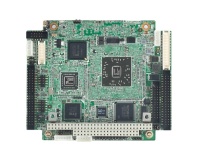
However, it's the processor that's likely to gain the most attention. Rather than the usual single- or dual-core Atom chip, Asus has chosen to fit this latest device with a single-core AMD Geode processor running at 1.4GHz, originally designed as a system-on-chip embedded computing device.
The Geode NX 1750 used in the latest Eee PC isn't exactly cutting edge; based around the Socket A design and built on a 130nm process, it features a TDP of 25W on an average power draw of 14W - significantly higher than the 2.5W TDP of the faster Intel Atom N270.
It's hard to see why Asus has chosen the Geode NX 1750 for this latest entry into the netbook market. It's older, slower, and the high-by-modern-standards power draw drops the battery life of the 1201K to a mere two hours. Beyond the possibility that the company has come into possession of a large quantity of Geode chips for which it needs to find a use, there appears to be nothing to recommend it over the more common Atom processors in the rest of the company's range.
Asus hasn't yet confirmed whether the Eee PC 1201K is an Italian exclusive, or if we'll see a UK launch.
Are you just pleased that
someone is making a netbook that doesn't use an Atom chip, or confused why Asus isn't letting the ancient Geode line die a dignified death? Share your thoughts over
in the forums.

21 Comments
Discuss in the forums ReplyThe sticker price on the link is 328. £270 is too much for what your getting here. Guess they're hoping that they can trade on name alone with this one.
Geode NX 1750 is actually faster than Atom, as it's based on Thoroughbred core so it has a much better FPU unit and has full out-of-order execution. I don't have any Geode based industrial machines atm, but given that Pentium M is exactly twice as fast as Atom and Geode NX series are about 20% slower than Pentium M (clock to clock of course), a 1.4 GHz NX will still be a lot faster than Atom.
From a quick Google, users are claiming to get a bogoMIPS reading of around 2400 on the NX 1750 compared to 3200 on the Atom N270. Granted, that's a completely unscientific measurement - but I'd definitely be interested to see real benchmark scores, if you've got any.
EDIT:
Here we go: PassMark CPU scores for the Atom N270 and the Geode NX 1750, which clearly show the Atom beating the Geode. Not by as much as I would have thought, I'll grant you, but still showing the Atom scoring higher. I see someone should at least *attempt* to read something about the topic before giving out opinions, TheUn4seen. ;)
Who knows, maybe it could be a freakish success for them
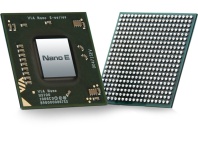
Is this the pre Nano chip? IIRC HP did do a Netbook based around a VIA CPU. I seem to recall it had dissapointing performance even when compared to the Atom based Netbooks around at the time.
I can't think of any other reason to release this now other than they were free. If that was the case then these need to be £100 at the most.
The 2 hour battery life is the bigger killer here regardless of performance. I think we all bought netbooks not expecting them to be performace kings anyway but the portability is one of the main reasons.
First of all, clock to clock Geode is faster. NX 1750 at 1.6GHz would be an equivalent to Mobile AMD Athlon XP-M 1900+ (actually it's exactly the same core) which scored quite a bit better in Passmark.
And since when synthetic benchmarks represent real world performance? OOE + real FPU mean that system is far more responsive and much better suited for graphics-heavy tasks, so NX 1750 even on stock clock is much faster in Flash, rendering image-heavy websites and even rendering Windows XP UI.
i like my explanation better, lol
Please, find me a score - any score, any benchmark - that shows a Geode NX 1750 outperforming a 1.6GHz Atom N270, or admit that you're being a bit of a plonker.
After all, the response to being aggressive and wrong is not to be more aggressive and wrong. ;)