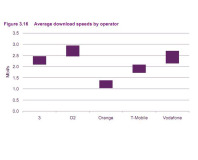
The HSPA+ trials run by Vodafone demonstrate speeds of up to 16Mb/s, but will require new infrastructure and mobile handsets.
If you'd like to see the day when mobile broadband can compete with its wired equivalents for speed, you might want to have a word with Vodafone about its HSPA+ trials.
According to
The Register the company has successfully completed a trial of the next-generation packet data technology on its mobile network in Spain, achieving impressive “
actual peak download rates of up to 16Mb/s.”
Based around the 64 Quadrature Amplitude Modulation (QAM) technology being developed by Ericsson and Qualcomm along with a similar MIMO (Multiple Input Multiple Output) antenna system as used in 802.11n wireless networks, the HSPA+ technology offers far greater speeds than currently available with standard HSDPA as used in 3G networks in this country.
While the company readily admits that end users will be lucky to see the full 16Mb/s offered by the technology, it reckons that 4Mb/s will be easily achievable – and “
good conditions” could allow up to 13Mb/s for services such as video download.
The downside of the new standard is, as always, the requirement for new equipment – both at the user level in the form of new handsets and a the network level – but the company claims to have a range of equipment currently going through its testing and certification processes.
With no official rollout date for the technology announced, it could be a while before we start seeing true broadband speeds from our mobile handsets – and if Vodafone isn't careful, its service could be outdated before it's even launched. Australian mobile service provider Telstra already has an HSPA+ service running, offering theoretical peak speeds of up to 21Mb/s – which the company is hoping to double to 41Mb/s before the year is out.
Hoping for true broadband speeds from your mobile handset in the near future, or are you happy just using it for calling people? Share your thoughts over in
the forums.

14 Comments
Discuss in the forums ReplyQuite neat, really... if they can get the data costs down, it'd be more useful.
http://rationalsecurity.typepad.com/blog/images/tinhat.jpg
No internets here, kthxbi.
No mention of upload though, or the backhaul. Upload's the key once you hit the 10meg range really and there's no point having a 16meg connection if they only put 3.5meg ADSL line to the mast which is being shared by maybe 10 others.
At least you lot will probably end up with some unlimited data plan along the line , we will not see any useful limit for a long LONG time
For me its not global enough. Im fed up with roaming charges etc so im looking into a Sat Phone or better yet.... BGAN from Inmarsat
(Thats Broadband Global Area Network)
Keeping a decent backhaul from the BSSs is the least of their problems right now.
The closest FTTH access you're likely to get, is the Bournemouth/Dundee sewer-based network. That's the one to watch.
Unfortunately that is no good for last mile services, as most people living far enough from civilisation for decent broadband to be unavailable aren't going to be on mains sewage.
As mentioned before: Solve the upload problems and lower the prices, down speed is not the main issue!
Unfortunately living where I am, those networks will never come near, well, not until my children are old enough for PCs anyway :) (And that's just LLU, forget fibre goodness).
But the point here is that NAT, port blocking, proxies and contracts. All these things are nothing compared to the task of running fibre to every house in the country. Most of this problems can be overcome just by a simple policy change.
However, you do have a point in that the FTTH roll-out isn't good for rural areas. But guess what: there's about as much chance as FTTH to my parents farm, as there is HSPA+. You currently don't get anything more than GPRS! As it stands, their only hope for something over the 1Mbit ADSL sync that they enjoy now, is a 2-way Satellite connection. The sad truth is that I was probably only person in 100 people that actually cared about fast Internet access in those places.
As it stands, the FTTH networks being rolled out in Bournemouth/Dundee are really exciting: it's not locked to one provider, the fibre installation is free, and there's an almost infinite amount of bandwidth available. Currently it's only 100Mbit (symmetrically - probably 100BASE-FX) but there should be no issue with upgrading the network transceivers for Gigabit in ~5 years, 10G in ~10 years, etc. :)
What's wrong with rural users setting-up directional wireless antenna links to a building with an FTTH backbone? It's very, very cool, and long over-due in this country. Good luck to them! Hopefully it'll force Virgin to re-think their service quality: competition is good.
As for a change of policies, yes, absolutely correct; that is all it takes (ignoring the technical infrastructure changes, of course) but the real challenge is educating these mobile companies on how to run a decent ISP. At the minute they're offering a half-arsed service, and laughing themselves silly at how much money they're making out of it. It's sickening, really.