bit-tech.net

Thomson and Leadtek prep Cell graphics

Thomson and Leadtek prep Cell graphics

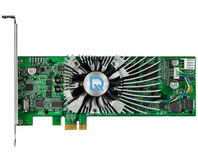
The Leadtek and Thomson SpursEngine cards are likely to differ greatly from the Toshiba reference design.

If you've been convinced of the awesomeness of the Cell processor as used in the PS3, I've got some good news: soon you'll be able to add Cell goodness to your PC in the form of a discrete graphics card add-on.

According to PC World, the SpursEngine – based around four Cell Broadband Engines – developed by Toshiba and featured in several laptops from the company has been sold to video card manufacturers Thomson and Leadtek for them to base products around. Due, allegedly, in the next few weeks and hitting a price point of around £150-£250 the cards aren't aimed at your average gamer.

Thanks to the SpursEngine's somewhat specialised design, it's perfect for high-definition encoding and decoding of both MPEG2 and H.264 video with nary a hint of strain on the part of the host system's CPU. Leadtek's first card to be based on the chip, the Winfast PxVC 1100, demonstrates where the company believes this tech is heading: with a scant 128MB of XDR memory, the card is a half-height PCIe unit designed to fit in a small-form factor system such as a home theatre computer and provide all the grunt required for high-definition goodness – and, if the company gets its way, all cooled completely passively, although the current revision of the card requires a small fan.

With Leadtek hoping to capture the lower end of the market – aiming specifically at low-powered systems not capable of decoding high-definition footage in real-time – Thomson appears to be heading for the higher end. While details are scarce, the company's expected retail prices of nearly double that of Leadtek show that Thomson's products are most certainly aimed at the semi-professional video producer who needs to accelerate the creation of high-definition content.

With the cards expected towards the end of this month and the start of November – in Japan, at least – we won't have long to wait to see what the Cell system can do when coupled with a high-end PC.

Tempted to give your CPU a break when watching high-definition content, or is the SpursEngine a solution looking for a problem? Share your thoughts over in the forums.

22 Comments

Discuss in the forums Reply
Delphium 3rd October 2008, 12:28 Quote
Waste of money i beleive for the purpose of HD playback, as anyone interested in runnign a home cinima would likely have a video card that support hdcp as required for a lot of HD content, thus the video card would have hardware accerlation for HD playback (but not the 8800gtx).

On another note, after i manged to get HD working smoothly on my own pc, i assisted a friend setup his pc to be abel to play HD content, of which he has only a 3ghz P4, after installing the CoreAV codec which is around $15 this worked fine, a sure saving from the £150+ required for this cell card.

However as for HD video encodingthis may aid a little, but does software for it need to be made compatible with it, much like the situation with CUDA?
In which case cannot the user just use CUDA over this solution, as a single card would be cheaper yet again.

This card seems to remind me of the situation of the agea physx cards in some ways.
Mentai 3rd October 2008, 12:53 Quote
Wouldn't this card make emulation of the PS3 really easy? As I understand it, the difficulties in emulation lie in the differences of the very specific hardware consoles have and PC's. Would having a cell processor would cut down those differences almost completely?
xaser04 3rd October 2008, 13:07 Quote
Why on earth would anyone buy this for HD playback when you can get £30 - 50 graphics cards that will do the job just as well?!
TreeDude 3rd October 2008, 13:12 Quote
I will take a 4550 over this. That is just way too expensive.
p3n 3rd October 2008, 13:21 Quote
The NMT I bought my mum for her birthday for £100 can play 1080p .h264, try making something as small, cheap and efficient out of a SFF PC and that card.. madness
Evildead666 3rd October 2008, 15:05 Quote
This is a fast, small multicore chip....
If it can do encoding/decoding fast, can it do Physics processing as well ?
This could be a nice 'Daughter card' to the CPU, where the CPU really takes the general processing, and anything really hard is sent to the Co-processor CELL card...
mclean007 3rd October 2008, 15:33 Quote
For DEcoding HD video, a low end current generation GPU will do the job for a tiny fraction of the price (and power draw). However, I seem to recall the SpursEngine does a sterling job of upscaling (haven't tried it myself, but it would make sense, if the PS3's DVD upscaling is any indication), so may have an application there, but unlikely at the price point!

Maybe for ENcoding, it will justify its price tag??
wharrad 3rd October 2008, 15:53 Quote
Well I'm happy :)

I don't buy a lot of blue ray, but when I do I like to store it on the old server. Tend to offload the task of encoding it so it doesn't interfere with any PCs I actually sit in front of.

Anyway, let's just say at 'nearly' highest settings with a turbo first pass the dual Opteron 248 server still needs nearly a month to encode a full 1080p movie. If this cuts the encode time down and doesn't put restrictions on the quality level, then power savings alone will justify the purchase.

Of course, will it use MeGUI / AviSynth or some dumbed down software though?!?
Flibblebot 3rd October 2008, 17:58 Quote
Quote:
Originally Posted by mclean007
...However, I seem to recall the SpursEngine does a sterling job of upscaling (haven't tried it myself, but it would make sense, if the PS3's DVD upscaling is any indication), so may have an application there, but unlikely at the price point!
A line of Toshiba's newest generation of TV's is going to come with Cell/SpursEngine built in to provide quality upscaling for broadcast TV images (most upscalers on TVs are crap).
ssj12 3rd October 2008, 23:22 Quote
for high-end media center PCs or audio design PCs I could see this being worth wild otherwise unless this can output physics like mad for gaming its useless.
bubsterboo 4th October 2008, 00:15 Quote
Wouldn't you be better off investing that money into a new card that supports CUDA? The hardware decoding is already there, and the hardware encoding is already here in early stages.

I think I'd rather let my GFX card handle those tasks, sound like a complete waste of money.

I think the power of the encoding software that comes with this guy will determine whether it sells to the encoding enthusiasts. But i doubt it's going to be anything like x264 (features wise).
Sparrowhawk 4th October 2008, 06:52 Quote
Yeah, unless there is some 'killer app' for having the Cell, I'd go for a 4550.
Nexxo 4th October 2008, 12:07 Quote
It looks like a cooler (in terms of temperature) lower power alternative for increased graphics grunt to bigger, hotter graphics cards.

I wonder how well it would fold?
cyrilthefish 4th October 2008, 14:01 Quote
Quote:
Originally Posted by Evildead666
This is a fast, small multicore chip....
If it can do encoding/decoding fast, can it do Physics processing as well ?
This could be a nice 'Daughter card' to the CPU, where the CPU really takes the general processing, and anything really hard is sent to the Co-processor CELL card...
from what i recall of the techy side of the cell processor, it being an 'in-order' processor makes physics and AI calculations one of the worst things you can run on it.

though it really excels at easy to predict / simpler calculations, such as video encoding/decoding... it's a slightly more general-purpose version of the shader units in current graphics cards.

though this is from memory, i might have got the details a little confused :o
Bindibadgi 4th October 2008, 14:48 Quote
Quote:
Originally Posted by Nexxo
It looks like a cooler (in terms of temperature) lower power alternative for increased graphics grunt to bigger, hotter graphics cards.

No - AMD 780G for example is made using the 55nm TSMC process and is sub 1W TDP. Throw in a £40 CPU and it does exactly the same job for a fraction of the cost.

I read this story and have talked about it to various others and still can't fathom what it will be good for. It excels at nothing.
rollo 4th October 2008, 15:09 Quote
as is usauly said if you mension price as a reason not to buy it wasnt aimed at you in the first place.

quality is above anything else a paramount for most people intrested in this sort of stuff. And a dedicated card does alot better than a graphics card in this sence
talladega 4th October 2008, 20:00 Quote
Quote:
Originally Posted by Nexxo
It looks like a cooler (in terms of temperature) lower power alternative for increased graphics grunt to bigger, hotter graphics cards.

I wonder how well it would fold?

If it will be anything like the PS3's CELL chip then it will fold pretty amazingly.
Icy EyeG 5th October 2008, 00:23 Quote
Quote:
Originally Posted by Evildead666
This could be a nice 'Daughter card' to the CPU, where the CPU really takes the general processing, and anything really hard is sent to the Co-processor CELL card...

Wouldn't this be a PPU-like approach all over again? Thanks, but no thanks.
Quote:
Originally Posted by Delphium

However as for HD video encodingthis may aid a little, but does software for it need to be made compatible with it, much like the situation with CUDA?
In which case cannot the user just use CUDA over this solution, as a single card would be cheaper yet again.

This card seems to remind me of the situation of the agea physx cards in some ways.

QFT.
Nexxo 5th October 2008, 13:17 Quote
Quote:
Originally Posted by Bindibadgi
No - AMD 780G for example is made using the 55nm TSMC process and is sub 1W TDP. Throw in a £40 CPU and it does exactly the same job for a fraction of the cost.
In terms of HDTV encoding, true. But in terms of folding?
Quote:
Originally Posted by talladega
If it will be anything like the PS3's CELL chip then it will fold pretty amazingly.
That's what I'm hoping... The PS3 Cell has twice the numer of SPEs (8 instead of 4), and runs at 3.2Ghz rather than 1.5Ghz. So it has four times the performance. On the upside, the SpursEngine runs at 10-20Watts.

A bunch of these on a basic PC and you have yourself a tidy folding array. I couldn't think of any other useful application though.
Cupboard 5th October 2008, 15:28 Quote
Quote:
Originally Posted by Nexxo
A bunch of these on a basic PC and you have yourself a tidy folding array. I couldn't think of any other useful application though.

Problem is, you are spending quite a lot of money on hardware for no gain* other than a warm fuzzy feeling (said with my selfish hat on)

*at least, I don't think you can get money from folding
metarinka 5th October 2008, 17:29 Quote
Isn't this aimed at the proffessional video editing/mastering world? I don't think this is marketed for the HTPC or budget crowd. I could see a card based on the cell specifically designed for encoding/decoding etc performing well over even high end graphics cards.
talladega 6th October 2008, 01:50 Quote
Quote:
Originally Posted by Nexxo
In terms of HDTV encoding, true. But in terms of folding?


That's what I'm hoping... The PS3 Cell has twice the numer of SPEs (8 instead of 4), and runs at 3.2Ghz rather than 1.5Ghz. So it has four times the performance. On the upside, the SpursEngine runs at 10-20Watts.

A bunch of these on a basic PC and you have yourself a tidy folding array. I couldn't think of any other useful application though.

If they could make good dev tools for the CELL chips so that programming for them was easy they could make great video cards. Imagine 6 of them on a video card. 6x1.5GHz and just 10-20W per chip.

If only........
Log in

You are not logged in, please login with your forum account below. If you don't already have an account please register to start contributing.


Discuss in the forums

More About...