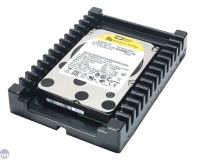
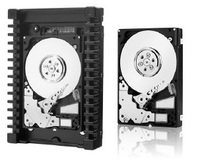
Several industry sources have said that Western Digital is working on a 20,000 RPM Raptor hard drive.
According to several sources close to the hard drive industry, Western Digital is working on a 20,000 RPM Raptor hard drive to combat the increasing pressure from SSD manufacturers.
We have spoken to a lot of people out here in Taipei about this industry’s direction and one thing is becoming clear: SSDs are going to be affordable in the next 12 to 18 months.
Because of this, hard drive manufacturers are starting to get a little worried about what marketshare SSDs might eventually take away from them—especially where performance is more of a concern than storage capacity.
And that’s exactly what Western Digital’s Raptor line is all about.
The new drive will be very similar to the recently-released VelociRaptor, in that it’ll be a 2.5in drive with a custom 3.5in housing built around it. Details are incredibly light at this stage, given that the product is still in development, and we don’t even have a release timeframe at the moment.
However, our sources said that the drive will be ‘silent’ – that’s the last thing I would have expected from a drive with platters spinning at 20,000 RPM. Western Digital is apparently working on silencing the beast by improving the housing technology, which will now not just act as a heatsink, but also as a noise cancelling device. We’d also hope that the drive enclosure has some vibration dampening technology as well, because that’s also likely to be a problem given the high spindle speeds.
What do you think of these plans: feasible or barking mad? Discuss
in the forums.

That's insane. I want to see some reviews, if/when it hits. Gotta be good for a laugh at least.
my Raptor 74GB is almost silent, i don't hear anything idle, and similar noise to the 500GB AAKS when seeking..... where the AAKS are said to be silent!
20k RPM! i may get one just to piss off a Apple lover, where they only have 15k RPM drives :P
SSD:
+ no noise
+ no vibrations
+ no moving parts
+ no magnetic problems
+ ultra fast
+ small
+ Energy efficient
+ Less/none heat buildup
+ Memory will grow over time (so no issues here)
+ less recourses needed to build
+ Life cycle
+ no problems with shocks
- Expensive (for now)
- eh.. (anybody knows another negative?)
Hard Drive:
+ capacity
+ cheap
- Noise
- Heat
- Vibrations
- Shocks
- Energy
- Life cycle
- Large
- Mechanical moving parts
- Lot of resources to make
- Not so fast
- don't drop it
Nope, I'll never buy a single small platter drive again. For storage they are fine. I don't get why they bother competing with performance any more, they've been beaten and they can never catch up again.
i agree completely.
Hoover doesn't get cool even if you put chrome rims to it. HDDs aren't gonna remain the kings of the hill even how you supercharge the decades old idea behind them.
Perhaps in 6-12 months you'll see this.. Perhaps in 18-24 months (catch-up) you'll see performance SSDs from WD. :)
(Even so, I'm waiting for cheaper SSD's, before updating my storage)
Life cycle is not that different if you look a MTBF 1.4m Hours (VelociRaptor) vs 2m Hours (Samsung SSD).Both have MTBF over the life span of humans(~160 years for the VelociRaptor) SDD are the next step in data storage but i don't think they will replace Hard drive anytime soon. Also Currently Hard drive do not suffer from the issue of a shorten life span with large rewrite operations. The SSD currently use of different algorithms to make up for this flaw. IMO SSD still need more time before they hit mainstream
http://en.wikipedia.org/wiki/Solid-state_drive#Disadvantages
does twice the speed mean half the life?
i wonder whats the lifespan of sth that spins at 20k rpm......
Kimbie
The future for fast is SSD - nothing they can do with a spinning disk can knock its seek times to levels anywhere near that of something with no moving parts. For lots of storage, magnetic media still has a good amount of time left - at least until memory gets really dirt cheap. They would be very wise to act accordingly.
if there are vibrational problems at that fast of a spindle speed.... your drive is already dead...
While I think the raptor sounds interesting ultimately SSD will probably slowly take over in the long running (barring any other technology advances) so far the problem just is the fact of limited read write cycles associated with flash. Which means they woudln't be good for holding swap files or php databases on a high traffic server. I think SSD will take over in laptops first where the power space and ruggidness are a big asset.
wasn't there some talk about crystals structures and boron doped diamond as storage along with other out there storage mediums? I'm waiting for something trully impressive
Yep, they should focus on the advantage HDDs have over SSDs, high capacity, although you can get quite high capacity SSDs, you can't get the 1TB size monsters, that and the price are about the only advantage they have currently, best to push that.
on a side note I have a kind of fetish for last dying breath tech so might pick one up second hand in a few years time.. I particualrly love the 4 GPU card put out by voodoo and there very hard to find info on geforce 3 competitor (which was actualy viable and playing games in the last week of voodoo).
Personally I don't see why anyone desires anything faster than a fast high capacity disk, they're damn fast and untill SSD is everywhere you're not really going to do that much better by spending an extra few hundred on a low capacity high speed disk.
- They are very sensitive to write fragmentation
- Professional data recovery is not possible. Even more due to wear leveling
- Wasteful , too small and/or very slow for ISO files, videos, installation packages, hi res pictures, Temp, Temporary internet files, Pagefile, Hibernation file and so on.
- Where is the proof that consumer grade SSD's will have high quality, reliability, and support a large number of write cycles? Or is this based on claims from manufacturers?
- Some manufacturers are packaging cheapo MLC flash and calling them SSD. I'm talking about deceiving advertising
Hard Drive:
Desktops: Don't you have a car? Don't you use a 1000W heater in the winter? Don't you turn on the lights?
Servers: TCO is THE metric, not fashion or bandwagons.
Some more SSD disadvantages, or at least half-truths:
- Superfetch mitigates the problem of random reads on HD. So what's the point? It can't do anything about the horrible random writes performance of the SSD. If you have Vista, a PC with SSD will boot faster and that's it.
- SSD prices are coming down, but so are HD's. I can buy a 500GB disk for 75€
- HD's are known to have high failure rates, but SSD doesn't avoid the most common reasons why you lose important data: filesystem corruption, virus, human error like deleting files, application bugs, memory errors that corrupt system cache.
- If I pay 600€, I don't want any compromise, if I pay high end, I want high end.
Agree with concensus though, that surely ssd is the way to go.
they should be spending there time doing more porductive things
(note: I'm currently a big raptor fan. I don't have a velociraptor, but I have both a 74 and 150 "regular" raptor)
When I can buy an SSD with a useful capacity and a reasonable price, I certainly will.
Useful capacity = enough to install games on, but doesn't need to house movies or music. 64GB would probably do it, but I'd prefer 128.
Reasonable price = not much more than a raptor. I'm going to cite US dollars, though I know you guys hafta pay more across the pond. (sorry!) I'll assume that the relative price is consistent (ie the whole world pays twice as much for X than for Y, though the price of each varies around the world) The 150GB raptor is ~$170 USD right now, and the veloci 300GB is ~$300. The only SSD Tom's recommended in the above-linked article was the Samsung, which is at $400 for 32GB and $800 for 64. That's small enough that I can have only a few games installed at once.
My point is that depending on where SSD price and performance stand when this 20k rpm drive becomes available, the 20k drive may very well be worth it!