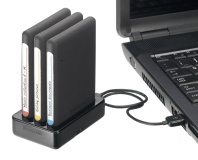
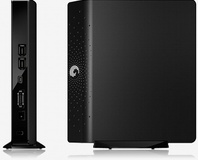
Add-in cards will be the first to benefit from the new Power-Over-eSATA standard.
The Serial ATA International Organization has announced plans to simplify the use of external SATA (eSATA) drives by combining power and data on the one cable while keeping the technology pin-compatible with current systems.
Current eSATA systems require the data cable plus a separate power source, usually run from a dedicated power supply external to the case. Obviously, that can be somewhat awkward when compared to other single-cable solutions for external drives. SATA-IO hopes that the plans to combine the two wires together and ditch the bulky PSU, an initiative that goes under the imaginative banner 'power over eSATA', will give the technology a jump start, enabling it to catch up to – and hopefully surpass – the more successful USB and FireWire technologies currently used for external drives.
Hoping to encourage manufacturers to get the new tech out by the second half of 2008, SATA-IO president Knut Grumsrud says the design will “
provide a new level of convenience to the designer and the end user,” and make eSATA “
an even more attractive solution for mainstream storage applications.”
No manufacturers have announced any products based on the standard yet but, coming as it does from the main industry body responsible for the already highly successful SATA standard, you can bet that they're tooling up as we speak. As a frequent user of external drives, I can tell you right now that I can't wait to ditch my USB 2.0 units and regain some much-needed electrical sockets.
Tempted by the tech, or are you hoping that USB 3.0 and the new FireWire specification will make eSATA redundant? Give us your thoughts over in
the forums.

but i wonder how much power is it going to be able to supply?
enough to run a 3.5" drive?
Although having a server setup for any major storage needs kind of cancels the need for this with me anyway :)
Certainly would make backing up data easier though without the need to fumble around looking for a power cable.
[Edit] As I see it, it would also make it easier for average-joe to increase the storage in their PC too? [/Edit]
About USB-3.0 now theres something to talk about system I/O will get dramatically upgrade when USB 3.0 makes its debut in the later half of 2008. Details on the updated spec are sketchy, but Intel (the creator of USB) says it and its partners plan to get the ubiquitous standard up to 5Gb/s. Intel says the new spec will be backward-compatible with previous generations of USB but will have the added benefit of being able to run over either copper or optical cabling using the same connector. USB-3.0 will be finalized in the first half of 2008 and have a rollout similar to the high speed USB-2.0 launch: controllers will initially be available via PCI-Express add-in cards, with motherboard integration slated for 2009. Now with that off my head STOP!! and think your 4Gb USB-3.0 drive plug it in, the full 4Gb USB-3.0 drives data can transfer all that in 1s. So SATA-IO if it had optical and at 5Gb/s then there is some to talk about, so i hope to see optical on eSATA SATA in the up coming years.
PhoneyVirus
-Indybird
yep, now i keep all my drives fixed inside my fileserver:D. esata is an enthusiast technology. i don't really see a market for esata-only drives. there is no point in me buying a disk that i can only plug into my computer. i want to be able to bring it over to my friends place and plug it into his computer too.
current flash memory has a hard time saturating the 480Mb/s provided by usb2. at this point, usb3 is just wasted bandwidth. also, 4Gb (gigabit) != 4GB (gigabyte). storage is talked about in bytes, bandwidth in bits. eight bits in a byte.
thats what external enclosures are for ;)
i already have a USB + eSATA external caddy, use eSATA on my machine but can hook up USB to connect to others
There's a solution available now which would suit your needs - namely Ultra's 'Stackable' devices
http://i32.photobucket.com/albums/d40/DavyDuncan1955/PC%20Hardware/UltraStackabledevices.jpg (Original pics courtesy of Bjorn 2D)
All the devices are connected to/powered by a single, 180w PSU... such that the PSU itself, is the only device in the 'stack' which requires plugging into the mains B)
The only drawback I can see with it, is that you can only use Ultra's own products in the 'stack'