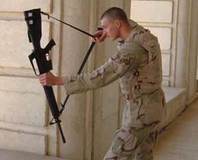
America's Army taught one man all he needed to know in order to save a life.
Paxton Galvanek is an ordinary American man. He likes computer games and war simulators like
America's Army, he's never really been bothered about taking any medical training or working as a paramedic and he probably has to cope with a mother who constantly tells him how computer games are bad for him.
That didn't stop Paxton from becoming the hero of the hour though when he was privy to an atrocious car crash - in fact, Paxton attributes his life saving heroics to computer games he plays.
Driving home one night, Paxton and his wife could only watch as a driver lost control of an SUV and flipped it across the opposite lane multiple times. Paxton's wife immediately called the emergency services, while he ran to aid the injured passengers. He was able to effectively diagnose the critically injured people involved in the accident, then correctly treated as many people as he could until the ambulances arrived according to
Kotaku.
Later interviewed on how he remained so calm under pressure, Paxton thanked computer games.
"
I have received no prior medical training and can honestly say that because of the training and presentations within America's Army, I was able to help and possibly save the injured men. As I look back on the events of that day, the training that I received in the America's Army video game keeps coming to mind," said Paxton.
"
I remember vividly in section four of the game's medic training, during the field medic scenarios, I had to evaluate the situation and place priority on the more critically wounded. In the case of this accident, I evaluated the situation and placed priority on the driver of the car who had missing fingers. I then recalled that in section two of the medic training, I learned about controlled bleeding. I noticed that the wounded man had severe bleeding that he could not control. I used a towel as a dressing and asked the man to hold the towel on his wound and to raise his hand above his head to lessen the blood flow which allowed me to evaluate his other injuries which included a cut on his head."
Thankfully, Paxton isn't a fan of the Soldier class in
America's Army - if he had been then things could have gone horribly wrong!
We know that
computer games aren't very realistic even at the best of times, but have you ever managed to learn real-life skills through a game? Personally, I thank the old Lucasarts adventure games for instilling me with patience, logic and a love of pirates and tentacles - but maybe you learned something different? Let us know in
the forums.

Good to see not everyone is blaming everything bad in society on computer games. Wouldn't surprise me if someone turned around and said a driving game was to blame for the accident.
Fair play to Paxton for remaining calm and dealing with the situation, don't know if I could handle someone whose just lost a bunch of fingers.
And you think that by the time you're 35, that basic bit of 'First aid training' will shoot back into your head after 17 years and you'll remember everything? Basic first aid training wouldn't save many lives, being able to put a sling onto someone who you've seen twist their arm may, for all you know, be doing more worse than good. Even CPR that is taught to 'first aid at workers' and in other first aid courses isn't very good. Has anyone ever seen properly done CPR, like by a cardiac resus team? It's scarey....
Karl Kennedy had to do it on Bridget the other night on neighbours, my heart was in my mouth :O
On the subject of first aid training, being taught the basic things like how to prioritise injuries, different methods of stopping bleeding, how to handle broken bones (especially neck injuries) and other things to do in the event of a trauma is going to help while you're all mashed up and bleeding out waiting 30 minutes for an ambulance to arrive.
Well, when I say learn, I mean I was able to pick it up very quickly once trying it in real life. I knew how to lean and shift my weight around. Me and my brother picked it up far quicker than the rest of our group did.
Spinal injuries isn't basic first aid though... Dealing with bleeding really is common sense. Also, I've never known an Ambulance to take 30 minutes, unless of course you're in a field in the countryside! Staying calm and making sure your safe and the area is as safe as it can be is about the best advice they teach you.
Dont' get me wrong, some first aid courses are brilliant, for example the Emergency first responder course that they offer to PADI scuba divers is brilliant, but if the government were to make it obligatory at a certain age, we all know for a fact it would be a shitty course.
win
(LeM lying injured on the ground) "Bless you Sir, I'm parched!"
Don't forget to let them know when you have uber ready
I remember those medic presentations... but I didn't pay too much attention to them. Then again that was a long time ago when I did play AA. I play a lot of GT and Forza, but I wouldn't say they've improved my driving. I'll probably test that out if I have the chance to attend a track day. Perhaps WoW taught me that I could stay up for more than 50 hours without sleep, but that's probably done more harm than good :p
I am with you on that one!
same here except with nascar 2003. most people are nervous when they start driving for the first time and make lots of mistakes but i had been racing in the game since i was like 6 years with a steering wheel and pedals so when i got my drivers it felt natural and driving at higher speeds is no problem. :)
Paxton FTW and showing that games can be educational. AA and Civ up there as most educational IMO
Yeah, done it more than a few times. None of the survived, but unless the patient is observed to go down (a witnessed arrest) and CPR is started very soo it's pretty pointless. A person's odds of survival drop about 10% for every minute of down time. Keep in mind that all CPR does is keep a body possibly viable until they can be defibrilated or recieve drug therapy. I had a patient we worked on for 45 minutes and they put so much atropine and epinephrine into her they eventually did get a pulse back. She died on the way to the hospital, but that's the closest to a save I've seen from CPR in 5 years as a firefighter.
Depends on where you are. We've had to hike in to where the patient is on more than a few occasions. Probably the most important skill for initial tratment of trauma is managing shock. The body is really good at stopping bleeding on it's own, even from some pretty horrendous wounds. Shock on the other hand will kill you, it may just take a while to do it. Laying a patient down, elevating their feet and keeping them warm will do more to keep them alive than a lot of other things you can do. Remember, Airway, Breathing, Circulation; we can deal with the rest of it later.
There is a lot of debate in the field of Emergency Medicine as to how much good spinal immobilization does for the patient. The general feeling now is that if the spinal cord is going to be severed then it is going to happen in the initial impact and that what we do to the patient afterwords isn't likley to make things any worse. That said, you try to immobilize the C-spine as best you can, but don't compromise other interventions to do it.
Again, it depends on where you are. If you're out in the woods or way out in the country, it can. The best thing to do for bleeding is direct pressure, elevate the extremity, and if it's really bad go for a pressure point. The current thinking on tourniquets is only use one if there is absolutly no other way to stop the bleeding because everything below the tourniquet is probably going to die if you apply one.
Yes, that's right, nothing special.
Picture yourself upside down, strapped inside a wrecked car in pain and agony, not knowing how badly you're hurt, listening to people in pain around you, not knowing what's happening... I'll bet you'd forever thank the first person that showed up and took control of the situation to help you, telling you it's ok and that help was on the way.
You ignorant f**k.
Actually, I've been forever thanked for being the first person that showed up and took control of the exact situation you just described. This guy is making out like America's Army gave him some special edge that allowed him to help more, but in reality it didn't unless the guy was a complete idiot. He looked at the people and judged who was worst - that comes automatically - he did his best to work out what damage had been done to what people - again that comes automatically - and he probably tried to direct paramedics to the worst injured - again, automatic.
Things like this just annoy me because people make out like some very minor factor made a difference when the main thing that makes a difference is being there, and using common sense. Using an experience like that as ammunition to boost a cause like video games seems fairly lame to me.
Well done for assuming I have no idea what I'm talking about though and being a p***k about it too, 10/10 on that one!
But overall, i doubt it helped him a tonne, ofc, considering how much BS gets spread around about games (like they cause people to go on a rampage and massacre buildings full of people) its nice to see some the other way
Jealous.
Try reading the thread....
Ohhhhhhh really? Hmm how interesting. Amazing you didn't mention the same situation in your original blab as a point of reference to quantify why it was "nothing special". So I guess what you did for these people you helped was, "nothing special" either huh? That's completely ungracious to the people "you helped" [snicker] and the event to which you managed [lol!]
Thank you -- I take full credit for assuming you have no idea what you're talking about. I caught you out on talking like an ignorant f**k and you tried to save your dignity by making up a story with a similar scenario, putting yourself into this chap's situation with you as the 'hero'.
Well played. Tho as a poker hand you'd of lost the pot
Exactly - it is nothing special. It's not a big deal, and you don't need to have played America's Army to do something. This guy acting like his favourite video game somehow helped him do lots more and save lives is just him using the horrific experiences of other people as ammunition against anti-video games people
You really have missed the point....
In this it is important to note that although he most likely would have tried to help regardless of playing the game or not, he may not have been as helpful without the experience and knowledge the game taught him. So remember the fact that he helped them and how he helped them are two different things and are effected by different sources. Such as instinct, confidence, knowledge, and experience.
i have learned that the enemy uav is online after playing call of duty 4