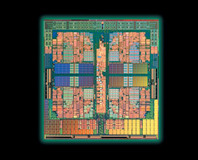
The new AMD Opterons - now with four cores.
After months of waiting, AMD
has announced that its quad-core Barcelona is finally here. Well, it is if you're interested in servers.
For those of us wanting the consumer orientated Phenom X4 processors, then the wait is still a little longer. Sorry.
Barcelona launches at 2.0GHz with the Opteron 2350, but by Q407/Q108 AMD expects to reach at least 2.5GHz, as samples at this clock speed are already doing the rounds. If you've had your head under a rock for the last six months, you can read our initial
Barcelona coverage, which details the core enhancements over the current Athlon X2 processors.
The new Opterons are socket compatible with current socket 1207 motherboards which just require a BIOS update.
Phenom will work best with AM2+ which uses split power planes to provide separate power to the CPUs and memory controller. The new CPUs are all built on a 65nm architecture and have 463 million transistors, in comparison the latest iteration of the Athlon X2 has "just" 230 million transistors.
Comparing the transistor count to its competition, Intel's Core 2 Quad and Xeon processors (which are made with two discrete dies) have 582 million transistors, but the majority of this can be put down to the larger caches.
Anandtech has put together a Phenom preview, where it compares a single Barcelona to a pair of dual-core Opterons at the same clock speed. From the results, it seems the new Barcelona core is somewhere between 10-15 percent faster, clock to clock, than the current Athlon 64 X2s. However, bear in mind that this is with slower registered ECC DIMMs at DDR2-667 and a server motherboard, not 1,066MHz unbuffered memory and an enthusiast-orientated chipset.
Can't wait until Phenom? Is quad-core over rated? Or will an Intel 45nm sort you for some potential-super-overclock action? Let us know your thoughts
in the forums.

What’s the power consumption on these Barcelona CPU…
Interesting times ahead for the CPU business, I wonder who will lead the CPU race next year – 2008
Phil
The battle for your soul is on AMD v Intel, which one is the devil though? :p
How many people are going to flock over to AMD untill they achually need a new cpu or if the AMD's blow away the intels enough to warrent a new board and cpu. As for the graphics cards, well what a joke. If AMD would buck there ideas up we might have had a nice high end nvida card for november. Looks like Nvida are going to hit mid market instead now.
That was my plan, but since I was going to be building a completely new system, I decided to hold off. I wanna get a decent Phenom and good RD790 board to match it. But I need a new case to fit everything in before spending money on components. :'(
OK, games are not "properly multi-threaded" (what the flying f*ck does that mean? Wouldn't the on-die crossbar or load distributor already solve this? What is the proposed "proper" way, then?) but that is really a moot argument these days. But, you know, I tend to put together a $2000+ machine to do a few things other than play computer games. Oh boy, don't tell me my operating system from 2003 isn't "properly multithreaded" either...
To have an application that uses several cores simultaneously to give you great application performance it needs to be programed to do so.
If it's not then your system, will decide which is core is free-er to take the task.
Therefore on a dual core CPU, you will have Core 1 which handles Windows and all your mini and startup apps, and Care 2 takes the game/application. UNLESS the game/application specifically mentions to be in core 1, as it cause issues if on the second core for some reason. (Which is the issue from some application, no so much for games (this includes old games).
therefore, a game will actually use 50% of each core (ish) its a bit stupid really, but whatever
edit
Technically im just going on technicalities here, and the rest of what you said is right :)
It's not beyond your control, you just need to set the affinity to a single core.
Only if it's a multi-threaded game. If the game is only single-threaded (as 99% of games today are), it can only be run on a single core. Everything else can (and probably will) be shifted over to the other core to let the game use as much in the way of resources as possible, but it still only uses a single core. I believe that Folding runs multiple instances of itself in the background on dual-core systems, but I'm not sure. While it is theoretically possible to split a thread (AMD was playing with it for a while, IIRC), it's not possible on modern desktop hardware and OSes.
It'd be really cool if it could be done efficiently, though... Finally, the old school n00b saying that "a dual-core 2.4 Ghz CPU is like a 4.8 Ghz single core!" would be close to true.
Because windows trys to even out usage over both cores, when the game is on Core0 that core has 100% usage and the other has 0% (ish) so it flips them, then its reversed and it flips again
Aslong as the cores share the same memory, i dont think there is a real performance drop for doing this (because programs are already loaded/unloaded from the CPU thousands of times a second anyway)
Task manager shows the average so you usually end up with 50/50 ish
Do bear in mind that's a 10-15% improvement over an already kick-ass system (Dual Dual-core Opterons). Considering you can take a Dual-Socket1207 Opteron board and drop these in (making a very nice 8 core system) Or (If they get some 4-way chips out) 16-core on a 4-socket board, this is definitely something to look out for. Comparing one of these to a Core Duo is no contest (It runs just as fast with only 2 cores. The extra 2 you get make it untouchable). And it's got the Core Quad beaten easily on price.
As for the "Windows can't cope with so many things" arguments going on, remember drivers run in seperate threads too, so you can have your video card drivers on core 1, soundcard on core 2, game on core 3 and all-the-other-systray-tasks on core 4. Or any combination of the above. And that's assuming the game you're playing isn't thread-aware (Even Doom 3 has r_smp=1 for better multi-core performance).
Oh, and remember that these are Opteron (That is, server) processors. So it'll help a lot with Virtualisation and CPU-intensive tasks (Pretty much every decent RDBMS out there is multi-cpu capable).
Anyway, back to the point, the game process is the thing that uses 100% of a core, lets say you force that to core1, and everything else to core0, i expect you will see about 1-2% on core0 and 100% on core1
As for the 4 core debate, there is an interesting article at extremetech: Does Quad Core Matter? (The last three pages are especially relevant.)
i am intrested in it my self, just depends on the performaceany of my none gameing pcs just low end X2 chips but high end may still be intel but thats like next year 1Q mayby