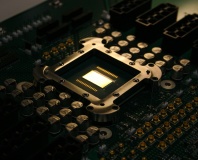
The quantum processor. Looks neat.
Quantum computing has been threatening to kill off traditional digital computing for a long time now, with various scientific journals hailing its approach. Well, perhaps a few years earlier than we expected, the world has seen the first demonstration of a commercial grade quantum computer in action.
A quick primer: quantum computers don't rely on bits to structure data. Instead, they work by assuming that the quantum properties of particles can be used to represent data structures. Rather than bits, these quantum data structures are called qubits. Since quantum computers deal with such tiny, tiny measurements and nuances - the behaviour of matter and energy at the subatomic scale - the potential for computing power is absolutely massive.
At least, I'm pretty sure that's
what Wikipedia says.
DWave Systems is a Canadian company, and they've built working hardware that computes at a quantum level. They're running 16-bit qubit computations at the moment, but hope to expand that to 32-qubit by the end of the year.
To work, the hardware has to be chilled down to -273 degrees centigrade. That's colder than outer space, and would make for a pretty decent Core 2 Duo overclock, we suspect.
"D-Wave's breakthrough in quantum technology represents a substantial step forward in solving commercial and scientific problems which, until now, were considered intractable. Digital technology stands to reap the benefits of enhanced performance and broader application," said Herb Martin, chief executive officer, according to
DailyTech.
Because of the massive scale that quantum physics operates on, quantum computers are thought to be perfect for solving problems that are simply to great for traditional computers to operate on, such as life sciences and theoretical physics. In theory, a single quantum computer should be multiple times more powerful than the fastest supercomputer cluster in existence today.
It's unlikely that we're going to see quantum computers on the desktop any time soon, but it seems like Ray Kurtzweil's theory of
technological singularity, where machines are more intelligent than people, could be upon us.
What do you make of all this technological insanity?
Let us know over in the forums.

Not to mention the significant technical problems in a home user chilling their CPU down to 0.15 degrees centigrade above 0 Kelvin(0 kelvin = absolute zero, there ain't no colder then that, and time tends to stop there).
OK - what am I not seeing here - we have to make giant advances in theoretical physics so as to be able to make a quantum processor, which will allow us to make giant advances in theoretical physics.
Er, marvellous. I think.
Technological singularity, anyone?
Phil
Although this technology is considered at its beginning, it looks promising.
Even the company that built this one has said it may actually be a digital computer that behaves very oddly not a quantum one, so don;t start going all paranoid or techlusty over Ai's or anything just yet.
What happens if you stick your finger in it?
Sounds err...confusing.
absence of thermal energy = cold, background microwaves in deep space ~ 3K. cold enough in my books!
you're either being deeply philosophical or a complete ****. lack of heat == cold.
Heat is just particles moving, the more the particles move (or vibrate) the hotter something is
Therefore, cold is in fact particles moving less, and at absolute 0, the particles stop moving altogether (even at very cold temperatures, they are moving slowly)
In space heat (or the energy) just dissipates, everything loses its energy in space so it seems "cold"
I do have to wonder how they managed to achieve such a low temperature though, i thought something that cold was still impossible for humans
Also, when your measuring atoms and such, wouldn't you want them to be moving ?
Also, technically wouldn't this mean the hotter a quantum chip is, the faster it could (theoretically) run
Exactly, in space, or at least in most of space where there are no particles, a complete vacuum, there can be no particles vibrating, no particles storing thermal energy. So it's not that theres a low temperature, there is NO temperature.
Cold is a completely subjective term, something CANNOT be just described as cold scientifically, you can say space is colder than my fridge, implying my fridge has a higher temperature than space, but just saying my fridge is cold doesn't make sense.
Even so, the energy of a wave isn't thermal energy? But then, wave particle duality, etc. so I guess it's thermal energy as well. However, the statement that space isn't cold is still true, but by a different argument :p
But anyway, if you want to go out on an EVA you need a cooling suit not a heating suit. But thats something different entirely.
brumster - i don't think it has been independently examined, I'm a little cautious about it because i find it hard to believe that they managed to achieve almost absolute 0 temperatures
This article was on slashdot and there were comments that it wasn't a true quantum computer, but has features that quantum computer have - also it seems quantum computers are actually not very good at (current) normal computing tasks
42 :(
Anyway, commercial? At that temperature, how close can you get before you start feeling a tad frostbitten?
We have a long wait yet methinks....
Sam
To the best of my knowledge the lowest T yet achieved in the lab is something like 80 picokelvin. Although this may have been lowered recently. This is what all the clever physicists do when they want to discover stuff like Bose - Einstein states, or get their funding renewed. Nanokelvin temperatures are now considered routine (1 x 10^-9 Kelvin) in the lab and are reached by both traping and expanding some atoms in uhv, but as Im a chemist and not a physicist Ill let you google 'how do I make nanokelvin stuff' for yourselves.
The 5 milikelvin that they quote in the paper is actually quite a high temperature as far as experimantal physics is concerned, there are quite a few telescopes of various design that work in this temperature range, as well as a few SQUIDs and other spectroscopic instruments.
nah it's 12 :p
Thank you for proving to me that new posters aren't all babbling idiots full of "OMG YES :D :D :) :) :)"
Quite revolutionary, but I doubt I'll see either of these technologies in my house any time soon. :'(
There are also other, somewhat more exotic commmputer technologies under development. Among which are DNA-computers which also seem very promising in particular for medical research.