Test Setup:
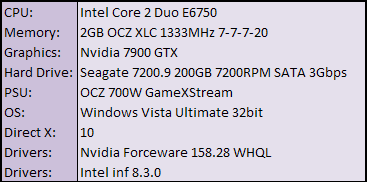
Systems:
- Gigabyte GA-X38T-DQ6; (D8 Engineering BIOS)
- Asus P5K3 Deluxe;
- Nvidia nForce 680i SLI (P30 BIOS);
Please be aware that this is a
first look at Intel's X38 chipset and as such we are not running the full suite of benchmarks, overclocking or stability testing until we receive a final retail samples. Both the BIOS and board we are using are engineering samples, so performance may improve with both retail board and BIOS revisions.
Memory Performance:
-
Gigabyte GA-X38T-DQ6
-
Asus P5K3 Deluxe
-
nForce 680i SLI (P30 BIOS)
0
1000
2000
3000
4000
5000
6000
7000
8000
9000
MB/s
-
Gigabyte GA-X38T-DQ6
-
Asus P5K3 Deluxe
-
nForce 680i SLI (P30 BIOS)
0
1000
2000
3000
4000
5000
6000
MB/s
-
Gigabyte GA-X38T-DQ6
-
Asus P5K3 Deluxe
-
nForce 680i SLI (P30 BIOS)
0
10
20
30
40
50
60
70
80
nanoseconds (lower is better)
-
Gigabyte GA-X38T-DQ6
-
Asus P5K3 Deluxe
-
nForce 680i SLI (P30 BIOS)
0
1000
2000
3000
4000
5000
6000
7000
MB/s
-
Gigabyte GA-X38T-DQ6
-
Asus P5K3 Deluxe
-
nForce 680i SLI (P30 BIOS)
0
10
20
30
40
50
60
70
80
90
nanoseconds (lower is better)
The nForce 680i SLI is still based on DDR2 and at 800MHz 3-3-3-9-18-1T its performance is generally still better than 1,333MHz DDR3 memory at 7-7-7-20, which is somewhat surprising on one front, but expected on another. Gigabyte's X38 board is still fractionally faster than the Asus P5K3 Deluxe in Everest though. The Sandra scores show the other end of the scale, with the average DDR2 score coming out far slower and the Gigabyte losing out ever so slightly to the Asus P35 board.









Want to comment? Please log in.