Test Setup
We’ve already exhaustively tested both these graphics cards on several occasions and we feel that our previous articles covering the hardware is more than adequate to describe how the GeForce 9600 GT and GeForce 8800 GT cards behave - even a 15 percent overclock isn't going to dramatically change the playing field. Because of that, we won’t be throwing the full gamut of benchmarks at these cards.
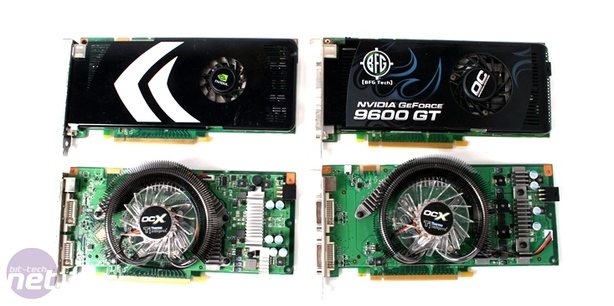
However, what is more important is gauging the performance of BFG's mid-range OCX cards against similar cards, so we've included a reference design GeForce 8800 GT and a BFG Tech GeForce 9600 GT OC. Below are the full details on the cards on test.
- BFG Tech GeForce 8800 GT OCX 512MB - operating at 700/1,728/2,000MHz using Forceware 175.16 WHQL
- BFG Tech GeForce 9600 GT OCX 512MB - operating at 725/1,850/1,950MHz using Forceware 175.16 WHQL
- Nvidia GeForce 8800 GT 512MB - operating at 600/1,500/1,800MHz using Forceware 175.16 WHQL
- BFG 9600 GT 512MB - operating at 675/1,700/1,800MHz using Forceware 175.16 WHQL
The four cards we tested
Test Machine
- Processor: Intel Core 2 Duo E6750 (operating at 2.66GHz – 8x333MHz)
- Motherboard: Gigabyte GA-X38-DS5 motherboard (Intel X38 Express)
- Memory: 4x 1GB OCZ FlexXLC PC-9200 memory (operating in dual-channel at DDR2-800 with 4-4-4-12 timings)
- Hard Drive: Seagate Barracuda 7200.9 160GB SATA 3Gbps
- PSU: PC Power & Cooling Silencer 750W
- OS: Windows Vista Home Premium x64
Games Tested
In this instance, we'll only be testing these cards using
Crysis, as we've already tested them exhaustively on a number of occasions and today's focus is more on the cooling performance and overclocking potential. In this instance, we'll be testing at 1,280 x 1,024 and 1,680 x 1,050, with high shaders and sound and everything else set to medium. This will give us a solid idea of how well these cards will perform in scenarios they're likely to be used in.









Want to comment? Please log in.