Publisher: Electronic Arts
What can we say about this game that hasn't been said already?
Crysis was probably the most anticipated game on the PC last year and was released on November 16th 2007.
Crysis is seen by many as the poster boy for DirectX 10 and it will make your system cry, quite literally – it's a monster! It doesn't come as much of a surprise then, that the graphics are something special – they're above and beyond anything we've ever seen before in a PC game.
We tested the game under both DirectX 9.0 and DirectX 10 with the 1.1 patch applied. We used a custom timedemo recorded on the Harbor map which is more representative of gameplay than the built-in benchmark that renders things much faster than you're going to experience in game. We found that around 30 fps in our timedemo was sufficient enough to obtain a playable frame rate through the game. It's a little different to other games in that the low frame rates still appear to be quite smooth.
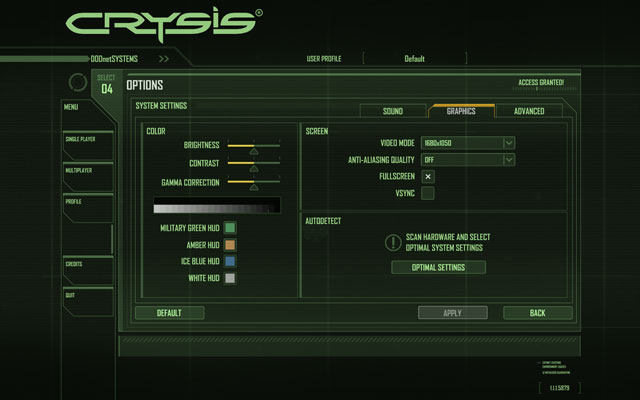
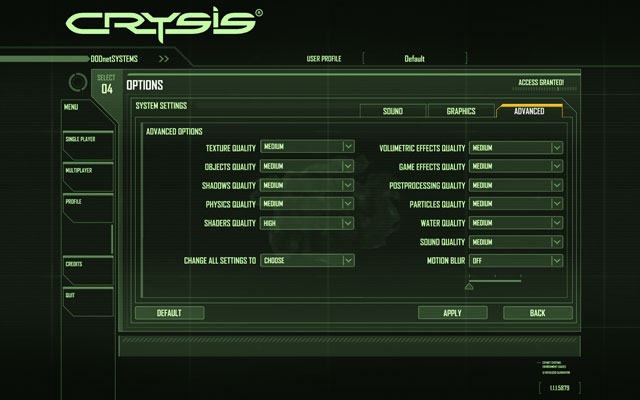
For our testing under both DirectX 9.0 and DirectX 10, we set the majority of the in-game settings to medium, with shaders and sound set to high. Because of how intense the game is, we tested with both anti-aliasing and anisotropic filtering disabled on these mid-range cards – but of course, you can enable AA if you want to sacrifice some other in-game details in order to get a playable frame rate. There is currently no support for anisotropic filtering in the game, but you can still force it from the driver control panel.
DirectX 9.0
-
Nvidia GeForce 8800 GT 512MB
-
Zotac GeForce 9600 GT 512MB AMP! Edition
-
Nvidia GeForce 9600 GT 512MB
-
ATI Radeon HD 3870 512MB
-
HIS Radeon HD 3850 IceQ3 TurboX 512MB
-
PowerColor Radeon HD 3850 Xtreme PCS 512MB
-
Nvidia GeForce 8800 GS 384MB
-
ATI Radeon HD 3850 256MB
-
ATI Radeon X1950 Pro 256MB
-
Nvidia GeForce 8600 GTS 256MB
Frames Per Second
-
Nvidia GeForce 8800 GT 512MB
-
Zotac GeForce 9600 GT 512MB AMP! Edition
-
ATI Radeon HD 3870 512MB
-
Nvidia GeForce 9600 GT 512MB
-
HIS Radeon HD 3850 IceQ3 TurboX 512MB
-
PowerColor Radeon HD 3850 Xtreme PCS 512MB
-
Nvidia GeForce 8800 GS 384MB
-
ATI Radeon HD 3850 256MB
-
ATI Radeon X1950 Pro 256MB
-
Nvidia GeForce 8600 GTS 256MB
Frames Per Second
DirectX 10
-
Nvidia GeForce 8800 GT 512MB
-
Zotac GeForce 9600 GT 512MB AMP! Edition
-
Nvidia GeForce 9600 GT 512MB
-
ATI Radeon HD 3870 512MB
-
HIS Radeon HD 3850 IceQ 3 TurboX 512MB
-
PowerColor Radeon HD 3850 Xtreme PCS 512MB
-
Nvidia GeForce 8800 GS 384MB
-
ATI Radeon HD 3850 256MB
-
Nvidia GeForce 8600 GTS 256MB
Frames Per Second
-
Nvidia GeForce 8800 GT 512MB
-
Zotac GeForce 9600 GT 512MB AMP! Edition
-
ATI Radeon HD 3870 512MB
-
HIS Radeon HD 3850 IceQ 3 TurboX 512MB
-
PowerColor Radeon HD 3850 Xtreme PCS 512MB
-
Nvidia GeForce 9600 GT 512MB
-
ATI Radeon HD 3850 256MB
-
Nvidia GeForce 8800 GS 384MB
-
Nvidia GeForce 8600 GTS 256MB
Frames Per Second
The HIS Radeon HD 3850 IceQ 3 TurboX 512MB slots right into the middle of the field in
Crysis at pretty much every resolution tested. Under DirectX 9.0 mode, HIS's card manages to keep up with Nvidia's GeForce 9600 GT in its reference configuration at 1680x1050, but when the resolution is lowered to 1280x1024, Nvidia's card creeps ahead by around four percent. You'd be hard pushed to tell the difference between the two though.
The same is true in DirectX 10 mode, although the HIS Radeon HD 3850 manages to deliver an almost identical average frame rate at 1280x1024 and is 10 percent faster at 1680x1050. The minimum frame rate on HIS's card is almost half that of the 9600 GT at 1280x1024, but then the roles reverse at 1680x1050.
When you compare to the GeForce 8800 GT 512MB, the gap is around 16 percent in DirectX 9.0 mode and then extends to 20 percent with DX10 mode enabled. One thing's for sure – that is quite a noticeable difference in performance and the cost difference isn't all that great in comparison.










Want to comment? Please log in.